Do assistive listening devices actually work in noisy environments?
Learn how assistive listening devices can improve speech clarity in noisy places and explore different options for Canadians, including FM, infrared, and hearing loop systems.
 primehearingclinic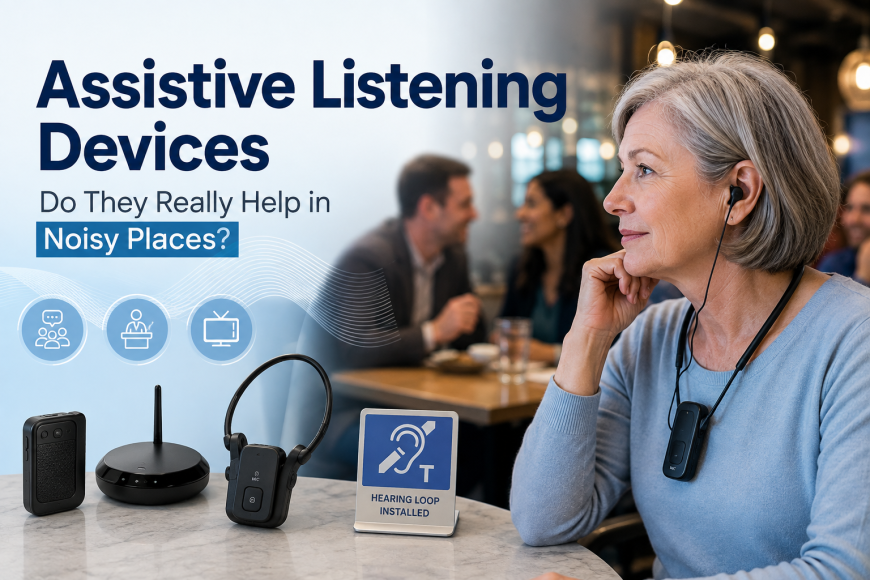
Have you ever spoken to someone at a restaurant, community center, workplace, church, or family gathering, and wondered, “Would listening devices improve my ability to understand speech in a noisy environment?”
This is a question a lot of people in Canada have because of the fatigue that comes from trying to follow a conversation in a noisy environment.
Many people are unaware that listening to speech in environments with a “competitive noise” background is a strong sign of hearing difficulty, and assistive listening devices can sometimes help reduce the effect of competing noise.
How do assistive listening devices work?
Assistive listening devices (ALDs) are technologies that aim to make certain sounds easier to hear. Many of these technologies aim to improve the speech to noise ratio (how much of a difference there is between the sound you want to hear and the background distractions).
Depending on the technology, sound is either directly transmitted or picked up with a microphone.
These devices are great for:
-
One-on-one conversations
-
Watching TV
-
Phone Calls
-
Meetings and presentations
-
Classrooms
-
Theatres, cinemas and churches
Do ALDs work for background noise?
This is by far the most frequent of the questions that people ask when considering ALDs.
Regardless of your device, how much benefit you experience will depend on the situation and environment.
It can be difficult to understand the person talking with all the background noise in a restaurant. With all the different conversations, dishes moving, music, and general noise, many people increase the volume of their devices. Unfortunately, it makes background noise louder as well.
Assistive technology can bring the speaker's voice closer to the listener and send it to the listener. With background noise, small sounds can often be hard to understand.
Assistive listening systems are described by the Government of Canada as technology that helps in separating speech from background noise.
What Are Some Examples of Assistive Listening Systems?
There is no one-size-fits-all solution when it comes to hearing aids. Different situations call for different technologies.
1. Personal Amplifiers
These types of devices are useful for one-on-one situations. They contain a microphone and a receiver. There are also options for equipment that can connect multiple microphones.
2. FM Systems
These systems help with more open-space situations. People have reported a lot of success with classroom settings.
3. Infrared Systems
Audio is sent to a receiver using a beam of light. Electronic aids using this system have been used to fill auditoriums and entertainment venues.
4. Hearing Loops
Hearing loops emit an electromagnetic signal. Audio is sent to the loop system receivers. Venues that install hearing loop systems can provide attendees with a stronger and clearer audio signal.
5. Systems for TVs and Phones
There are systems available for both TVs and phones. These systems are meant for people with difficulty hearing phone calls or TV audio.
Telephone amplification systems, infrared systems, the use of closed captioning, and FM-based systems are examples of the assistive technologies funded by Veterans Affairs Canada.
Can You Use an ALD with Hearing Aids?
An ALD can be compatible with hearing aids and cochlear implants, among other assistive technologies.
Hearing loops provide a direct audio stream to telecoils. In most cases, hearing loop systems and other types of assistive technology can connect via wireless systems and their related interfaces.
Are Assistive Listening Devices Only Used by Older People?
Again, many people of varying age groups can use assistive listening devices.
For example, a student has a tough time following a given lecture, a working adult has a hard time understanding and focusing on the points in a given meeting, or a person has a hard time understanding the conversations at a given restaurant.
Considerations When Choosing an Assistive Listening Device
It is important to think about where you have the most difficulty before making a purchase on an assisted listening device.
Consider the following questions:
-
Is more background noise creating a challenge for you?
-
Are you struggling with understanding the words in TV programs?
-
Do you have difficulty hearing and understanding conversations when the speaker moves further away from you?
-
Do you have difficulty in class or at meetings?
-
Would you benefit from hearing the words alongside captions?
-
Does the device need to interface with your hearing technology?
A hearing evaluation can determine if hearing loss is the challenge and can also help determine what Type of support is appropriate.
It is also important to note that assistive listening devices cannot substitute for hearing protection. Health Canada suggests limiting exposure to loud noise and using hearing protection earplugs/ ear muffs when in loud sound environments.
The Takeaway
Assistive listening devices can be a good solution for people who can hear but struggle to understand. In Canada, the most important factor in determining your assistive listening technology is identifying what scenarios are the most difficult for you in regard to understanding. It is important to realize that more technology is not always better and the solution for each individual in a variety of scenarios and settings can be something as simple as a personal microphone for conversations, a listening device for the TV, and a public support listening system.
If you find yourself understanding conversations less and less in public places, including restaurants or at meetings, it may be worth having your hearing checked to see if communication, listening, and understanding difficulties may be due to hearing loss.