SEO, Content, Paid Media: What the Right Marketing Partner Should Be Doing for Your Business
 anthony-rodgers
Most businesses aren’t clear on what they’re trying to say or who they’re trying to reach; they often mistake this for a marketing problem, when it isn’t.
They're running Google Ads, posting on social media, publishing the occasional blog, maybe dabbling in email, but none of it feels connected, and the results are hard to explain. Traffic goes up one month and drops the next. A campaign gets clicks but no conversions. Content gets written but never seems to rank.
Sound familiar?
What's almost always happening underneath is that they're being treated as separate activities instead of parts of a single, cohesive strategy. And that gap, between doing marketing and doing it in a way that compounds over time, is exactly where the right digital marketing agency makes its impact felt.
This blog is about what that should actually look like. Not in vague promises, but in concrete terms, what SEO involves when it's done properly, what content marketing is actually supposed to accomplish, how paid media fits into the picture, and how all three work together when the strategy behind them is sound.
Why the "Hire Someone to Post for Us" Approach Always Falls Short
Let's start with the most common version of how businesses approach marketing support: they hire someone (a freelancer, a junior team member, or a small agency) to handle the execution. Write the posts. Run the ads. Send the emails.
The work gets done. The reports get sent. But the needle barely moves.
The reason isn't effort; it's architecture. Marketing without a strategic foundation is just activity. And activity without direction rarely produces growth that you can plan around or build on.
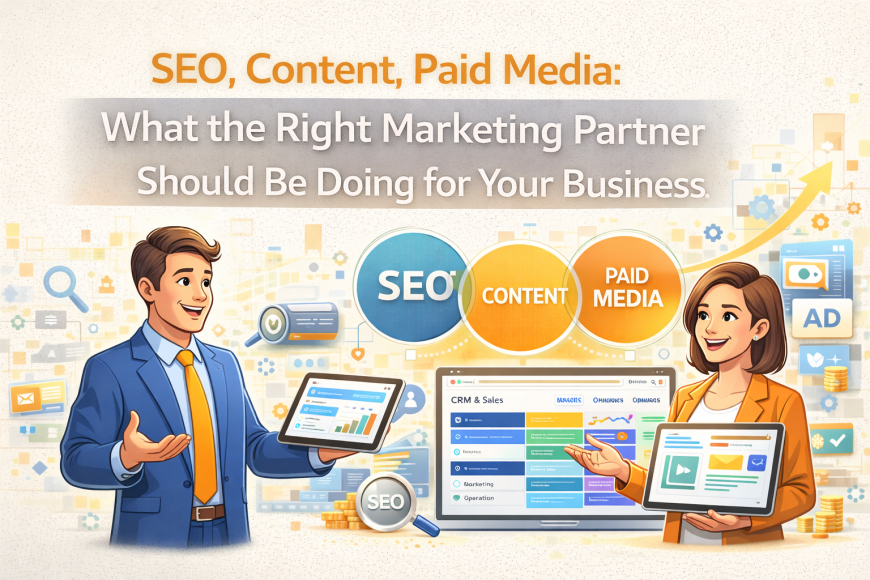
A well-structured digital marketing agency relationship looks very different. It starts with understanding your business (your actual customers, your sales cycle, your competitive landscape, and your margins) and then builds a strategy where each channel is contributing to the same outcome. Organic search builds compounding visibility. Paid media generates immediate, targeted traffic. Content bridges the two and does the heavy lifting on trust and authority.
When these three are aligned, each one makes the others more effective. When they're siloed, you're paying for three things that never quite add up.
SEO Services
Search engine optimization gets misunderstood more than almost any other marketing discipline. Most people think of it as "getting to page one," a one-time task you do to a website and then move on. In reality, SEO is an ongoing system of decisions that determines whether your business is findable by people who are actively looking for what you offer.
Here's what comprehensive SEO services actually cover:
-
Technical SEO is the foundation. Before any content strategy makes sense, the website itself has to be in good shape. That means fast load times, a clean site architecture that search engines can crawl efficiently, proper indexing, no broken links, mobile responsiveness, and structured data markup that helps Google understand what each page is about. A technically sound website is the prerequisite for everything else.
-
Keyword research and search intent mapping is where strategy begins. It's not enough to find keywords with high search volume; you have to understand what someone typing that query actually wants. Are they looking for information? Comparing options? Ready to buy? Each intent requires a different type of content and a different page to rank for it. Mismatching content to intent is one of the most common and costly SEO mistakes businesses make.
-
On-page optimization covers how individual pages are structured, headings, meta titles, meta descriptions, internal linking, image alt text, content depth, and how naturally the target keywords are used throughout. Every page that's meant to rank needs to be deliberately optimized for a specific search query.
-
Link building and authority is the part most businesses either ignore or do incorrectly. Search engines use the quality and quantity of external websites linking to your content as a signal of credibility. Earning genuine backlinks from relevant, authoritative sources, through great content, digital PR, partnerships, and outreach, is one of the most impactful things you can do for long-term rankings.
-
Local SEO deserves its own mention for businesses with a physical presence or a specific geographic market. Optimizing your Google Business Profile, building local citations, earning local reviews, and creating location-specific content are all part of showing up when people search for businesses like yours in their area.
One more thing worth noting: SEO is a long game. The businesses that treat it as a channel they invest in consistently (not a box they check) are the ones that build search presence that pays dividends for years. The results take time to arrive, but once they do, the traffic is organic, sustainable, and doesn't disappear the moment you stop spending.
Content Marketing Services: The Engine That Powers Everything Else
Content marketing is the discipline that most businesses either undervalue or misunderstand. It's often reduced to "writing blogs," which is a bit like describing architecture as "stacking bricks." Technically accurate, but wildly incomplete.
Effective content marketing services cover the full scope of how content works across your marketing ecosystem:
-
Content strategy is the starting point, deciding what to create, for whom, at what stage of the customer journey, and why. Not every piece of content has the same job. Some content exists to attract people who have never heard of you. Some are designed to educate people who are considering their options. Some are built to convert people who are close to a decision. A coherent content strategy maps the process out deliberately, rather than publishing at random and hoping something lands.
-
Long-form editorial content (detailed blog posts, guides, research articles) is the backbone of organic search authority. These are the pieces that earn rankings for competitive keywords, attract backlinks from other websites, and give potential customers a reason to stay on your site and trust what you're saying. Thin, generic content doesn't rank and doesn't convert. Substantive, genuinely useful content does both.
-
Conversion-focused content lives further down the funnel (landing pages, case studies, comparison pages, FAQs, product and service descriptions). These exist to turn interest into action, and they need to be written with a clear understanding of the objections, questions, and hesitations your customer has at that stage.
-
Content distribution is the step most businesses skip entirely. Creating content is only half the equation. Getting it in front of the right audience, through social media, email newsletters, content repurposing, syndication, and paid promotion, determines whether it actually does any work. A great piece of content that nobody reads is just an invisible asset.
-
Content performance measurement closes the loop. Which pieces are driving traffic? Which are generating leads? Which are ranking for their target keywords and which aren't? Without this, you're operating blind, producing content based on gut feeling rather than what's actually working.
Paid Media: The Accelerant, Not the Foundation
Paid media (Google Ads, Meta Ads, LinkedIn Ads, display advertising, YouTube, and more) gets a mixed reputation. Businesses either swear by it or feel burned by it, and the difference usually comes down to how it was managed.
The fundamental thing to understand about paid media is what it is and what it isn't. It's an accelerant. It can put you in front of a precisely defined audience immediately, generate leads before your organic channels have matured, test messaging and offers quickly, and fill gaps in your funnel. What it isn't is a substitute for strategy. Paid traffic sent to the wrong page, with the wrong message, targeting the wrong audience, will reliably waste your budget, regardless of how much you spend.
A genuinely effective paid media management should look like this:
-
Audience and targeting strategy is the first and most important layer. Who specifically are you trying to reach? What platform are they on? What stage of the buying journey are they in? A Google Search campaign targeting high-intent queries works very differently from a Meta awareness campaign targeting a cold audience, and both should be set up with a clear purpose.
-
Ad creative and copywriting is where most campaigns either win or lose the click. Headlines, descriptions, images, and video need to be built around what the customer cares about, not what the business wants to say about itself. Testing multiple variations continuously is how you find what works.
-
Landing page alignment is the piece that gets overlooked most often. The experience a person has after clicking an ad is just as important as the ad itself. If someone clicks a Google Ad for "accountants in Manchester" and lands on your homepage instead of a page specifically built for that query, you've already lost most of your conversions.
-
Bid strategy and budget management require ongoing attention. Automated bidding strategies from platforms like Google are powerful but need to be set up correctly and monitored continuously. Left on autopilot without review, they often optimize for the wrong thing.
-
Tracking and attribution is the backbone of knowing whether any of it is working. Conversion tracking, Google Analytics configuration, UTM parameters, and regular reporting need to be set up properly from day one, not added as an afterthought when someone asks where the leads are coming from.
How SEO, Content, and Paid Media Work Together
These three disciplines aren't competing for your budget. When they're integrated properly, they make each other significantly more effective.
-
Paid media feeds content strategy. When you run paid search campaigns, you learn, very quickly and with real money on the line, which messages resonate with your audience, which queries convert, and which offers people respond to. That intelligence should be flowing directly into your content strategy and SEO keyword targeting. Most businesses keep these two completely separate. The ones that connect them move faster.
-
Content supports paid media efficiency. The more trust and authority your organic content builds with an audience, the better your paid retargeting campaigns perform. Someone who has already read your detailed guide on a topic is more likely to convert when they see your retargeting ad than someone encountering your brand for the first time.
-
SEO and content compound over time. Every well-optimized page that earns a ranking is an asset that generates traffic indefinitely, without ongoing spend. Over time, a business with a strong organic foundation needs to spend proportionally less on paid acquisition because its content is doing the work instead. Getting there takes investment and patience, but the economics of it are compelling.
When a digital marketing agency is managing all three of these channels with an integrated strategy, sharing data across disciplines, and making decisions based on the full picture rather than channel-specific metrics, the results are measurably different from running each one in isolation.
What to Actually Look for in a Marketing Partner
As explored throughout SEO, Content, Paid Media: What the Right Marketing Partner Should Be Doing for Your Business, the common thread across all of it is integration. Not just doing the activities, but connecting them to each other and to your actual business goals.
Here's a practical checklist of what that looks like in practice:
-
They start with your business, not your channels. Before recommending any tactics, a genuine partner wants to understand your customers, your sales process, your competitive position, and what growth actually means for your specific situation.
-
They set expectations honestly. SEO takes time. Paid media requires testing budgets. Content compounds gradually. Any partner that promises overnight results in organic search or guarantees specific rankings is either mistaken or misleading you. The same applies to how they present their SEO packages; a well-structured package will always tie its deliverables to realistic timelines and measurable outcomes, not just a list of activities that sounds impressive on paper.
-
They report on outcomes, not just outputs. The number of blog posts published, keywords tracked, and ads running is not the point. Leads generated, cost per acquisition, organic traffic growth, and revenue influenced are the point. Your reporting should reflect the metrics that matter to your business.
-
They connect strategy to execution. A strategy document that sits in a shared folder while someone else runs the ads and a third person writes the blogs is not integrated marketing; it's a collection of services. The thinking and the doing need to come from the same place.
-
They evolve with the data. Digital marketing is not a set-it-and-forget-it discipline. Algorithms change. Competitive landscapes shift. What worked six months ago may not work today. A strong partner is continuously reviewing performance and adjusting strategy based on what the data is showing.
Conclusion
There is no shortage of providers offering digital marketing services, SEO, content, paid media, social, email, and all of it. What's rarer is a partner that brings genuine strategic thinking to how those services connect, measures success by your business outcomes rather than their own deliverables, and builds something that compounds in value over time rather than resetting every time a campaign ends.
That's the standard worth holding your marketing partner to. And it's the standard that separates a cost center from a genuine growth engine.