Why Does a Growing Salesforce Org Need a Health Check?
Learn how Salesforce health checks can uncover technical debt, security gaps, reporting issues, and performance problems before they affect growth.
 techforceservices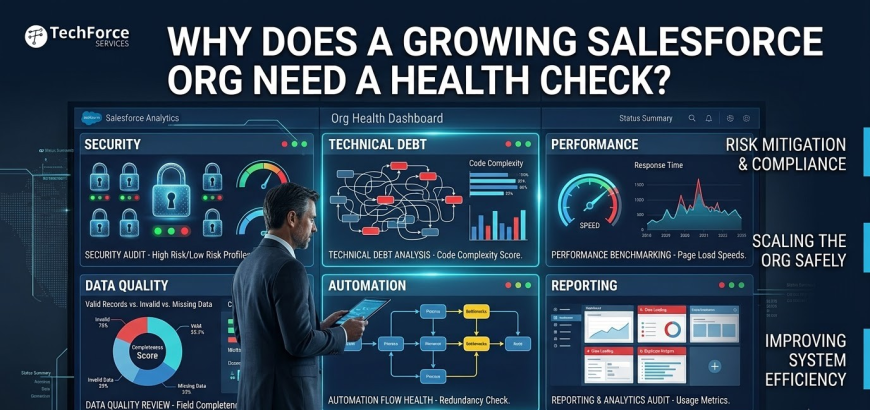
A Salesforce org rarely becomes complicated overnight. Complexity usually builds through years of reasonable business decisions. A new field is added for one team, an automation is created for another, an integration connects a new application, and dashboards multiply as reporting needs change.
The result can be a CRM that still works but is harder to maintain, slower to change, and more difficult for users to trust.
That is where a Salesforce health check becomes valuable. Rather than waiting for a major failure, organisations can periodically assess whether their CRM remains secure, efficient, and aligned with current business needs.
What does Salesforce technical debt look like in practice?
Technical debt is not always obvious. It can appear as unused fields, redundant automation, outdated integrations, unnecessary customisation, complicated permissions, or processes that no longer reflect how employees actually work.
Salesforce Ben's recent coverage of Salesforce technical debt highlights how accumulated configuration decisions can increase delivery complexity and create maintenance problems for administrators.
Security is another concern. Salesforce's 2026 Health Check updates have expanded proactive monitoring, including additional configurable security settings and notifications when security scores change.
A broader review can examine these technical factors alongside business performance. TechForce Services describes its approach as an AI-enhanced assessment covering metadata, code, security, workflows, data models, reporting, performance, and user adoption.
For organisations looking for a broader Salesforce org assessment, the value is therefore not simply finding faults. It is understanding which issues deserve attention and which can safely wait.
Can better analytics reveal weaknesses in a CRM?
Analytics can expose problems that may not be visible from configuration alone. If sales reports contain inconsistent figures, service dashboards are missing information, or managers cannot trust pipeline forecasts, the underlying issue may involve data quality, integration, or CRM configuration.
Salesforce CRM Analytics is designed to connect data sources, provide interactive insights, and help users act on information within their workflow. Salesforce also supports predictive insights and recommendations that can move teams from observing results to responding to them.
That makes analytics a useful companion to CRM governance. A business reviewing its Salesforce environment can examine not only whether the system is functioning, but whether the information it produces is actually useful.
TechForce's CRM analytics and reporting capabilities include data integration, data cleansing, custom dashboards, predictive modelling, and role-based analytics.
When should a business conduct a Salesforce health check?
There is no single moment when every company needs an assessment. However, major changes can be useful triggers. A business preparing for an integration, significant Salesforce release, expansion, or new automation programme may benefit from understanding the current state of its org first.
The same applies when users report slow performance, inaccurate reports, broken flows, or declining adoption.
A health check creates a baseline. From there, technical teams and business leaders can prioritise remediation according to risk, cost, and business impact.
What makes a Salesforce health check valuable?
A useful health check should lead to decisions, not simply produce another report. Businesses need to understand what is working, what creates risk, and what improvements will make the greatest difference.
Regular reviews can help organisations control technical debt, strengthen security, improve data confidence, and prepare their Salesforce environment for analytics and automation. As CRM systems become increasingly connected to AI, maintaining a healthy underlying platform is becoming part of long-term business planning.
Conclusion
A Salesforce health check helps businesses understand whether their CRM remains secure, efficient, reliable, and aligned with current business requirements.
By identifying technical debt, security risks, data issues, reporting inconsistencies, and performance problems early, organisations can prioritise improvements before they become costly disruptions. Regular health assessments also create a stronger foundation for analytics, automation, and future AI initiatives, helping businesses get more long-term value from their Salesforce investment.