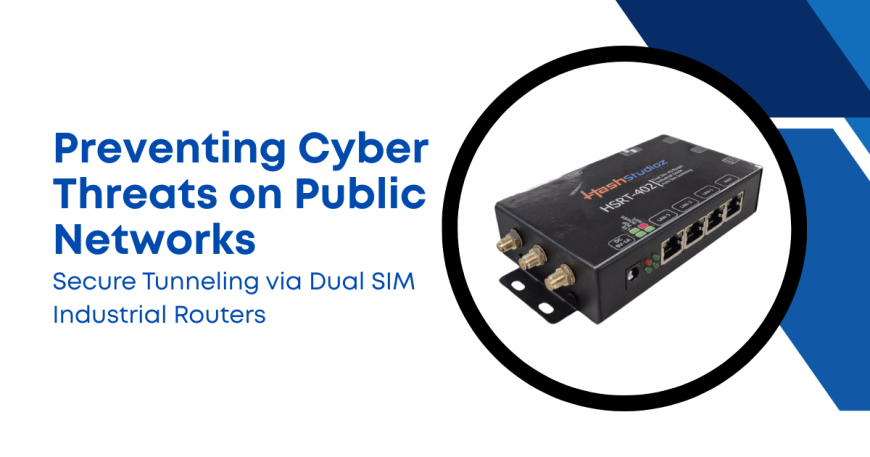
Preventing Cyber Threats on Public Networks: Secure Tunneling via Dual SIM Industrial Routers
Learn how a Dual SIM Industrial Router uses secure tunneling and network redundancy to protect data and prevent cyber threats on public networks.
 JamesHunt
Industrial operations frequently expand into geographic zones without private fiber connections. Remote utility sites, municipal water systems, and distributed traffic infrastructure rely heavily on cellular data networks. While cellular paths resolve physical connection challenges, they route telemetry across public infrastructures.
Using public cellular networks exposes sensitive operational data to external traffic. Malicious actors continuously scan public IP spaces for exposed industrial assets. Global cybersecurity reports show that over 20% of newly discovered network vulnerabilities target critical infrastructure nodes. The financial risk is substantial. The average cost of an enterprise network data breach reached $4.63 million per incident.
Organizations can no longer trust simple cellular modems for critical field assets. Unprotected endpoints provide entry points into corporate data centers. Field deployments require dedicated hardware to isolate data traffic from public space threats. Incorporating a robust Industrial Router into your field infrastructure provides the necessary physical and digital protection.
Understanding the Dual SIM Protection Concept
A Dual SIM Industrial Router mitigates two specific network vulnerabilities: carrier downtime and targeted packet interception. The inclusion of two distinct subscriber identity modules ensures data path survival.
When a cellular carrier experiences an infrastructure outage, the router switches interfaces instantly. This action preserves the telemetry link between the field and the central office. Security teams maintain uninterrupted monitoring of the remote asset.
Furthermore, dual SIM designs allow for network segregation. An operator can configure the primary SIM to handle local machine-to-machine data over a private network profile. The secondary SIM can handle diagnostic traffic over a separate carrier profile. If one network faces a denial-of-service attack, the router shifts traffic to the alternative provider space. Network metrics reveal that dual-carrier setups push data availability above 99.99%.
Architectural Mechanics of Secure Tunneling
Secure tunneling forms an encrypted envelope around data packets before they travel over public cellular networks. The router serves as the local endpoint for this process.
1. Encapsulation and Data Protection
The router intercepts outgoing data from field equipment like programmable logic controllers. It wraps the original data packet inside a new internet protocol packet. The device encrypts the entire original payload using hardware-accelerated cryptoprocessors.
This transformation prevents interception during public cellular transit. Any entity capturing packets on the public cellular tower sees only unreadable ciphertext. The receiving gateway at the central office peels away the outer packet layer. It decrypts the payload and routes the clean data to the internal processing network.
2. Cryptographic Standout Protocols
Industrial routing hardware utilizes specific tunneling protocols to maintain data confidentiality:
-
IPsec (Internet Protocol Security): Operates at the network layer to authenticate and encrypt every IP packet in the data stream.
-
OpenVPN: Utilizes custom security protocols based on OpenSSL to provide flexible, high-speed encryption across public spaces.
-
WireGuard: Implements modern cryptographic primitives to establish fast, lightweight tunnels with minimal processing overhead.
Hardware Architecture of the Industrial Router
Industrial routing hardware differs completely from office-grade networking units. The physical and internal designs handle the intense demands of outdoor processing stations.
1. Resisting Harsh Field Environments
Field infrastructure components face extreme ambient conditions. An Industrial Router utilizes a rugged metal chassis without internal cooling fans. The elimination of moving parts prevents dust accumulation and mechanical failure.
The internal electronics operate reliably across a temperature envelope from -40°C to +75°C. Built-in galvanic isolation protects the data ports from electrical surges. These surges commonly occur when lightning strikes nearby field infrastructure.
2. Advanced Cellular Failure Handling
The router does not rely on simple signal loss detection to execute a carrier switch. The hardware operating system features deep link monitoring capabilities.
The device sends low-bandwidth echo packets through the active cellular tunnel at specific intervals. If a carrier network drops packets or experiences latency above 250 milliseconds, the router identifies a degraded path. The device switches to the backup SIM card within seconds, ensuring continuous data security.
Step-by-Step Implementation for Tunneling Deployment
Deploying an Industrial Router for secure tunneling requires a disciplined configuration process. Following specific technical steps ensures the endpoint remains secure against external probes.
1. Establish Physical and Electrical Placement
Mount the router onto a standard DIN rail inside the field equipment cabinet. Connect the power terminals to a filtered direct current power supply, utilizing the 9V to 36V input terminal blocks. Run low-loss coaxial cables from the SMA antenna ports to weather-resistant external antennas. Mount the antennas outside the metal control cabinet to optimize radio frequency reception.
2. Configure Local Network and Passwords
Connect a technician laptop to the local LAN port of the router. Open the web configuration console using the secure HTTPS address. Immediately change the factory-assigned administrative password to a unique, complex code string. Disable unused management protocols such as Telnet or unencrypted HTTP to eliminate basic entry vectors.
3. Initialize the Dual Cellular Profiles
Insert the primary SIM card into slot one and the secondary SIM card into slot two. Enter the specific Access Point Name configurations provided by your cellular carriers. Set the failover priority policy to favor slot one. Configure the smart check parameters by entering three distinct public IP addresses for the router to ping during link health evaluations.
4. Build the Encrypted Tunnel
Navigate to the virtual private network configuration submenu. Select the IPsec protocol option and set the device to operate in tunnel mode. Input the public static IP address of the central office gateway server. Select AES-256 for data encryption and SHA-256 for packet authentication. Input the pre-shared cryptographic key string to finalize the configuration.
5. Validate Traffic Isolation
Activate the network connections. Verify that the diagnostic LEDs show a stable connection to the primary carrier tower. Check the routing table inside the management software to confirm that all outbound traffic moves exclusively through the encrypted tunnel interface. Attempt to ping the device from an outside public address to verify that the internal firewall successfully blocks unauthorized scans.
Mitigating Edge Cyber Threats
Securing the data tunnel resolves only one part of the remote asset threat landscape. Field endpoints require localized defenses to prevent local physical exploits.
1. Localized Firewall Implementations
The router utilizes a built-in stateful packet inspection firewall. This control examines the state and context of incoming data packets. The firewall drops any packet that does not match an active, internally initiated session. If a hacker connects a rogue laptop directly to an open field switch port, the router isolates that malicious traffic from the broader corporate network.
2. Access Control Lists
Engineers must enforce strict access control lists on the routing hardware. These rules explicitly define which local media access control addresses can send data through the gateway. If an unauthorized device connects to the physical site network, the router blocks its packets instantly. This step prevents unauthorized lateral movement across the network.
Real-World Operational Example
A municipal water authority managed 120 distributed pumping stations across a sprawling metropolitan zone. The stations used standard commercial cellular modems to send pump metrics back to the main control facility. The modems utilized public IP addresses without data encryption.
A scanning script run by a malicious group discovered 14 exposed pump modems. The actors executed a credential-guessing attack and gained access to the modem interfaces. They modified the internal network settings, cutting off telemetry data to the central SCADA system.
The municipal authority lost control visibility for six hours. Technicians had to drive to each site to reset the hardware manually. The response and configuration restoration actions cost the city $45,000 in emergency labor costs.
To correct this vulnerability, the city replaced the modems with a Dual SIM Industrial Router at each site. The engineering group configured a permanent IPsec VPN tunnel between each pump station and the central datacenter. They placed Carrier A on the primary SIM and Carrier B on the backup SIM.
Three months later, a regional power failure knocked out Carrier A's local cellular tower. The industrial routers detected the link failure within 10 seconds. They transitioned all security tunnels to Carrier B automatically.
The central monitoring office noticed zero interruption in data delivery. Simultaneously, the stateful firewalls on the routers blocked over 1,200 automated malicious port scans during the network event. The encrypted tunnels protected the public utility assets from exploitation.
Troubleshooting Common Industrial Networking Pitfalls
Field technicians can encounter distinct technical issues during deployment. Understanding how to isolate these faults keeps security installations on track.
1. Tunnel MTU Fragmentation Issues
If encrypted packets exceed the Maximum Transmission Unit size of the cellular carrier, routers fragment the data. This fragmentation causes packet drops and disrupts telemetry streams. To resolve this issue, lower the maximum segment size settings inside the router configuration. Setting the MSS value to 1360 bytes ensures encrypted packets fit within the standard cellular payload limits without splitting.
2. Resolving Carrier APN Traversal Barriers
Some cellular networks implement strict carrier-grade network address translation. This technique blocks the establishment of inbound IPsec tunnels. If your tunnel fails to connect, modify the configuration to use User Datagram Protocol encapsulation for your traffic. Enabling Nat-Traversal allows the encrypted tunnel packets to navigate carrier routing barriers successfully.
3. Addressing Antenna Cable Signal Loss
Long antenna cable runs degrade cellular signals, causing high packet loss inside the tunnel. This loss triggers unnecessary SIM card failover cycles. Keep antenna cable runs under 3 meters whenever possible. If your installation requires longer runs, replace standard RG58 coaxial cables with low-loss LMR400 cables to preserve radio frequency power.
Long-Term Infrastructure Value
Deploying advanced industrial routing hardware delivers significant operational benefits over multi-year asset lifecycles. It alters how organizations handle distant field infrastructure security.
1. Centralized Management Audits
Modern industrial networks allow security teams to monitor thousands of remote routers from a single interface. Administrators push security patches and firmware updates to all field endpoints simultaneously through the encrypted tunnels. This capability eliminates the need to send trucks and technicians to distant sites for software maintenance.
2. Compliance and Regulatory Verification
Infrastructure industries face strict national cybersecurity regulations. Power, water, and transport operators must prove that data remains secure during transit.
The continuous utilization of hardware-enforced VPN tunnels provides a clear compliance pathway. The router logs confirm that all operational data moves exclusively through authorized, encrypted channels.
Conclusion
Securing remote operational assets requires moving past basic cellular modems. Utilizing public cellular paths without encryption exposes critical data to opportunistic and targeted cyber threats.
Deploying a Dual SIM Industrial Router provides the rugged reliability and cryptographic protection needed for field networks. The dual-carrier infrastructure eliminates network downtime risks. Simultaneously, secure tunneling technologies shield data from public network inspection. Utility operators and infrastructure managers protect their networks by investing in high-quality routing hardware. This implementation establishes a resilient, defended perimeter for modern distributed operations.