Earning From Property in Dhule: Commercial Space or Agricultural Land?
How a Dhule owner should choose between a commercial let and an agricultural land lease, weighed on returns, effort, tenants and lease terms today.
 mananiyerr
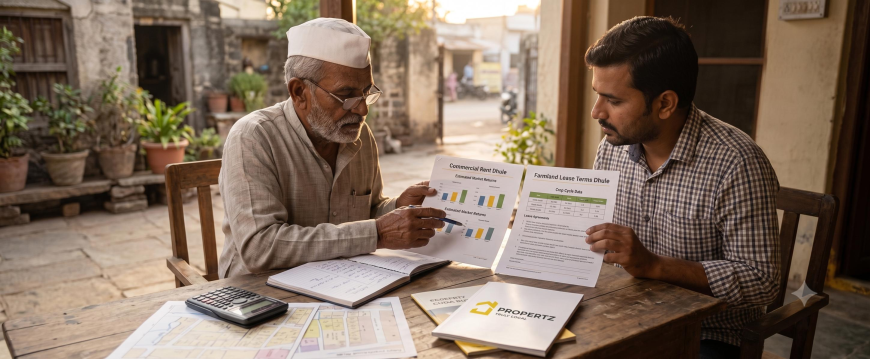
Own property in Dhule and you sit on a genuine choice. You can put up a commercial property for rent in Dhule and earn a fixed monthly rent from a shop, an office, or a warehouse, or you can lease your farmland to a cultivator and earn on the land's output instead. The district gives you both engines: a highway-driven trade economy and a wide agricultural belt. Which one you pick should turn on a single honest question, and it is not 'which pays more'.
The question is how close you want to be to the work
A commercial let keeps you involved. You find tenants, negotiate the fit-out, chase the rent on a slow month, handle the repairs. A farmland lease keeps you at arm's length. Set the terms, let the season run, and most weeks you hear nothing. So before the yields, ask whether you want an asset that runs a small business under it or one you can largely forget. That answer does most of the deciding.
What the highway does for commercial demand
Dhule's place on the national highway corridor is the quiet driver here. Goods move through, which lifts demand not just for shops but for storage. A warehouse for rent in Dhule near the highway or a shopfront on a busy trade road tends to find tenants faster than the same space tucked into a residential lane. Commercial rent is usually higher per month than a farmland lease on comparable land, and it lands on a fixed date regardless of the season.
The cost of that steadiness is management. A shop tenant who falls behind is a slow problem to fix. Warehouses take wear. And your rent lives and dies by location: highway-adjacent space commands a premium that an identical unit two kilometres inland simply will not. My view is that commercial rewards owners who will treat it as light work and frustrates those who wanted money without involvement.
If this fits you, listing a commercial property in Dhule where the trade actually flows, near the highway, the market, or the main commercial stretch, matters far more than the floor area. A small unit with footfall beats a big one without it, and a commercial space lease in Dhule signed with a stable tenant beats a higher rent from a shaky one.
What farmland leasing offers instead
Agricultural land for rent in Dhule runs on the season, not the calendar month. Leases are usually annual or seasonal and quoted per acre, and that per-acre rent swings widely with water, soil, and crop. Irrigated land leases well above dry land. I will not attach a fixed figure, because a farm land for rent in Dhule with assured water and one dependent on the monsoon are close to different assets.
The draw is how little it asks of you. The cultivator carries the crop risk and the daily labour. You collect and mostly stay out of the way. But the ceiling is lower and the floor is weather-shaped. A poor monsoon or a soft market for the district's crops pressures the tenant, and that pressure eventually reaches your renewal conversation. Lower effort, lower drama, lower peak return.
Why storage may be the Dhule sweet spot
The option owners here overlook is storage. Dhule's highway position means goods pass through in volume, and goods that pass through often need somewhere to pause. A warehouse or a godown near the corridor answers a demand that a plain shop does not, and it tends to come with a tenant who thinks in longer terms, because relocating stored stock is a genuine cost they would rather avoid. That can mean a steadier, longer let than retail typically offers.
The trade-off is real, though, and worth naming. Storage suits a narrower pool of tenants, so when a warehouse does fall empty, it can take longer to fill than a shop on a busy street. You are swapping a wider, shallower demand for a narrower, stickier one. For an owner who values a long, quiet tenancy over quick re-letting, that swap often makes sense. For one who wants the flexibility to re-let fast, a shop may still be the safer commercial bet. Neither is wrong; they simply reward different temperaments.
Tenants and lease length differ sharply
A commercial tenant often wants a longer commitment with a lock-in, because they are sinking money into a fit-out and building a customer base. Good for your income stability, less good if you later want the space back at short notice. A farmland lease tends to be shorter and renewed on trust and reputation as much as on paper, especially with a cultivator your family has known for years.
On how to rent out farmland cleanly, the practical answer is that the right tenant matters as much as the right clause. A reliable cultivator on a fair agricultural land in Dhule lease will treat your soil like their own; the wrong one will strip it in a season. Still put it in writing, and still keep an agreement, whatever the trust.
The costs that do not show up in the rent
Two things eat quietly into commercial income in Dhule, and neither appears on the rent line. The first is the vacancy gap between tenants; a warehouse or a shop can sit idle for weeks, and on the highway corridor a specialised storage unit sometimes takes longer to re-let precisely because it suits a narrower kind of tenant. The second is upkeep. A warehouse takes wear from loading and stock, a shop takes wear from fit-outs, and both land on you between tenancies. Count these before you treat the higher rent as clear gain.
Farmland's hidden costs are slower and easier to miss. Soil that is overworked leases for less a few seasons on. A borewell that weakens takes your rent down with it. And a lease renewed on habit rather than a fresh look can drift below what the land is really worth. None of these announce themselves; they show up as a number that quietly stops rising.
So I distrust any comparison built on a single month's rent against a single season's lease. The fair version nets the commercial rent of vacancies and upkeep against the farmland lease of soil and water risk, across years. Do that honestly and the gap narrows, and the decision returns to the question that started this: how hands-on you actually want to be.
Which one is the smarter hold?
The commercial number is usually bigger, and that pulls most owners toward it. But bigger is not the same as better once you subtract vacancy gaps, the occasional bad tenant, and your own hours. Net of all that, the gap narrows.
Here is my contrarian take. For an owner who lives outside the district, works a full job, or simply values quiet, farmland can be the wiser choice even at a lower headline return, because the effort saved has real value that never shows up in the rent column. The right answer depends on how hands-on you want to be, and there is no shame in choosing the calmer, smaller-earning option if it fits your life.
1. Want the highest steady monthly rent and can manage tenants? Lean commercial, ideally near the highway.
2. Own land with storage potential by a trade route? A warehouse let may beat a plain shop.
3. Want low effort or live away from Dhule? Lean farmland.
4. Hold irrigated land on the periphery? A crop lease usually suits it best.
If you are still torn, run a simple test over a full year rather than a good month. Picture the commercial unit empty for the weeks it will realistically take to re-let between tenants, and subtract that. Then picture the farmland through a poor season, and subtract that too. Whichever option still looks comfortable after you have imagined its worst normal year rather than its best is usually the one that fits your nerves as well as your numbers. Owners who only picture the good year tend to overreach on commercial and then resent the management; owners who picture both tend to choose something they can actually live with. The best hold is the one that survives your imagination's worst case, not the one that shines only in its best.
A necessary caution: lease structures, stamp duty, registration, and the rules on agricultural land on lease in Maharashtra carry legal weight and vary by case. Treat this as general guidance, not advice, and have a professional review any agreement that matters.
Whichever engine you choose, demand has to find your property, so list it where the right tenants look. Propertzz.com, the PAN-India platform launched in 2026, offers verified and secure listings, a fast approval system, and filters that connect owners with serious tenants. Weigh a commercial property for rent in Dhule against an agricultural land for rent in Dhule by the effort you will genuinely put in, and let that, not the headline rent, settle it.