Diamond Saw Blades Reviewed Honestly: Where Metal Bonds Shine And Electroplated Fails
Honest breakdown of metal-bonded vs electroplated diamond blades — which holds up on concrete and which belongs on marble in Indian construction.
 mananiyerr
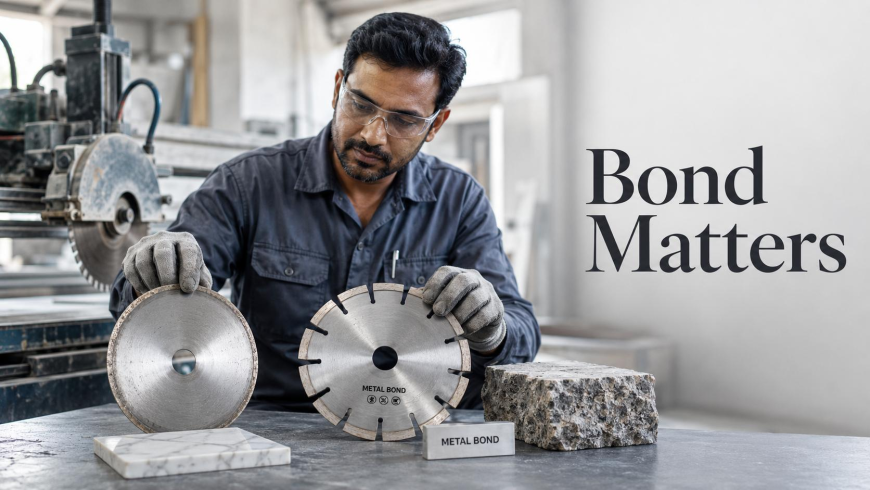
Most tile fabricators in India have made the same mistake at least once: grabbed an electroplated diamond saw blade off the shelf because it was cheap and available, then used it to cut granite kerb stones, and watched it go dull within 15 minutes. The blade did not fail because it was poorly made. It failed because it was the wrong tool for the material density. Understanding why requires looking at what actually holds a diamond to a blade body — and what happens when that bond meets the wrong surface.
A diamond saw blade works through controlled abrasion: industrial-grade diamond particles embedded in a matrix grind through the workpiece. The matrix — the bond material holding the diamonds — determines how quickly diamonds are exposed as the blade wears, and how long individual particles last before being released. This is the variable that separates a ₹200 electroplated blade from a ₹1,800 metal-bonded sintered segment, and it explains almost every case of premature wear or surface burn a contractor reports.
Electroplated blades: precise, fast, and genuinely unsuitable for heavy masonry
Electroplated diamond blades are made using an electrochemical process that bonds a single layer of diamond particles to a steel core. They are excellent tools for the right application: thin cuts on marble, glass, ceramic tile, and other relatively soft, non-abrasive materials where precision matters more than longevity. On these surfaces, the single-layer design allows for a thinner kerf and faster cutting speed because there is very little resistance from the bond matrix itself.
The problem begins when electroplated blades meet materials they were not designed for. Concrete, granite, and sandstone are abrasive enough to strip the single diamond layer faster than the diamond particles wear down the workpiece. In practical terms, this means the blade does not go dull — it goes bald. Once the diamond layer is gone, the steel core is exposed, and the blade begins scoring rather than cutting. On Indian construction sites where the same crew often uses the same blade on marble tiles in the morning and concrete kerbs in the afternoon, this failure mode is extremely common.
There is another failure mode specific to the Indian summer: heat. Without the self-sharpening mechanism of a segmented blade, electroplated blades accumulate heat rapidly on abrasive materials. At temperatures above 200°C — easily reached when cutting dense concrete dry — the electroplated bond begins to fail structurally. The result is usually a perfectly circular ring of stripped steel where the diamonds used to be.
How metal-bonded sintered blades actually work during a hard cut
Metal-bonded sintered diamond saw blades — the correct category for diamond cutting blade for concrete, granite, and hard stone — work on an entirely different principle. Rather than a surface-applied layer, diamonds are embedded throughout a metal matrix segment (typically a mix of cobalt, bronze, or iron-based powders, sintered under heat and pressure). As the outer layer of the matrix wears away through cutting, fresh diamonds are continuously exposed. This self-sharpening mechanism is what allows a quality sintered blade to maintain cutting efficiency across hundreds of linear metres.
The bond hardness of the metal matrix must be matched to the material being cut. A soft bond releases diamonds quickly, which is correct for hard, dense materials like granite or reinforced concrete — the workpiece wears the matrix fast enough to keep fresh diamonds exposed. A hard bond holds diamonds longer, which is correct for soft, abrasive materials like green concrete or sandstone that would erode a soft bond too fast. Choosing the wrong hardness does not always cause visible blade damage — it simply results in glazing (the segment becomes polished and stops cutting efficiently) or rapid segment erosion, both of which look like "a bad blade" but are actually a bond mismatch.
How to choose diamond saw blade without wasting money on mismatches
Genuinely, the answer depends on what you are cutting regularly, and I would be cautious about any guide that gives a single universal recommendation. That said, the framework is simple: identify your primary material, then select bond hardness inversely — hard material needs a soft bond, soft or abrasive material needs a hard bond.
For Indian masonry contractors working primarily on reinforced concrete demolition and breakout, a medium-hard metal bond in the M40 to M60 range is the safe default. For tile fabricators working mainly on natural marble and limestone, a hard bond electroplated blade delivers better edge quality and acceptable longevity if the material never exceeds about 3 on the Mohs hardness scale.
For the increasingly common scenario on Indian infrastructure sites where the same crew cuts pavers in the morning and machine-base channels in the afternoon — standardise on a medium-bond segmented sintered blade and accept slightly slower marble cutting rather than risk the electroplated blade on concrete. The cost difference between replacing a burned electroplated blade and running a slightly less efficient sintered blade on marble is almost always in favour of the sintered option.
Heat and friction: the site manager variable nobody talks about
Water cooling is not optional on hard materials. Dry-cutting diamond blades exist, but their operating window on dense concrete is limited to short burst cuts with cooling intervals. On a typical Indian site where a worker runs the saw continuously for 20 minutes on concrete kerbs, a dry-cut blade — even a metal-bonded one — will reach temperatures that begin to alter the tensile properties of the steel core. Yuri Group, which has engineered cutting tools for Indian infrastructure conditions since 2006, specifies this clearly in its blade documentation: intermittent dry cutting on concrete should not exceed 30-second continuous cycles.
The practical implication for site managers: if your crew does not use water cooling, budget for shorter blade life and factor that into your procurement estimate. A ₹1,800 blade used correctly with cooling can outlast a ₹2,200 blade run dry by a factor of three or more.
On electroplated vs sintered diamond blade total cost for a month of operation: we ran the comparison informally with a masonry contractor in Navi Mumbai over six weeks. Electroplated blades, used on mixed marble and light concrete, needed replacement roughly every 4 days. Sintered metal-bond blades lasted 3 weeks on the same workload, at roughly 2.5 times the upfront cost. The sintered option was cheaper per working day by a significant margin, and never produced the surface burn marks the electroplated blades regularly left on the higher-value marble cuts.
The one situation where electroplated still wins outright
Precision inlay work, ornamental tile cutting, and any cut where kerf width and edge smoothness are the primary requirements — these remain the domain of the electroplated blade. No sintered blade at any price point produces the feather edge that a well-maintained electroplated blade does on polished marble or glass mosaic. For a tile fabricator doing detailed bathroom installations in high-end residential projects, that edge quality is a competitive differentiator worth paying for.
The mistake is generalising that advantage to every material on site. The most expensive blade failure is not the blade itself — it is the wasted time and rework when a builder uses the wrong tool on the wrong material and produces a surface that needs to be refinished or replaced.