How Custom Revit Families Enhance Coordination in Large-Scale BIM Projects
Commercial megaprojects demand extraordinary geometry management. BIM teams process thousands of parametric components across shared worksets simultaneously.
 Ankit Kansara
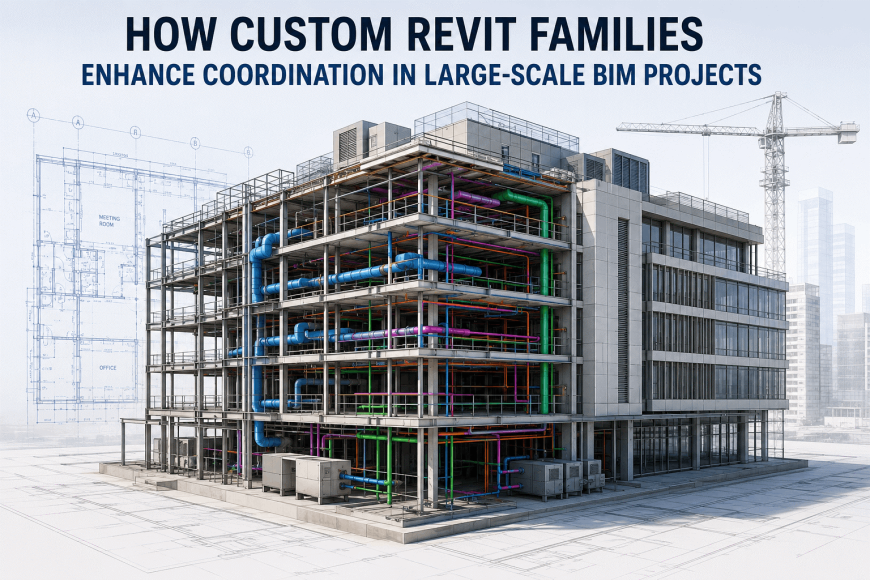
Commercial megaprojects demand extraordinary geometry management. BIM teams process thousands of parametric components across shared worksets simultaneously. Stock manufacturer assets frequently carry embedded CAD geometry from legacy drafting platforms. That excess polygon data degrades model performance and slows federated file synchronization during active coordination cycles. Project managers lose critical schedule hours tracing corrupt parameters back to source files. Those wasted hours compound across disciplines and inflate coordination overhead costs.
Deploying standardized, intelligent parametric components gives VDC teams a primary coordination mechanism. These purpose-built assets maintain model fluidity across all active disciplines. Each component carries exactly the spatial data coordination teams need. That targeted approach keeps cross-trade alignment intact from schematic design through construction documentation. Federated project environments gain predictable performance when every content item meets authoring standards at upload. Consistent component quality accelerates federated model publishing cycles across all project stages.
What Are Custom Revit Families?
Custom Revit families are parametric (.rfa) files built from explicit reference planes, flexible type parameters, and precisely configured visibility settings. Modelers author each component geometry against a controlled reference plane grid. That grid governs all spatial relationships inside the family editor. Coordination teams use professional Revit family creation services to produce components that encapsulate accurate manufacturer metadata. Those services strip unnecessary embedded CAD geometry from every deliverable. The resulting assets maintain lightweight file performance geometry across large federated project environments.
Each family type stores discrete dimensional values inside a shared parameter framework. Nested sub-components inherit parent visibility rules automatically. That inheritance structure eliminates redundant geometry loading across project phases.
Family types give authoring teams a scalable content architecture. A single source file generates multiple dimensional configurations using type catalog tables. Each configuration shares an identical parameter structure and connector logic with every sibling type.
Why Coordination Is Critical in Large-Scale BIM Projects
Crowded ceiling plenums represent one of the most spatially contested zones in commercial construction. Mechanical ductwork, electrical conduit runs, structural beam flanges, and fire suppression piping compete for identical physical coordinates. BIM modeling services teams map these interferences digitally before fabricators cut any material. That digital mapping process protects project budgets from expensive field rework orders. Early spatial resolution converts potential construction-phase delays into approved shop drawings.
Tight utility corridors amplify this spatial complexity on hospital and data center projects. Each discipline publishes independent models into a central coordination file. Coordination managers run interference checks against the combined geometry. Precise spatial clear zones documented inside each component protect final construction schedules from field modification cascades. Accurate spatial data inside components translates directly into measurable cost avoidance on complex projects.
How Custom Revit Families Enhance BIM Coordination
Custom families embed precise clearance zones directly into parametric geometry. Those zones activate automatically inside clash detection software during coordination reviews. Inside each family template, authoring teams define maintenance access clearances as visible geometry.
Coordination teams gain measurable advantages when they follow a tested Revit family creation process that maps connector logic and nested sub-components into every deliverable. That process assigns flow direction values to mechanical duct connectors at the family authoring stage. Interference testing against this prepared geometry identifies routing conflicts before fabricators begin manufacturing pieces. Teams resolve spatial conflicts at a fraction of the cost compared to field-stage discovery.
Explicit nested parameters allow coordination teams to test spatial clearance across all family type variations simultaneously. A single parametric HVAC unit family can output twenty-four configuration types from one source file. Each type carries its clearance zone geometry, enabling automated clash detection across all configurations in a single run.
Best Practices for Creating Custom Revit Families
BIM managers implement specific operational benchmarks to keep custom content lightweight, smart, and fully functional across shared project workspaces. Revit Family Creation Services USA providers codify these benchmarks into internal QA protocols. Those protocols govern every deliverable before content enters a live project environment. Consistent application of these standards across all vendor-supplied families accelerates federated model acceptance rates.
Implementing Strict Level of Detail (LOD) Controls
Revit family modeling teams map visibility rules at the parameter level inside each family editor session. Complex interior geometry hides inside coarse 3D views and small-scale plan drawings. That interior detail displays only inside large-scale section cuts and detail views. This controlled visibility approach keeps view regeneration times fast across the entire project team. LOD-mapped families also produce accurate quantity schedules at each project phase gate.
Standardizing Shared Parameters and Naming Nomenclature
Uniform shared parameter text files form the foundation of cross-trade schedule coordination. Each discipline references an identical parameter file during family authoring. Schedule sheets then harvest asset information consistently across independent trade files. That parameter uniformity eliminates manual data reconciliation tasks during quantity takeoff and procurement phases. Naming standards also accelerate asset searches inside large shared project content libraries.
Cleaning Omni Class Classifications and Connector Logic
Accurate Omni Class codes at the family type level connect component data to specification management platforms. Modelers map flow direction values to each mechanical duct connector during the family authoring session. Across the entire combined project file, those flow directions stabilize system calculation results. Accurate connector logic accelerates MEP system sizing routines by eliminating parameter conflict errors. Validated classification data also feeds downstream cost management and facility management systems.
Conclusion
Precision-crafted parametric components convert large-scale Revit environments into mathematically aligned project databases. Each custom family delivers geometry, parameters, and connector data that coordinate teams can verify digitally before construction begins. VDC directors who invest in structured family content production accelerate final design approvals and protect project timelines from field modification costs. The parametric nexus between intelligent components and federated coordination models defines project delivery performance in today's large-scale commercial AEC sector.
BIM managers who audit family content at the start of the project identify geometry problems weeks ahead of coordination review meetings. That early audit cuts RFI volumes during the construction documentation phase. Teams that skip that audit absorb the cost later inside congested field conditions where fixes cost ten times more. Custom families authored to a verified standard give the entire project team a shared spatial language from day one.