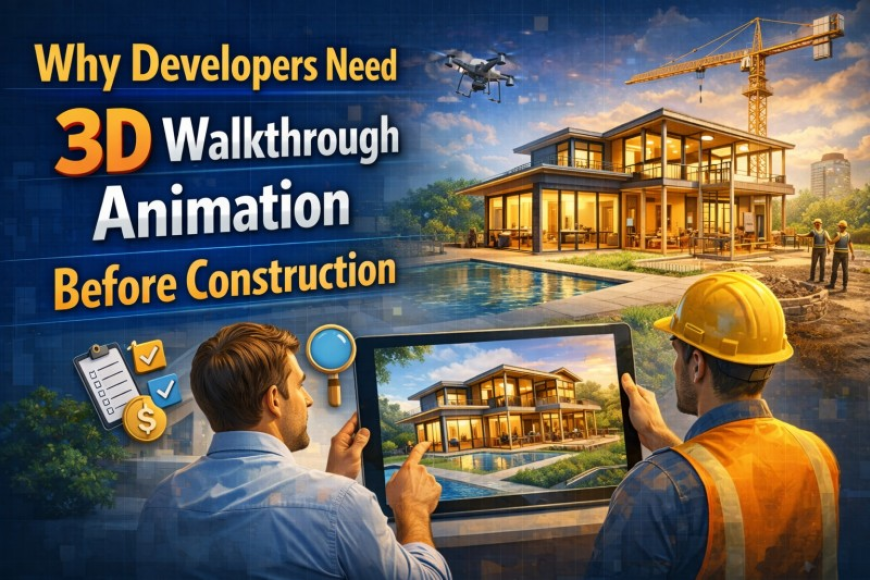
Why Developers Need 3D Walkthrough Animation Before Construction
 archdraw
Real estate development has always been a game of vision. But for decades, that vision was trapped in 2D blueprints and static sketches, relying entirely on the imagination of investors and buyers. Today, technology has bridged the gap between concept and reality.
3D architectural visualization has fundamentally shifted how projects are planned, marketed, and sold. It is no longer just a "nice-to-have" marketing add-on; it is a critical tool for risk management and capital efficiency. For modern developers, leveraging 3D Walkthrough Animation Services is now as essential as the architectural drawings themselves. These animations provide a photorealistic tour of a property that doesn't exist yet, allowing stakeholders to step inside the vision before a single brick is laid.
This shift isn't just about pretty pictures. It's about solving expensive problems early. From securing funding to correcting design flaws, here is why developers are prioritizing 3D walkthroughs in the pre-construction phase.
The Role of 3D Visualization in Modern Development
The complexity of modern construction projects demands clarity. Static renders offer a snapshot, but they lack context and flow. A single image of a living room doesn't tell you how the kitchen connects to the dining area or how the morning light hits the balcony.
3D walkthroughs introduce the element of time and space. They allow viewers to navigate through a digital twin of the project, understanding spatial relationships and traffic flow. This comprehensive view is vital for developers who need to ensure that the user experience of the building matches the architectural intent. By partnering with firms like Archdraw Outsourcing, developers can translate complex CAD files into fluid, immersive narratives that everyone—from the site foreman to the end-buyer—can understand instantly.
Enhancing Pre-Construction Sales
Selling a promise is hard. Selling a tangible experience is much easier.
One of the biggest hurdles in real estate development is pre-selling units to fund construction. Buyers are naturally hesitant to invest significant capital into something they cannot see or touch. Floor plans can be confusing to the untrained eye, and material samples on a mood board often fail to convey the final atmosphere of a home.
3D Walkthrough Animation Services dismantle this barrier. They allow potential buyers to virtually walk through the front door, explore the amenities, and visualize their life in the space. They can see the texture of the hardwood floors, the height of the ceilings, and the view from the penthouse window.
This emotional connection is a powerful sales driver. When a buyer can vividly imagine hosting a dinner party in the open-concept kitchen or relaxing by the community pool, the hesitation to buy off-plan diminishes. The result is a faster sales cycle and better cash flow for the developer during the critical early stages of the project.
Identifying Design Flaws Before Breaking Ground
The most expensive words in construction are "change order."
Discovering a design error during the construction phase is a nightmare scenario. Moving a wall, rerouting plumbing, or changing window placements after installation involves demolition, wasted materials, and schedule delays. These costs eat directly into the developer's profit margin.
3D walkthroughs act as a stress test for the design. When architects and engineers review a high-fidelity animation, they often spot issues that were invisible on 2D plans. Perhaps a hallway feels too claustrophobic, a structural column obstructs a key view, or the lighting in the lobby is insufficient.
By catching these issues in the virtual world, modifications cost pennies on the dollar compared to fixing them on the physical job site. It allows the design team to refine the layout and aesthetics until they are perfect, ensuring the construction process runs smoother and stays on budget.
Streamlining Stakeholder Communication
Development projects involve a massive web of stakeholders: investors, city planners, zoning boards, architects, contractors, and marketing teams. Miscommunication between these groups is common and costly.
Investors want to know their money is safe. City planners want to see how the building fits into the neighborhood. Contractors need to understand the intricate details of the finishings.
A 3D walkthrough serves as the single source of truth. It eliminates ambiguity. Instead of relying on technical jargon or abstract descriptions, developers can show exactly what they intend to build.
Securing investor approval is particularly easier with high-quality animation. Investors are bombarded with pitch decks. A dynamic, cinematic walkthrough stands out, demonstrating that the developer has a clear, mature vision and has done the due diligence to visualize the final product. It builds confidence and credibility, which are the currencies of securing capital.
Improving Marketing Efficiency
In the digital age, content is king. Developers are competing for attention on Instagram, Facebook, LinkedIn, and real estate listing platforms. Static images are easily scrolled past, but video commands attention.
3D Walkthrough Animation Services provide a goldmine of marketing assets. A single walkthrough can be cut into short teasers for social media, used as a hero video on the project website, or played on loop in the sales center.
These assets are highly shareable. A potential buyer might see a stunning walkthrough on social media and share it with their partner or family, organically expanding the project's reach. Furthermore, high-quality visuals signal quality. When the marketing materials are polished and professional, buyers assume the building itself will be built to the same high standard.
Cost-Savings of Virtual Modifications
Flexibility is a major advantage of the digital realm. In the physical world, changing a finish from marble to granite or switching a hardwood floor to polished concrete is a logistical headache. In a 3D model, it’s a matter of adjusting settings.
This flexibility allows developers to experiment. They can test different interior design schemes to see what resonates best with their target demographic without spending money on physical mock-up units.
If market trends shift during the planning phase—for example, if there is a sudden demand for home office spaces—developers can quickly update the walkthrough to showcase a study nook instead of a second walk-in closet. This agility ensures the product remains competitive and aligned with buyer needs, maximizing the potential sale price.
Future Trends: VR and AR Integration
The technology powering 3D Walkthrough Animation Services is evolving rapidly. The next frontier is the integration of Virtual Reality (VR) and Augmented Reality (AR).
While a video walkthrough is passive (you watch it), VR is active (you participate in it). Developers are increasingly setting up VR stations in their sales offices. Buyers can put on a headset and physically look around the unit, opening doors and turning on lights.
AR takes it a step further, allowing buyers to point their phone at a construction site and see the finished building superimposed on the empty lot. As these technologies become more accessible, the gap between the digital and physical worlds will vanish completely, making the pre-construction experience indistinguishable from a final walkthrough.
Visualizing Success
For developers, the pre-construction phase is fraught with risk. You are spending money on land, permits, and design with no guarantee of return. 3D Walkthrough Animation Services are the best insurance policy against that risk.
They accelerate sales by building emotional connections with buyers. They protect margins by identifying design clashes early. And they secure funding by communicating a clear, professional vision to investors. By partnering with experts like Archdraw Outsourcing, developers can transform abstract blueprints into compelling visual stories, ensuring that when they finally break ground, they are building towards a guaranteed success.