Why Is Connected GRC Becoming Important for Australian Businesses?
Disconnected spreadsheets and siloed systems can make governance harder to manage. Learn how connected GRC can improve risk and compliance visibility.
 AssurePlusGRC
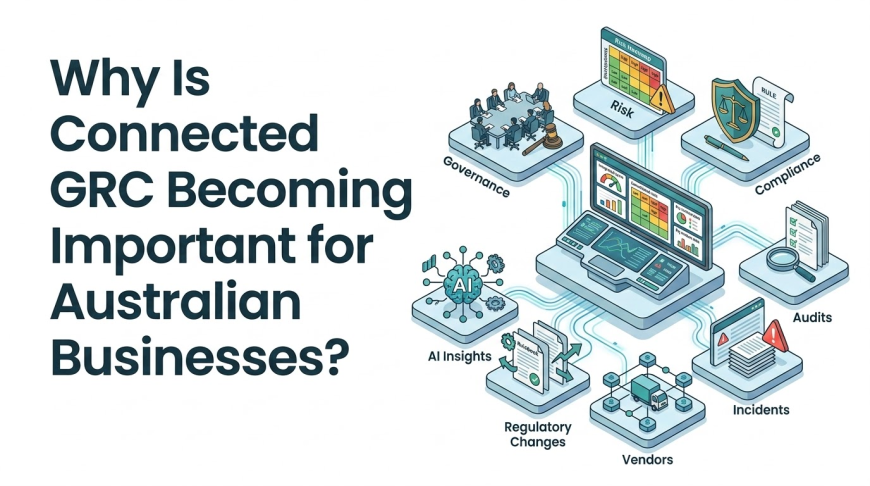
Governance, risk and compliance activities are often managed by different teams. Risk managers maintain risk registers. Compliance teams track obligations. Internal auditors manage findings. Operations teams record incidents. Vendor teams maintain supplier assessments.
Each function has a legitimate purpose. The problem appears when these activities have little connection to each other. A risk may be affected by an incident that the risk team does not immediately see. An audit may identify a control weakness that compliance teams need to know about. A regulatory change may require a policy or control to be reassessed.
This raises a practical question: can organisations make better decisions when their GRC information is connected?
Why Do GRC Silos Create Problems?
Information silos do not necessarily mean that information is inaccurate. The problem is that important relationships become harder to see. Imagine that an organisation has identified a supplier as a high-risk third party. Separately, the incident team records several service disruptions involving that supplier.
If those records are maintained independently, leadership may not immediately recognise that the supplier's risk profile has changed. The same issue can occur between audits and risk management.
An audit finding may reveal that a critical control is not operating effectively. If that information does not feed back into the relevant risk assessment, the organization could continue using an outdated risk rating. Connected GRC aims to reduce these gaps.
What Does a Connected GRC Platform Actually Mean?
A connected GRC platform is more than putting several software modules under one login. The important part is the shared information environment.
AssurePlus describes its AI-powered GRC platform for Australian businesses as a unified environment connecting risk management, compliance, incident response, audits and vendor data. This type of architecture can help organizations understand relationships between different governance activities.
For example, an incident can be associated with a control. The control can be associated with a risk. The risk can relate to a compliance obligation. That creates context that is difficult to maintain when every activity is managed separately.
How Can AI Help GRC Teams?
AI can potentially reduce some of the manual work involved in managing large volumes of GRC information. AssurePlus describes AI-driven capabilities for areas including risk insights, assessments, control monitoring and regulatory change monitoring.
The practical value depends on how these capabilities are implemented. AI should not replace governance professionals making important decisions. Instead, it can help teams identify information, patterns and changes that deserve human attention.
For example, if regulatory information changes, an automated system may help identify potentially affected obligations or controls. A risk team can then review the information and determine what action is appropriate.
Why Is Regulatory Change Difficult to Manage Manually?
Regulatory requirements do not remain static. Australian businesses may need to monitor changes across privacy, employment, financial services, cybersecurity, industry-specific requirements and other regulatory areas.
Manually reviewing every development, determining relevance and then identifying affected policies and controls can consume significant time. A continuous compliance approach can make this process more manageable by monitoring relevant changes and connecting them with the organization's existing compliance structure.
The Australian Government's regulatory environment demonstrates why ongoing monitoring matters. For example, the strengthened Aged Care Quality Standards took effect on 1 November 2025 and introduced more detailed and measurable requirements for relevant providers.
The broader lesson applies across regulated industries: organizations need processes that can adapt when requirements change.
Can Connected GRC Improve Risk Management?
It can provide better context for risk decisions. Risk management is not just about assigning likelihood and impact scores.
A risk owner needs to understand what controls are in place, whether those controls are working, whether incidents have occurred, and whether the surrounding environment has changed. ISO 31000 emphasizes identifying, analysing, evaluating, treating, monitoring and communicating risk as part of an ongoing risk management process.
A connected environment can support that cycle by making relevant information easier to access. For instance, repeated incidents associated with a particular process could prompt a review of the associated risk. An audit finding could provide evidence that a control needs improvement.
What About Audits and Corrective Actions?
Audits become more useful when their findings do not disappear into a separate reporting system. A finding may relate to a specific risk or compliance obligation. Its corrective action may require a process change, policy update or control improvement.
A connected system can help maintain those relationships. The organization can see the finding, the responsible owner, the required action, supporting evidence and follow-up status in context.
This can also make it easier for leadership to distinguish between actions that have merely been completed and actions that have actually improved the control environment.
Is Connected GRC Suitable Only for Large Enterprises?
Not necessarily, the appropriate GRC approach depends on organizational complexity, risk exposure, regulatory obligations and available resources. Smaller organizations may have fewer risks and simpler governance structures, while larger organizations may need more sophisticated workflows and reporting.
The underlying principle remains the same: information is more useful when the people responsible for governance can understand how different activities relate to each other.
What Should Businesses Look for in a GRC Platform?
Organisations should start with their governance problems rather than with a list of software features.
Can the platform connect risks and controls? Can teams track incidents and corrective actions? Can compliance obligations be monitored? Can audit evidence be managed? Can leadership obtain a current view of organisational exposure?
Integration and usability are also important. A platform that creates another isolated database may simply move the problem somewhere else. The objective should be to reduce fragmentation.
Conclusion
GRC becomes difficult when important information is scattered across disconnected systems. Risk, compliance, incidents, audits and vendor activities may each be managed effectively on their own, yet leadership can still struggle to understand the bigger picture.
A connected GRC approach can help bring those relationships together. AI can further support this model by helping teams process information, identify changes and surface potential areas requiring attention.
Ultimately, the value of connected GRC is not having more dashboards. It is giving organisations a clearer answer to a much more important question: What is changing in our risk and compliance management, and what should we do about it?