Choosing the Right Ultrasonic Testing Equipment for Industry
Choosing the right Ultrasonic Testing Equipment for industry requires clarity, precision, and long-term thinking. Learn how to select the best solution.
 evosonic
In modern industrial environments, quality, safety, and reliability are non-negotiable. From energy and infrastructure to manufacturing and aerospace, industries depend on precise inspection methods to detect flaws before they become failures. This is where Ultrasonic Testing Equipment plays a critical role. As one of the most trusted forms of Non-Destructive Testing Equipment, it allows professionals to evaluate materials internally, without cutting, damaging, or interrupting operations.
Yet, choosing the right ultrasonic solution isn’t as simple as picking the latest model or the most expensive device. It requires a thoughtful understanding of applications, materials, operating conditions, and long-term inspection goals. This guide is designed to help decision-makers, inspectors, and engineers confidently navigate that choice.
Understanding Ultrasonic Testing in an Industrial Context
Ultrasonic testing (UT) works by sending high-frequency sound waves into a material and analyzing how those waves reflect back. Any internal discontinuity, cracks, voids, corrosion, or inclusions, changes the signal pattern. Skilled operators can interpret these signals to determine defect size, depth, and location.
What makes Ultrasonic Testing Equipment especially valuable is its versatility. It works on metals, composites, plastics, and even complex welded structures. Unlike radiography or destructive testing methods, UT provides immediate results and can be performed repeatedly without risk to personnel or assets.
Why Equipment Selection Matters More Than Ever
Industrial inspection demands have changed dramatically. Faster production cycles, stricter safety regulations, and aging infrastructure have increased pressure on inspection teams. Outdated or poorly matched equipment can lead to missed defects, false positives, or inefficient workflows.
The right Non-Destructive Testing Equipment does more than inspect, it improves confidence, productivity, and decision-making. Choosing wisely ensures accurate data, reduced downtime, and long-term cost efficiency.
Key Factors to Consider When Choosing Ultrasonic Testing Equipment
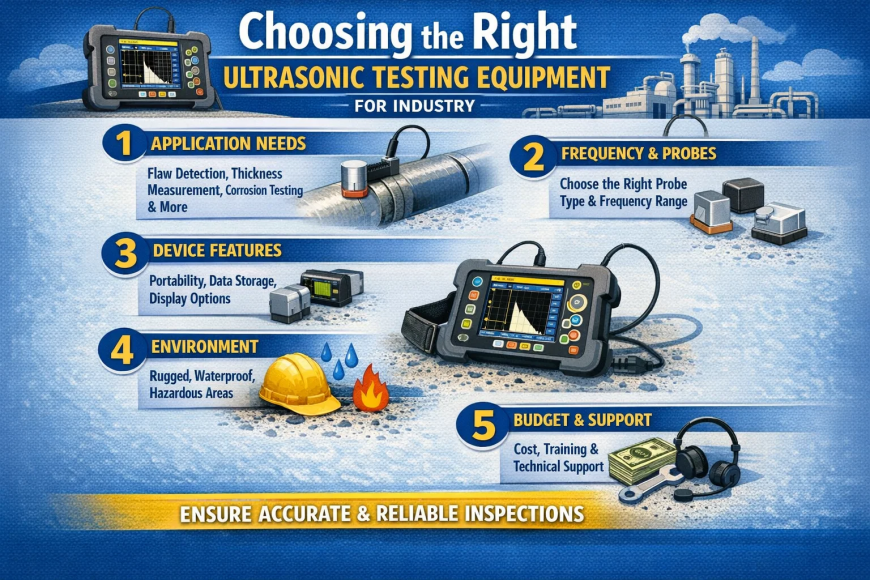
Application-Specific Requirements
Not all ultrasonic testing applications are the same. Inspecting pipeline corrosion differs significantly from testing aerospace composites or precision-machined components.
Before selecting equipment, define:
-
Material type and thickness
-
Expected defect types
-
Inspection environment (field vs lab)
-
Required inspection speed and resolution
Equipment optimized for weld inspection may not perform well for corrosion mapping or composite testing. Clarity on application prevents overbuying, or worse, underperforming.
Conventional UT vs Advanced Ultrasonic Technologies
Conventional Ultrasonic Testing
Traditional UT uses single-element probes and is still widely used for thickness measurement, basic flaw detection, and simple weld inspections. It is cost-effective, reliable, and suitable for many standard industrial tasks.
Phased Array Ultrasonic Testing (PAUT)
Phased array systems use multiple elements that can be electronically steered and focused. This allows faster scanning, improved defect characterization, and detailed imaging. For complex geometries or critical inspections, PAUT offers a significant advantage.
Time of Flight Diffraction (TOFD)
TOFD excels in detecting and sizing cracks, particularly in weld inspections. It provides highly accurate depth measurements and is often used alongside phased array systems.
Selecting the right technology depends on inspection complexity, regulatory requirements, and operator expertise.
Portability and Field Conditions
Industrial inspections often occur in demanding environments, offshore platforms, confined spaces, elevated structures, or extreme temperatures. Bulky systems with limited battery life can slow down operations.
Modern Ultrasonic Testing Equipment increasingly prioritizes:
-
Lightweight design
-
Long battery performance
-
Rugged, weather-resistant housings
-
Intuitive touchscreen interfaces
Field usability directly impacts inspection efficiency and operator safety.
Data Quality, Software, and Reporting
Hardware is only half the story. Advanced inspection requires intelligent software capable of clear visualization, data storage, and reporting.
Look for systems that offer:
-
High-resolution A-scan, B-scan, and C-scan views
-
Easy data export and traceability
-
Cloud or network integration options
-
Customizable reporting formats
Strong software support ensures inspection results are not just collected, but understood and actionable.
The Human Factor: Operator Skill and Training
Even the most advanced Non-Destructive Testing Equipment depends on the person using it. Equipment that is overly complex or unintuitive increases the risk of user error.
When evaluating systems, consider:
-
Learning curve and interface design
-
Availability of training resources
-
Manufacturer support and documentation
Well-designed Ultrasonic Testing Equipment should enhance operator skill, not compensate for confusion.
Compliance and Industry Standards
Industries operate under strict codes and standards, such as ASME, ASTM, ISO, and API. Equipment must meet or exceed these requirements to ensure inspection validity and regulatory acceptance.
Before purchasing, verify:
-
Certification compatibility
-
Calibration standards
-
Audit and documentation support
Compliance is not optional, it protects both operational integrity and organizational reputation.
Long-Term Value Over Initial Cost
While budget constraints are real, focusing solely on upfront cost often leads to higher expenses over time. Low-quality equipment may require frequent repairs, limited upgrades, or early replacement.
High-value Ultrasonic Testing Equipment offers:
-
Modular upgrades
-
Long service life
-
Manufacturer support and spare availability
-
Consistent performance across years of use
The goal is sustainable inspection capability, not short-term savings.
Integrating Ultrasonic Testing into a Broader NDT Strategy
Ultrasonic testing rarely works in isolation. It often complements other Non-Destructive Testing Equipment such as visual inspection, magnetic particle testing, or radiography.
Choosing equipment that integrates smoothly into an existing inspection ecosystem improves:
-
Workflow consistency
-
Data correlation
-
Inspection coverage
Strategic integration leads to smarter maintenance decisions and fewer unexpected failures.
Common Mistakes to Avoid
-
Buying overly complex systems for simple tasks
-
Ignoring operator feedback during selection
-
Overlooking software and data management needs
-
Choosing based on brand reputation alone
-
Failing to plan for future inspection requirements
Avoiding these pitfalls ensures your investment delivers real operational value.
Making a Confident, Informed Decision
Choosing the right Ultrasonic Testing Equipment is a strategic decision that affects safety, productivity, and long-term reliability. The best choice aligns technology with application, supports operators, and adapts to future demands.
By understanding your inspection needs, evaluating technology options, and prioritizing usability and compliance, you can select equipment that works as hard as your team does.
Conclusion
In an industrial world where precision and prevention matter more than ever, Ultrasonic Testing Equipment stands as a cornerstone of modern inspection. As a trusted form of Non-Destructive Testing Equipment, it empowers industries to detect problems early, protect assets, and maintain operational confidence. Choosing the right system is not about chasing features, it’s about matching capability with purpose, today and tomorrow.