Why Process Engineers & Associates Are Trusted PHE Manufacturers
Process Engineers & Associates (PHE INDIA™) is a leading manufacturer of Industrial Plate Heat Exchangers. The company provides efficient, reliable, and customized heat-transfer solutions for industrial heating, cooling, and heat-recovery applications across various industries.
 phemanufacturers
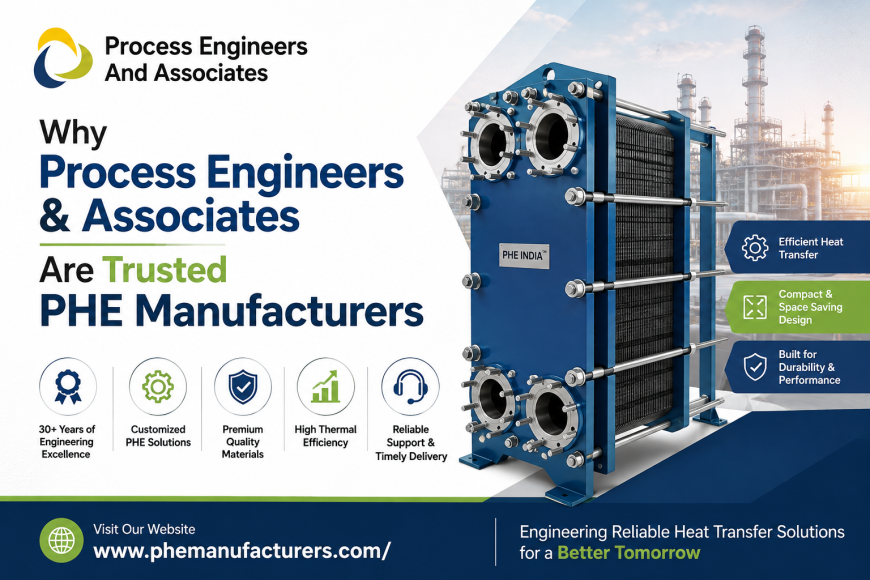
Selecting a Plate Heat Exchanger (PHE) supplier is rarely a decision that should be made on price alone. A PHE sits at the center of critical heating, cooling and heat-recovery processes across a plant, and an underperforming or poorly matched unit can lead to production slowdowns, higher energy bills and unplanned maintenance. That makes the choice PHE manufacturers of just as important as the choice of the equipment itself.
Process Engineers & Associates, operating as PHE INDIA™, has been supplying Industrial Plate Heat Exchangers since 1995, which puts more than three decades of engineering experience behind every unit that leaves its facility. But experience alone doesn't explain why a manufacturer earns trust. This article looks at what actually makes a PHE manufacturer reliable, and examines how Process Engineers & Associates measures up against those criteria — so that industrial buyers evaluating PHE Manufacturers in India have a clear, practical basis for comparison.
What Should You Look for in Trusted PHE Manufacturers?
Before looking at any single company, it helps to define what "trustworthy" actually means in the context of industrial heat exchangers. A handful of factors consistently separate dependable Industrial PHE Manufacturers from suppliers who simply sell equipment off a catalogue:
-
Manufacturing experience — how long the company has been solving real-world thermal problems, not just producing units to a spec sheet.
-
Engineering expertise — the ability to translate a process condition into an appropriate plate configuration, not just sell a standard model.
-
Material selection — matching plates and gaskets to the fluid, temperature and pressure involved.
-
Customization capability — the willingness and technical capacity to design around your process, rather than asking your process to fit their product.
-
Understanding of industrial applications — familiarity with how PHEs actually behave in chemical, HVAC, oil and gas, or water treatment environments.
-
Quality control — consistent manufacturing standards that reduce the risk of leaks, corrosion or premature failure.
-
Technical support — access to engineers who can help with selection, commissioning and troubleshooting.
-
Maintenance considerations — a design that's realistic to inspect, clean and service over its working life.
-
Delivery reliability — the operational discipline to deliver equipment on schedule.
Industrial buyers who evaluate a Plate Heat Exchanger Supplier only on the initial quotation often end up paying more later, through inefficiency, downtime or replacement costs. A more complete evaluation looks at the total value a manufacturer brings across the life of the equipment.
More Than 30 Years of Engineering Experience
Process Engineers & Associates has been involved in Industrial PHE solutions since 1995. Over three decades of continuous work in heat transfer technology is significant, because industrial processes are rarely uniform. A facility handling hydraulic oil cooling faces different demands than one managing sulphuric acid cooling in an anodizing plant or chilled water transfer for an industrial chiller system. Temperatures, pressures, flow rates, fluid chemistry and corrosion behavior all vary from one application to the next.
Long-term experience doesn't automatically make a manufacturer the "best" or "number one" — but it does mean a company has likely encountered a wide range of these variables already, and has had the opportunity to refine how it approaches plate selection, gasket compatibility and configuration for different operating environments. For a buyer, that accumulated exposure reduces the risk of specifying equipment that's poorly matched to the actual process.
Expertise in Industrial Plate Heat Exchangers
Process Engineers & Associates specializes specifically in Industrial Plate Heat Exchangers, built using precision-engineered corrugated stainless steel plates. This design creates efficient flow channels for hot and cold fluids and increases the surface area available for heat transfer, which allows for faster thermal exchange within a smaller footprint than many conventional shell-and-tube systems typically require.
The plate-and-gasket construction also has a practical maintenance advantage: the modular arrangement makes it comparatively easier to inspect, clean and replace individual plates, which can help reduce the time and effort involved in routine servicing. It's worth noting that shell-and-tube exchangers still have their place — particularly in very high-pressure or high-fouling applications — so the comparison is less about one design being universally superior and more about matching the right technology to the right process.
Customized PHE Solutions for Different Process Requirements
A generic, off-the-shelf heat exchanger will rarely perform optimally across every application. That's why customization is one of the clearest markers of a serious PHE Manufacturer in India, rather than a basic equipment reseller.
Process Engineers & Associates develops customized PHE solutions based on:
-
Flow rate
-
Operating temperature
-
Operating pressure
-
Fluid characteristics
-
Heat-transfer capacity required
Consider the difference between two applications: DM water cooling for an induction furnace typically involves cleaner fluid streams and more predictable operating conditions, while quench oil cooling deals with higher viscosity fluids and greater thermal load variation. A PHE configured correctly for one would likely underperform, or wear faster, in the other. Customization exists precisely to account for these differences, rather than forcing every process through the same standard unit.
Quality Materials for Industrial Applications
Material selection directly affects how long a PHE lasts and how reliably it performs. Process Engineers & Associates manufactures plates using materials including SS304, SS316 and titanium, along with gasket options such as EPDM, NBR and Viton, depending on the application.
None of these materials is universally "better" — the right choice depends on the process fluid, operating temperature, pressure and the surrounding chemical environment. SS316, for instance, generally offers stronger resistance to certain corrosive conditions than SS304, while titanium is often selected for particularly aggressive or high-chloride environments. Gasket materials follow a similar logic: EPDM, NBR and Viton each have different tolerances for temperature ranges, oils, and chemical exposure. A manufacturer that offers a range of validated material options — rather than a single fixed configuration — gives buyers a better chance of matching the equipment to their actual operating conditions.
Designed for Efficient Heat Transfer
The corrugated plate design used in PHE INDIA™'s Industrial PHEs is intended to increase the surface area available for thermal exchange while promoting more turbulent fluid flow across the plates. In practical terms, this can translate into:
-
A more compact equipment footprint compared with older heat exchanger designs
-
Reduced installation space requirements
-
More efficient thermal exchange for a given plate area
-
Support for lower energy consumption during heating and cooling processes
These are the general engineering principles behind plate heat exchanger design rather than guaranteed performance figures for any specific installation — actual results depend on the process conditions and how the unit is specified and maintained.
Compact and Modular Construction
Space is often at a premium on an industrial plant floor, and a compact, modular heat exchanger can be a meaningful advantage when planning layout or retrofitting existing systems. Beyond the footprint itself, modular construction offers a few operational benefits:
-
Easier inspection of individual plates
-
Simplified cleaning routines
-
More straightforward maintenance scheduling
-
Easier replacement of worn components
-
The potential to expand capacity later by adding plates, rather than replacing the whole unit
These characteristics matter most in facilities where planned maintenance windows are limited and where minimizing downtime is a priority. While a well-designed modular unit can support easier servicing, actual maintenance intervals and downtime will still depend on the specific application, fluid characteristics and how the equipment is operated.
Industrial Applications Across Multiple Sectors
Process Engineers & Associates' Industrial PHEs are used across a broad set of sectors, including chemical processing, oil and gas, HVAC, refrigeration, power generation, water treatment, food processing, pharmaceuticals, textile manufacturing, pulp and paper, and marine applications.
In practice, this shows up in specific process needs such as:
-
Hydraulic and gear oil cooling in lubrication systems
-
DM water cooling for induction furnaces
-
Quench oil cooling
-
Sulphuric acid cooling in anodizing plants
-
Wastewater and effluent heat recovery
-
Chilled water heat transfer with industrial chillers
-
Degreasing solution heating in automobile paint shops
-
Hot water heat transfer in solar panel systems
-
Coolant water cooling in cable and tube plants
-
Vegetable oil heating
What connects these very different use cases is the underlying need: transferring heat efficiently between two fluids, often under demanding pressure and temperature conditions, without letting them mix. A manufacturer with exposure across this range of applications is better positioned to recognize which configuration fits a new requirement, rather than defaulting to a one-size-fits-all approach.
Quality Control and Engineering Approach
Consistency matters as much as design when it comes to heat exchangers operating in demanding industrial environments — even a well-engineered plate configuration can underperform if manufacturing tolerances or assembly quality aren't controlled. Process Engineers & Associates emphasizes advanced manufacturing facilities, stringent quality-control processes, modern engineering practices and premium materials in producing its Industrial PHEs.
The company states that its units are engineered to operate reliably under demanding conditions, including high pressure and temperature applications. For buyers, this underscores the importance of asking any prospective supplier how quality is controlled during manufacturing, and not just what materials appear on a specification sheet.
Technical Support and Customized Engineering
Buying an industrial heat exchanger isn't the same as buying a standardized commodity part. Getting the right unit requires understanding flow rates, thermal loads, fluid properties and the practical constraints of the installation site. This is where technical support becomes one of the more important — and sometimes underrated — factors in choosing a manufacturer.
Process Engineers & Associates' engineering team works with customers directly to understand process requirements before recommending a configuration. That kind of consultative approach — rather than a purely transactional sale — is one of the clearer signals of a manufacturer that can be trusted with equipment selection, not just equipment supply.
Why Process Engineers & Associates Are Trusted PHE Manufacturers
Bringing these factors together, a few core reasons stand out:
1. Over 30 Years of Experience. Operating since 1995, the company has had extensive exposure to varied industrial heat transfer requirements.
2. Industrial PHE Expertise. The company's specialization is specifically Industrial Plate Heat Exchangers, rather than a broad, unfocused product catalogue.
3. Customized Solutions. Units are engineered around actual flow rate, temperature, pressure, fluid characteristics and capacity requirements.
4. Quality Materials. Plates in SS304, SS316 and titanium, paired with EPDM, NBR or Viton gaskets, allow selection suited to the application.
5. Efficient Design. Corrugated plate construction supports compact, high-surface-area heat transfer.
6. Broad Industrial Applications. Experience spans chemical processing, oil and gas, HVAC, water treatment, food processing, pharmaceuticals and more.
7. Quality and Technical Support. Manufacturing is backed by quality-control procedures and an engineering team available to guide selection.
8. Long-Term Operational Focus. Modular construction is designed with maintenance, inspection, cleaning and component replacement in mind.
How to Choose the Right PHE Manufacturer in India
Whether or not you ultimately work with Process Engineers & Associates, it's worth approaching any Industrial Heat Exchanger Manufacturer with a structured set of questions:
-
How long has the manufacturer been in the industry, and in what applications?
-
Does the manufacturer understand the specifics of your process, or are they simply matching you to a catalogue model?
-
Can the PHE be customized to your operating conditions?
-
What plate and gasket materials are available, and how do they suit your fluid and temperature range?
-
Can the manufacturer design for your specific pressure and temperature requirements?
-
What technical support is available before, during and after installation?
-
How easy is the equipment to inspect, clean and maintain?
-
Does the manufacturer offer application-specific recommendations, or a generic quote?
-
What information will you need to provide to get an accurate quotation?
Comparing suppliers on these questions — engineering suitability, materials, quality control, support and lifecycle value — gives a far more complete picture than comparing quoted prices alone.
Why Choose Process Engineers & Associates for Your PHE Requirement?
Process Engineers & Associates combines over 30 years of engineering experience, a focused specialization in Industrial Plate Heat Exchangers, custom engineering capability, a range of quality materials, efficient plate designs, experience across multiple industrial sectors, and direct technical support during the selection process. Together, these factors position the company as a credible partner for businesses evaluating Customized Plate Heat Exchanger solutions and broader Industrial Heat Transfer Solutions for their operations.
Conclusion
Choosing among PHE manufacturers ultimately comes down to more than comparing sticker prices. Experience, engineering expertise, the ability to customize a solution, appropriate material selection, efficient design, consistent quality control and genuine technical support all directly affect how well a heat exchanger performs over its working life — and how much it ultimately costs a plant in energy, maintenance and downtime.
Process Engineers & Associates, through its PHE INDIA™ brand, brings more than three decades of experience to Industrial Plate Heat Exchanger manufacturing, backed by customization capability, a range of proven materials and an engineering team available to work through your specific process requirements. If you're evaluating options for a heating, cooling or heat-recovery application, it's worth reaching out to discuss your operating conditions and getting a recommendation suited to your actual process — rather than a generic quote.
Contact Us
If you're evaluating PHE Manufacturers for an upcoming project or need guidance on selecting the right configuration for your process, the team at Process Engineers & Associates (PHE INDIA™) is available to discuss your requirements directly. You can contact us using the details below or through our online enquiry form.
PHE INDIA™ (Process Engineers And Associates) Office: E-78, Sector 63, Noida - 201301, UP
Sales Line: +91 85274 55996 Alternate: +91 93505 45996 Email: [email protected]
To get a quotation, share your process details — including fluid type, flow rate, operating temperature, pressure and required heat-transfer capacity — through the enquiry form on the PHE India website, by phone, or by email. The technical team will review your requirements and recommend a suitable Industrial Plate Heat Exchanger configuration along with a quotation.
Frequently Asked Questions
1. What makes a PHE manufacturer trustworthy?
A trustworthy PHE manufacturer combines manufacturing experience, engineering expertise, quality materials, customization capability, consistent quality control, and responsive technical support — evaluated together, rather than judged on price alone.
2. Why is experience important when choosing PHE manufacturers?
Experience means a manufacturer has likely encountered a wide range of process conditions, fluids and operating environments, which can help in recommending an appropriately configured solution rather than a generic one.
3. Can Process Engineers & Associates provide customized PHE solutions?
Yes. The company designs Industrial PHEs based on specific flow rate, operating temperature, pressure, fluid characteristics and heat-transfer requirements.
4. What industries use Industrial Plate Heat Exchangers?
Industries including chemical processing, oil and gas, HVAC, refrigeration, power generation, water treatment, food processing, pharmaceuticals, textile manufacturing, pulp and paper, and marine applications all rely on Industrial PHEs for heating, cooling and heat-recovery processes.
5. What materials are available for Industrial PHEs?
Process Engineers & Associates manufactures plates in SS304, SS316 and titanium, along with gasket options including EPDM, NBR and Viton, selected according to the application.
6. Why choose Process Engineers & Associates for Industrial PHE requirements?
The company offers more than 30 years of engineering experience since 1995, customized engineering solutions, quality materials, efficient designs and direct technical support — factors that together support a reliable, application-suited heat exchanger.