What Retail Chains Should Know Before Becoming Brandsway Partners
A transparent guide for retail chains weighing Brandsway partners: stock consistency, high-touch trade management and steady standards in every boutique.
 mananiyerr
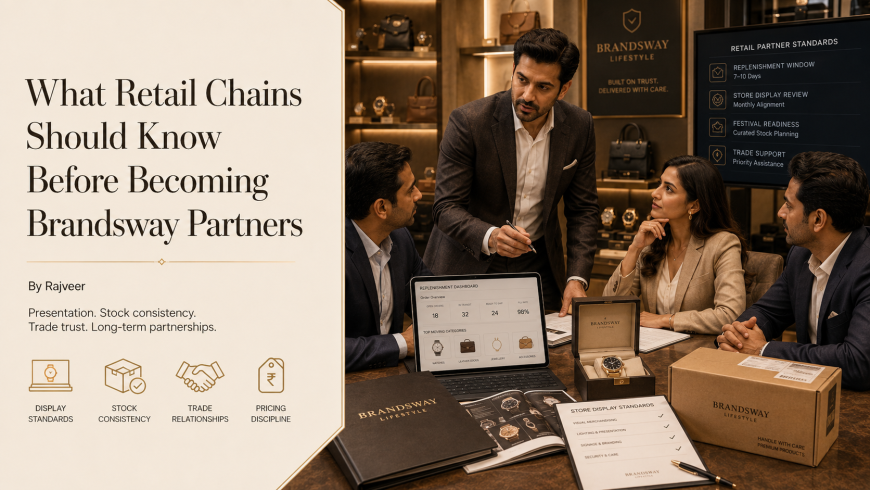
Most retail partnerships fail quietly, not loudly. Not in a dramatic dispute, but in a slow drift: a delivery that slips, a display that goes off-standard, a reorder that never gets answered on time. I lead trade relationships, so I have watched that drift start and learned to name it early. If you run a boutique or a high-end chain and are weighing whether to become one of our Brandsway partners, this is the honest version of what the relationship asks of you, and what it gives back.
I would rather you know the demands before you sign than discover them after the first festival season.
The first thing we check is not your footfall
Retailers expect us to open with sell-through targets. We do not. The first question is whether your floor can hold a luxury standard on an ordinary Tuesday, not just during a launch. A heritage watch shown on a scuffed tray under harsh light loses more value than a slow month ever costs. Presentation is the price of entry, and we are frank about it upfront.
We have declined accounts with excellent numbers because the setting would have cheapened the brand. That is not snobbery. A label placed badly teaches the market where it belongs, and undoing that lesson takes years. I would rather lose the account than spend the next three seasons repairing a brand's position.
Stock consistency is a promise, not a hope
The fastest way to lose a luxury customer is to have the piece they want visible online and absent from your counter. So we manage stock consistency as a shared obligation. We commit to replenishment windows we can actually meet, and in return we ask partners not to over-order for a vanity display they cannot sell through. Distributing luxury goods well is mostly the discipline of matching supply to genuine demand, city by city.
This is where our commercial operations team earns its keep. When I promise a chain a delivery date, it is because that date has already been confirmed against real inventory, not against optimism. I will not make a commitment the warehouse has not signed off on, and I would be wary of any distributor who does. A confident promise you cannot keep is worse than an honest maybe.
What high-touch trade management looks like on the ground
A trade relationship is not a portal and a price list. In luxury retail partnerships across India, our Brandsway partners deal with a named person who answers the phone and knows their store. My team keeps that contact human on purpose. When a piece is delayed, you hear it from us early, with a plan, rather than discovering it when a customer is standing at your counter.
Last wedding season, a Bengaluru partner had a client waiting on a specific reference. Rather than let them field an awkward silence, we rerouted the piece from another city and kept the store updated by name through the day. That is the standard. It is also expensive to maintain, and I will not pretend it scales without effort or that we manage it flawlessly every single time.
How we keep standards even across every boutique
The hardest problem in a growing network is drift between locations. A brand should feel identical in Mumbai and in Hyderabad, or the equity leaks at the weaker door. We manage this with shared presentation standards, training for floor staff, and regular checks that are less about policing and more about consistency. Working alongside the Brandsway directors on the strategy, my job is to make sure the plan survives contact with a real shop floor, so that partners in every city present the same brand.
We do not always get it right. A new partner's team takes time to absorb the standard, and there is a stretch early on where consistency wobbles. We would rather flag that honestly and work through it than pretend onboarding is instant. Anyone who promises you a fully aligned network from week one has not run a real one.
What we ask of you, plainly stated
Fairness means naming our side of the bargain too. We ask partners to protect agreed pricing rather than quietly discount to move stock, because one store cutting price undermines every other store carrying the same brand. We ask that display standards hold when no one from our team is watching. And we ask for honest sell-through data, because we cannot plan replenishment against numbers that are massaged to look better than the shelf. The Brandsway partners we keep longest are the ones who honour those three things without being chased.
In return, you get a supply line that does not surprise you at the worst moment. That is the quiet value most retailers underrate until they have been let down elsewhere.
Who this partnership suits, and who it does not
If your model runs on deep discounting and volume churn, we are a poor fit, and I will say so in the first meeting. Our terms protect brand pricing, which sometimes means slower turns and fuller margins rather than fast clearance. That trade-off is deliberate. It suits a retailer building a long-term luxury reputation, not one chasing this quarter's number.
The first ninety days, honestly described
Onboarding a new store is where good intentions meet reality. In the first weeks we train floor staff on presentation and product knowledge, align on replenishment windows, and set the single point of contact who will actually answer your calls. It is not instant. There is usually a stretch where a new partner's team is still learning why we insist on the small things, and consistency wobbles before it settles. We would rather walk that in-honestly with you than pretend a network snaps into alignment overnight.
My advice to a prospective partner is to judge us on month three, not week one. Anyone can look polished at a launch. The real test is whether the standard holds on an ordinary Tuesday in the second quarter.
What a good partnership looks like after a year
A year in, the relationship should feel unremarkable, which is the highest compliment in this trade. Stock arrives when promised, the display holds without supervision, and a delayed piece is flagged before your customer ever notices. If we are doing our job, you spend less time chasing supply and more time selling. That quiet reliability, tested through a full festival cycle and a slow season, is the standard I would ask any retail chain to hold us to before signing anything long term.
The partners who thrive with us treat a brand as something to be looked after, not merely stocked. For those retail chains, becoming one of our Brandsway partners means a supply relationship that stays reliable through festival peaks and quiet months alike. That reliability, more than any single brand name, is what I would ask you to judge us on before you commit.