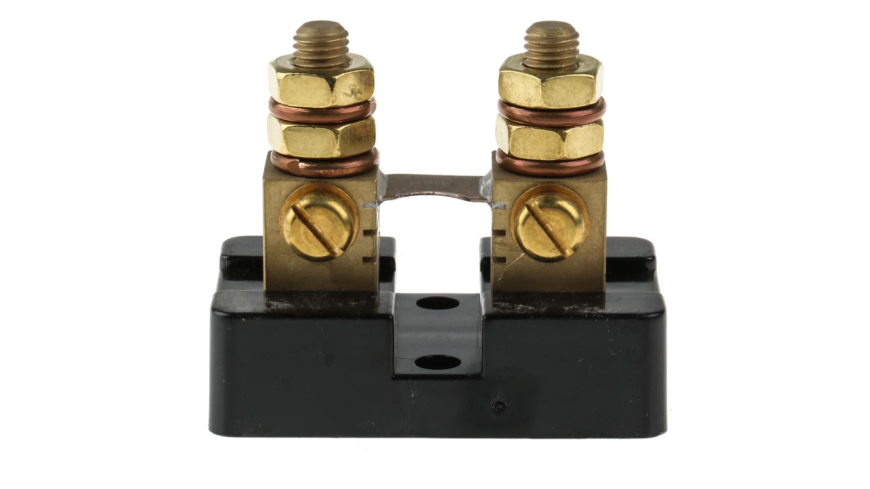
What Exactly Is a Shunt in Electrical Terms?
A shunt is a low-resistance electrical device installed in circuits to enable precise current measurement. It functions by allowing current to pass through a calibrated resistance, creating a voltage drop proportional to the current. This voltage is then measured and translated into a current reading by meters or monitoring instruments.
Rather than directly measuring the current in high-load circuits, a shunt enables indirect yet accurate monitoring while keeping instruments safe from excessive power levels.
How Does a Shunt Work Inside a Live Electrical Circuit?
In practical usage, the shunt is connected in series with the circuit carrying the current to be measured. As current flows through the shunt’s resistive element, a small voltage is generated across its terminals. The resistance value of the shunt is known and fixed, making it possible to calculate the current using the relationship between voltage, current, and resistance.
This non-intrusive method makes it ideal for both manual and automated current monitoring across a variety of voltage ranges.
What Are the Key Advantages of Using Shunts?
Shunts offer several operational and technical benefits that make them suitable for various environments and systems:
-
They provide high measurement accuracy with simple passive construction.
-
Their performance is reliable across a wide range of temperatures and currents.
-
They isolate sensitive measuring equipment from high voltages and large currents.
-
They are durable, cost-effective, and require little maintenance.
Thanks to their simplicity and dependability, shunts are widely trusted in control systems, battery banks, and load monitoring applications.
Where Are Shunts Commonly Found?
Shunts are present in many areas where current measurement is critical. In energy meters, they provide real-time monitoring of consumption. In automotive systems, they are used to track power delivery from batteries to motor controllers. In renewable energy setups, shunts are positioned between solar panels, charge controllers, and battery packs to monitor power flows accurately.
Data centers, electrical test labs, industrial automation lines, and aerospace systems also rely on shunts to keep systems operating efficiently and safely.
What Materials Are Used in Shunt Construction?
Materials used in shunt design are chosen for their stability and electrical characteristics. Common choices include alloys such as manganin and constantan. These materials are selected for their low temperature coefficients, meaning they maintain consistent resistance across varying temperatures.
This stability ensures the voltage drop remains proportional to the current, even under extreme operating conditions. The terminals are usually made of copper or plated metal to reduce contact resistance and improve connectivity.
How Are Shunts Physically Configured?
Shunts come in various physical forms based on application. For small electronic systems, compact PCB-mounted shunts are used. For high-current applications, shunts are typically made with thick metal bars and bolted terminals capable of handling thousands of amps.
Some configurations include temperature sensors or are mounted in enclosures for environmental protection. The design varies widely, but the core concept of precise resistance for current sensing remains consistent.
What Types of Shunts Are Available?
Different styles of shunts serve different requirements. Some of the most commonly used include:
-
Current sensing shunts for power monitoring in industrial and commercial setups
-
Battery shunts for state-of-charge tracking in energy storage systems
-
Digital-output shunts with integrated circuits for data communication
-
High-power shunts for electric vehicle drivetrains or renewable energy systems
The availability of such a wide range allows for customized solutions suited to voltage levels, current ranges, and environmental conditions.
How Do Shunts Fit Into Energy Management Systems?
Modern energy systems rely heavily on accurate real-time data. Shunts provide the foundation for this by offering continuous current measurement without requiring complex sensors. They feed data to smart controllers, which use the information for load balancing, power forecasting, fault detection, and energy optimization.
As energy efficiency becomes more critical across all sectors, shunts continue to be a core part of intelligent monitoring and control networks.
What Are the Challenges in Using Shunts?
Despite their benefits, shunts must be chosen and installed correctly to avoid measurement inaccuracies. Poor terminal connections, overheating, or selecting a device with an unsuitable resistance value can all affect performance. Engineers must also consider thermal management since continuous current flow can generate heat in the shunt element.
When used correctly, however, shunts require minimal upkeep and perform consistently over long periods.
Conclusion
Shunts are simple yet powerful tools for current measurement and control in electrical circuits. Their ability to deliver reliable data with minimal intrusion makes them a core component in applications ranging from household energy meters to industrial automation systems. Whether monitoring solar panels, electric vehicles, or battery banks, shunts play a vital role in helping modern electrical systems operate efficiently, safely, and intelligently.

 joddie25