Understanding the Technology Behind Santa Rosa Gum Disease Laser Therapy
Learn how gum disease laser therapy works, why wavelength matters, and how laser treatment compares with conventional periodontal care.
 Buzza Dental Group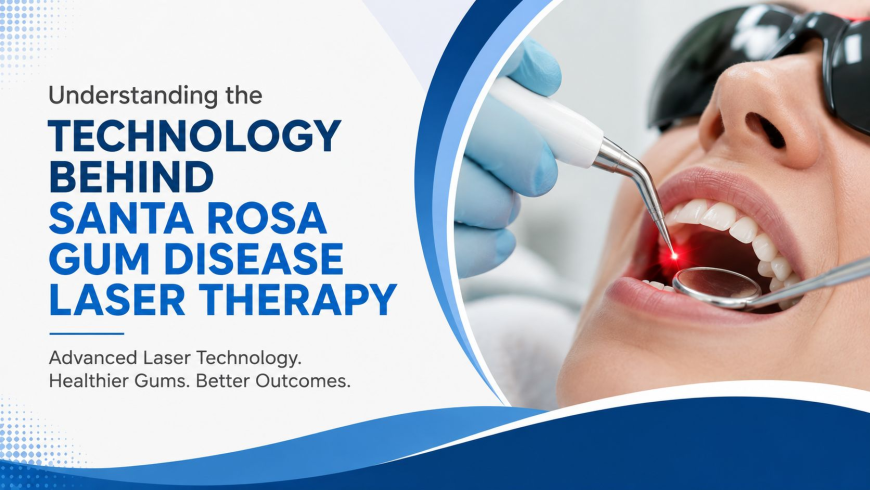
Gum disease is not simply a problem of bleeding gums. Periodontitis can damage the tissues and bone supporting teeth, and the disease can progress before noticeable symptoms appear. The technology used in Santa Rosa gum disease laser therapy is designed to help clinicians target diseased tissue and bacteria within periodontal pockets while treating the affected area with controlled light energy.
The important distinction is that “laser therapy” is not one standardized procedure. Dental lasers differ in wavelength, power, pulse characteristics, and intended clinical use. Understanding those differences helps patients evaluate what laser treatment actually does and where it fits alongside established periodontal treatments.
What Is Gum Disease Laser Therapy?
Gum disease laser therapy uses concentrated light energy to interact with targeted tissue during periodontal treatment. Depending on the laser and protocol, the technology may be used to address diseased soft tissue, bacteria, or inflammation around teeth.
Periodontal disease develops when plaque and bacteria accumulate around teeth and, when untreated, extend beneath the gumline. Periodontal pockets can develop as the supporting tissues become inflamed and damaged. In periodontitis, bone supporting the teeth can also be lost.
Traditional periodontal treatment can include scaling and root planing, commonly called deep cleaning. The American Academy of Periodontology notes that lasers can also be used in periodontal treatment, but outcomes depend on the specific laser, wavelength, power level, and clinical application.
That distinction matters: a dental laser is a technology, not a diagnosis or a universal replacement for periodontal care.
How Does Laser Technology Work?
A dental laser works by delivering energy at a particular wavelength. Different tissues absorb different wavelengths differently, allowing clinicians to select equipment and settings according to the intended procedure.
For periodontal applications, the objective may include reaching areas below the gumline and interacting with inflamed or diseased tissue. Some protocols use laser energy as part of a broader treatment sequence that also includes mechanical removal of deposits from tooth surfaces.
This is why the phrase “laser treatment” alone does not tell a patient enough about the procedure.
Before treatment, a clinician should establish:
-
The type and severity of gum disease
-
Periodontal pocket measurements
-
Whether bone loss is present
-
The condition of individual teeth
-
Existing restorations or implants
-
Relevant medical and medication history
-
Whether nonsurgical treatment has already been attempted
NIDCR notes that periodontal diagnosis can involve gum examinations, pocket measurements, medical-history assessment, and X-rays when appropriate.
Why Wavelength Matters in Dental Lasers
One of the most overlooked aspects of laser dentistry is wavelength.
Laser energy is absorbed differently depending on the tissue and the wavelength being delivered. That interaction influences how the energy affects water, pigments, blood components, or other biological structures.
Consequently, two dental lasers should not automatically be considered interchangeable simply because both are marketed for periodontal applications.
The American Academy of Periodontology specifically cautions that different lasers use different wavelengths and power levels and that inappropriate settings can damage periodontal tissues.
This makes operator training, treatment protocol, and appropriate device selection just as important as the presence of the laser itself.
Is Laser Therapy Better Than Traditional Gum Disease Treatment?
There is no universal answer.
The American Academy of Periodontology's evidence review found that laser treatment can produce periodontal outcomes comparable to certain nonsurgical treatment approaches in controlled studies, while emphasizing that evidence varies according to the specific laser and application.
Scaling and root planing remains an established periodontal treatment. It mechanically removes plaque, calculus, and bacterial deposits from tooth and root surfaces. Depending on disease severity and response, additional periodontal therapy may be necessary.
Therefore, patients should be cautious about claims that laser therapy automatically means:
-
No conventional periodontal treatment is necessary
-
Every case can be treated with a laser
-
Surgery will never be required
-
The treatment guarantees regeneration
-
One particular laser is appropriate for every patient
The correct treatment depends on the diagnosis and the technology being used.
What Makes Modern Laser Treatment Different?
The most significant technological advantage is precision.
A dental laser can deliver energy to a defined area rather than applying the same mechanical action across an entire region. Depending on the device and protocol, this can make laser energy useful for selectively interacting with soft tissue or bacterial environments.
Some periodontal protocols combine laser energy with mechanical instrumentation rather than treating the laser as a standalone solution. For example, the LANAP protocol uses a specific pulsed Nd:YAG laser alongside periodontal instrumentation. The manufacturer describes a sequence involving laser treatment, ultrasonic scaling, hand instrumentation, and additional laser application.
That example illustrates an important principle: the clinical protocol matters as much as the word “laser.”
Patients should ask what device is being used, what procedure is being performed, and how the laser fits into the overall periodontal treatment plan.
What Should Patients Ask Before Choosing Laser Therapy?
A technology-focused consultation should involve more than asking whether a dental office offers lasers.
Useful questions include:
-
What type and stage of periodontal disease do I have?
-
Which laser wavelength and device will be used?
-
Is the laser being used alone or with scaling and root planing?
-
What evidence supports this specific treatment protocol?
-
What measurements will determine whether treatment worked?
-
Will periodontal maintenance be required afterward?
-
Would referral to a periodontist be appropriate?
These questions help separate evidence-based treatment planning from technology-driven marketing.
This is particularly relevant for people with dental implants. Gum inflammation around an implant is not necessarily the same condition as periodontitis around a natural tooth. Some laser protocols have been studied for peri-implant disease, but the treatment decision should be based on the implant's clinical condition and supporting bone.
Similarly, patients searching for a general dentist Santa Rosa CA, dental implants Santa Rosa CA, or sedation dentist Santa Rosa CA may encounter different technologies and treatment approaches. The appropriate choice should follow the diagnosis rather than the technology's marketing appeal.
How Technology Is Applied?
For readers researching treatment options in Sonoma County, a local explanation of gum disease laser therapy in Santa Rosa describes laser treatment as an approach intended to disinfect periodontal areas and remove diseased tissue, while noting that treatment varies according to the patient's individual condition.
The same practice also describes its broader use of dental laser technology for periodontal and other soft-tissue procedures, illustrating how lasers can serve multiple clinical purposes rather than representing one single treatment category.
That local resource is useful for understanding what a Santa Rosa dental practice says patients can expect, but treatment suitability still requires an individual periodontal examination.
The Bottom Line
The technology behind Santa Rosa gum disease laser therapy is based on controlled light energy interacting with specific oral tissues. Its effectiveness cannot be judged simply by whether a practice owns a laser.
The more meaningful questions are which laser is being used, what protocol is being followed, what the diagnosis is, how the treatment compares with established alternatives, and how periodontal health will be monitored afterward.
For patients, technology should support clinical judgment—not replace it. Periodontal diagnosis, appropriate treatment selection, professional maintenance, and daily plaque control remain central to managing gum disease.
FAQs
Does laser therapy replace deep cleaning?
Not necessarily. Scaling and root planing remains an established periodontal treatment, while lasers may be used alone in selected applications or as an adjunct to other periodontal procedures. The appropriate approach depends on disease severity, clinical findings, and the specific laser protocol.
Are all dental lasers the same?
No. Dental lasers differ in wavelength, energy delivery, power, and intended applications. These characteristics affect how laser energy interacts with oral tissues. A clinician should select the device and settings based on the procedure rather than treating all dental lasers as interchangeable.
Can laser therapy treat advanced periodontitis?
Laser therapy may be considered in selected periodontal cases, but advanced disease requires careful diagnosis and treatment planning. Periodontitis involving significant tissue or bone destruction may require multiple treatment approaches or referral to a periodontist.
Is gum disease laser therapy painful?
Patient experience varies according to the procedure, disease severity, treatment site, and technique. A laser procedure should not automatically be assumed to be painless or appropriate for everyone. Discuss anesthesia, expected discomfort, recovery, and alternatives with the treating dental professional.
Can laser treatment prevent future gum disease?
Laser treatment does not eliminate the need for ongoing periodontal care. Daily plaque control, professional dental care, and periodontal maintenance remain important because periodontitis is a chronic condition that can be managed but not simply erased by one procedure.