STEM Education in UAE Schools: What the 2031 Vision Means for Your Child
Discover how STEM education in UAE schools supports future-ready skills, innovation, AI learning, robotics, coding, and technology development aligned with the country's changing education and economic priorities.
 mhintellect
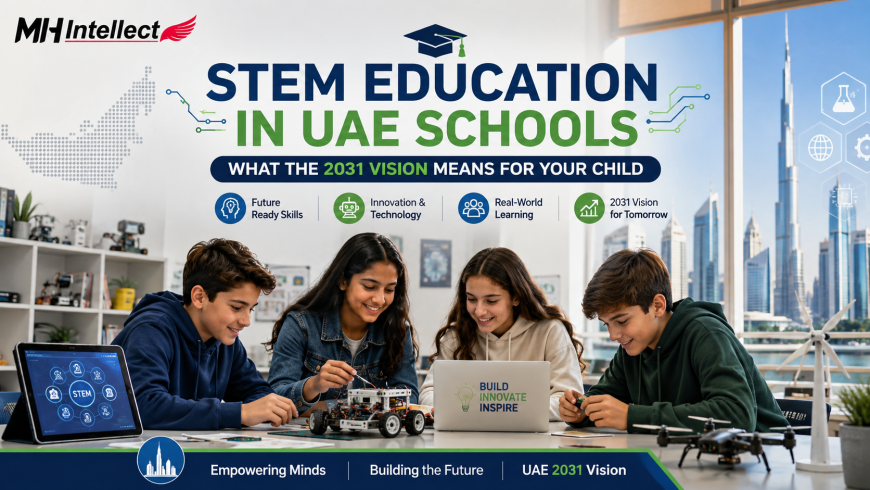
The UAE is placing increasing emphasis on innovation, technology, knowledge-based growth, and future-ready skills. For schools and families, this means education is increasingly expected to prepare students for a world shaped by artificial intelligence, automation, engineering, and emerging technologies. The UAE Vision 2031 provides an important context for understanding why STEM learning is becoming more relevant to students' long-term development.
Why STEM Matters for UAE Students
STEM education integrates Science, Technology, Engineering, and Mathematics through practical, problem-based learning. Instead of focusing only on memorising concepts, students get opportunities to:
-
Build and test ideas through hands-on activities
-
Develop coding and technology skills
-
Solve practical engineering challenges
-
Work collaboratively on projects
-
Strengthen critical and analytical thinking
-
Understand how technology is applied in real life
These experiences can help students become more confident learners while developing skills that can remain valuable as technology and career requirements continue to evolve.
Connecting Education With the UAE's Future
The country's focus on innovation and economic development creates a strong reason for schools to strengthen practical technology education. The UAE innovation strategy reflects a broader emphasis on innovation, technology, and knowledge-driven development.
For parents, the impact is straightforward: students need opportunities to understand and work with emerging technologies rather than simply consume them. Coding, robotics, AI, engineering, IoT, and other STEM activities can give learners practical exposure while they are still developing their academic foundations.
What UAE Schools Are Building
Modern STEM programmes can take many forms depending on the school's objectives, students' ages, and the available learning environment. A primary classroom may introduce simple engineering and coding challenges, while older students can work with robotics, AI, drones, automation, and advanced technology projects.
Schools in Dubai and other Emirates are increasingly exploring structured practical learning as part of their broader education strategies. Our guide to STEM Education in Dubai explores how schools can use STEM learning to develop future-ready capabilities.
STEM, AI and the Future of Learning
Artificial intelligence is also changing how schools think about STEM. AI can automate certain routine technical tasks, but students still need to understand how systems work, evaluate information, solve unfamiliar problems, and apply technology responsibly.
This is why the relationship between STEM and broader learning models is becoming increasingly important. Why AI Is Changing the STEM vs STEAM Debate in the UAE explores how AI is influencing the way schools approach technical and applied learning.
What This Means for Parents
For parents, the key question should not simply be whether a school offers a STEM programme. It is worth asking what students actually do during those programmes.
A meaningful STEM experience should give students opportunities to:
-
Create rather than simply observe
-
Experiment and learn from mistakes
-
Apply mathematics and science to practical challenges
-
Develop coding and engineering confidence
-
Work collaboratively
-
Explain how their solutions work
The UAE national strategy and broader focus on UAE economic diversification make these capabilities increasingly relevant as students prepare for future education and careers.
How MH Intellect Supports Future-Ready Schools
MH Intellect helps schools develop practical STEM learning experiences through robotics, AI, coding, IoT, drones, aviation, engineering, STEM labs, teacher training, and project-based programmes. The focus is on connecting technology with meaningful learning outcomes so students can build, test, solve problems, and develop confidence through practical experience.
For schools looking to strengthen their technology and innovation programmes, this approach can provide a structured pathway from foundational STEM activities to more advanced emerging-technology projects.
Preparing Students for Tomorrow
STEM education is not simply about preparing students for one particular career. It helps develop adaptable capabilities that can support learners as industries continue to change. For UAE schools, combining academic foundations with practical technology experiences can help students become confident problem-solvers, creators, and responsible users of emerging technologies.
Ready to Build a Future-Ready STEM Programme?
If your school wants to prepare students for an increasingly innovative and technology-driven future, the right STEM strategy can make a meaningful difference. Book a consultation with MH Intellect to explore customised STEM, AI, robotics, coding, drone, engineering, and innovation programmes designed around your school's goals.