Sourcing Organic Maitake Mushroom Powder: What B2B Buyers Should Evaluate
Sourcing Organic Maitake Mushroom Powder requires more than comparing price per kilogram. B2B buyers should evaluate organic certification, mushroom source, processing methods, quality specifications, batch consistency, formulation performance, documentation, and bulk supply capacity. This guide explains the key sourcing considerations for procurement managers, formulators, R&D professionals, and sourcing teams looking to build a reliable supply of Bulk Maitake Mushroom Powder for supplements, functional foods, beverages, and wellness formulations.
 greenjeeva
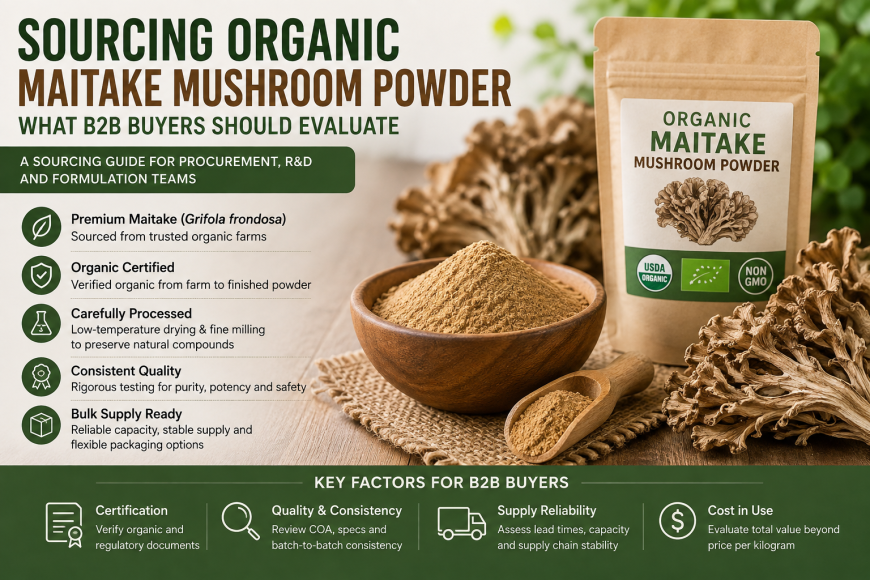
As demand for mushroom-based functional ingredients grows across dietary supplements, functional foods, and wellness products, procurement teams are looking beyond simple price comparisons. For manufacturers sourcing Organic Maitake mushroom Powder, the key challenge is finding a supplier that can provide consistent quality, reliable documentation, suitable formulation performance, and dependable bulk supply.
For procurement managers, formulators, R&D professionals, and sourcing teams, a structured sourcing approach can help evaluate Bulk Maitake mushroom Powder more effectively and reduce avoidable supply-chain risks.
Start With the Intended Application
Before requesting supplier quotations, manufacturers should define how Organic Maitake mushroom Powder will be used.
A capsule, tablet, powder blend, beverage, or functional food can have different requirements. R&D teams may need to establish specifications for moisture, particle size, appearance, solubility, microbial limits, and other characteristics relevant to the finished product.
Application requirements should guide the purchasing specification. This allows procurement teams to compare suppliers against the same technical criteria instead of selecting a product simply because it has a lower price.
Verify the Mushroom Source
Maitake, commonly known as Grifola frondosa, is a mushroom used in various food and supplement applications. For commercial sourcing, buyers should understand the source and identity of the material being offered.
Procurement teams can request information about:
- Botanical or scientific identity
- Mushroom part used
- Growing or cultivation method
- Country of origin
- Organic certification
- Processing location
- Batch traceability
Source transparency is particularly important when purchasing organic ingredients because documentation should support the organic status of the material through the relevant supply chain.
Evaluate Powder Specifications
A supplier's product description provides only an initial overview. Quality teams should review the complete technical specification before commercial approval.
For Organic Maitake mushroom Powder, buyers may evaluate moisture, ash, particle size, appearance, odor, microbiological parameters, heavy metals, pesticide residues, and other agreed quality requirements.
Physical properties can also influence production. Powder flowability, bulk density, particle distribution, and moisture behavior may affect blending, encapsulation, filling, and packaging.
The most appropriate specification will depend on the intended application.
Understand Whether It Is Powder or Extract
One important purchasing consideration is the distinction between whole mushroom powder and mushroom extract.
Whole Maitake mushroom powder is generally produced by drying and milling the mushroom material. An extract undergoes additional processing and may have different concentration or marker specifications.
Procurement teams should ensure that quotations are technically comparable. A whole mushroom powder and a concentrated extract should not be evaluated solely on price per kilogram because their composition and intended inclusion rates can differ substantially.
Clear product descriptions and specifications help prevent confusion during supplier comparisons.
Request Samples for Formulation Testing
A sample should be evaluated by R&D under realistic formulation conditions.
For a powder blend, the team may examine mixing behavior, flow, particle distribution, taste, aroma, and color. For beverage applications, solubility and dispersion may become more important.
R&D teams can also evaluate compatibility with other ingredients and determine whether the material creates processing challenges.
This application-based testing provides procurement teams with practical information that cannot always be obtained from a specification sheet.
Review Organic and Quality Documentation
Documentation is an essential part of ingredient qualification.
Depending on the target market and product type, buyers may request:
- Organic certification
- Certificate of Analysis
- Product specification
- Microbiological testing
- Heavy-metal analysis
- Pesticide-residue information
- Allergen statement
- Non-GMO documentation
- Country-of-origin information
- Lot traceability records
The COA should correspond to the specific production lot supplied. Quality teams should also confirm that certification and supporting documents remain current.
Assess Bulk Supply Capability
When purchasing Bulk Maitake mushroom Powder, procurement teams should evaluate whether the supplier can support commercial volumes consistently.
Important commercial questions include:
- What is the minimum order quantity?
- What are standard lead times?
- How much production capacity is available?
- Is inventory maintained?
- What packaging formats are offered?
- What storage conditions are recommended?
- Can the supplier support increased future demand?
A supplier capable of fulfilling a sample order may not necessarily have the capacity to support regular bulk purchasing.
Evaluate Cost in Use
Price per kilogram should be considered alongside formulation requirements.
Procurement teams should compare inclusion rates, freight, packaging, storage, handling, testing requirements, and potential production losses.
For example, a supplier with a higher unit price may offer better overall value if its batches are more consistent and its delivery performance is more reliable.
Cost-in-use provides a more practical basis for comparing suppliers than purchase price alone.
Monitor Supplier Performance After Approval
Supplier qualification should continue after the first commercial order.
Procurement teams can monitor delivery accuracy, lead times, pricing stability, communication, and responsiveness. Quality teams can track batch compliance and documentation, while R&D can record formulation performance.
This creates a supplier-performance history based on actual commercial experience.
If recurring issues appear, manufacturers can address them through corrective actions or evaluate secondary sourcing options.
Conclusion
Sourcing Organic Maitake mushroom Powder requires manufacturers to consider more than organic status and price. Ingredient identity, processing, specifications, formulation performance, documentation, batch consistency, and bulk supply capability all contribute to the overall value of a supplier.
By defining requirements before supplier comparison, testing samples in real formulations, reviewing multiple production lots, verifying organic documentation, and evaluating cost in use, procurement teams can make more informed decisions.
For manufacturers purchasing Bulk Maitake mushroom Powder, a cross-functional approach involving procurement, quality, R&D, and supply-chain teams can create a stronger foundation for consistent production and long-term ingredient supply.