Smart Agriculture: Aggregating Soil and Weather RS485 Sensor Data via Ethernet Gateways
Smart Agriculture RS485 Sensors connect through Ethernet gateways to aggregate soil and weather data for efficient farm monitoring.
 JamesHunt
Smart agriculture fundamentally changes how modern farms manage their natural resources. Precision farming relies heavily on exact environmental metrics. Field operations require immediate data from the ground to prevent crop failure.
According to global market statistics, the smart agriculture market value reached $26.27 billion in 2025. Experts project this market to reach $29.48 billion in 2026. This fast growth highlights the massive deployment of field sensors across agricultural lands.
Large-scale farms contain multiple microclimates. Soil conditions alter drastically within a single square mile. Weather variations affect irrigation needs daily. Farmers must track these parameters continuously.
To manage this complex data collection, modern operations rely on an RS485 to Ethernet Converter to transmit field metrics safely over local area networks. Using an RS485 to Lan Converter allows agricultural managers to view real-time soil moisture and weather trends right from their central office computer.
This technical analysis covers the deployment of specialized hardware. It details the collection of sensor data over long field distances. It focuses on using industrial data networks to connect fields directly to management offices.
Technical Features of RS485 Field Sensors
Industrial agricultural sensors utilize the RS485 serial communication standard. This physical layer standard handles harsh electrical environments efficiently. It works perfectly over long wire runs across large fields.
Farms use two primary categories of serial devices:
-
Multi-Parameter Soil Probes: These devices insert directly into the ground. They measure soil volumetric water content, temperature, and electrical conductivity. Higher-end models monitor pH levels alongside nitrogen, phosphorus, and potassium.
-
Integrated Weather Stations: These units sit above the plant canopy. They track wind speed, wind direction, ambient temperature, relative humidity, and rainfall rates.
The RS485 standard uses differential signaling. This design uses two wires, labeled A and B, to transmit data. The receiver analyzes the voltage difference between these two lines.
External noise affects both wires equally. The differential receiver cancels out this common-mode noise completely. This makes the system ideal for farms with large electrical pumps.
Furthermore, RS485 supports multi-drop networks. A single master device can communicate with up to 32 slave sensors on one cable. This cable run can reach up to 1200 meters without signal degradation.
Field hardware operates on the Modbus RTU protocol. This protocol structures data into simple binary frames. Each sensor possesses a unique slave identification address.
The master device requests specific register addresses from the slave. The slave sensor then transmits its payload containing the raw physical measurements.
The Role of Gateway Converters
Field data must travel to local servers or cloud applications. Standard computer networks use Ethernet architecture. However, RS485 to Ethernet Converter serial signals cannot plug directly into standard network switches.
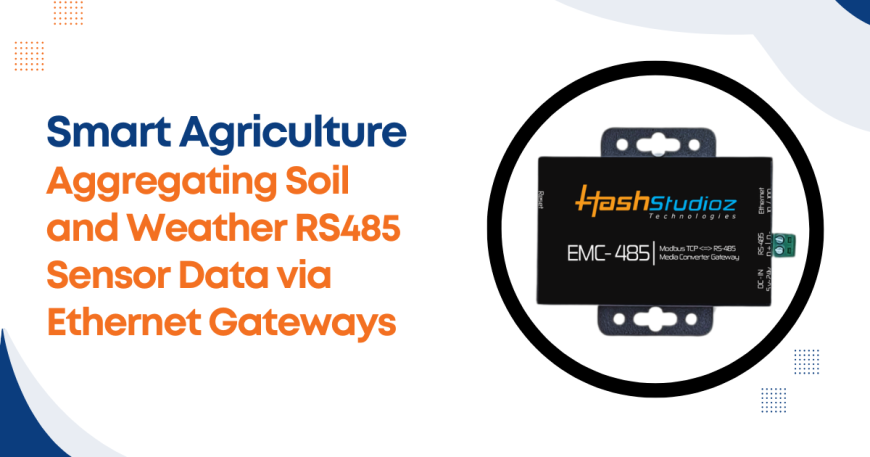
The specialized conversion gateway bridges this technical gap. This device contains an RS485 serial port on one side. It features an RJ45 Ethernet port on the other side.
The converter acts as a transparent data bridge. It receives serial Modbus RTU packets from field sensors. It packs these serial bytes directly into standard TCP/IP network frames.
This process changes the protocol layer from Modbus RTU to Modbus TCP. This component integrates serial sensor networks directly into local area farm infrastructure.
These converters utilize robust internal microcontrollers. They feature dedicated hardware components for transient voltage protection. This prevents lightning strikes in the field from destroying the main farm network switches.
Designing the Field Hardware Architecture
Building a reliable field network demands systematic planning. Farmers must lay out physical cables across open fields. They must place sensors in strategic agronomic zones.
1. Serial Bus Layout
The serial cable must follow a daisy-chain topology. The cable travels sequentially from one sensor to the next. Installers must avoid star topologies or long stubs. Stubs cause signal reflections that corrupt data frames. Use shielded twisted-pair cabling for all ground runs. Connect the cable shield to a single ground point at the gateway. This step drains away induced static charges safely.
2. Power Allocation
RS485 sensors generally require a DC voltage source between 5V and 30V. Long cable lines cause electrical resistance. This resistance creates a noticeable voltage drop over hundreds of meters. System designers must calculate the total current draw. They must ensure the final sensor receives adequate voltage. Centralized 24V DC power supplies work best for long field chains.
3. Termination Resistors
Long data lines suffer from signal echoing. Engineers must place a 120-ohm resistor across lines A and B. This resistor sits at the absolute furthest end of the cable run. The resistor matches the characteristic impedance of the cable. This termination absorbs the signal energy. It prevents reflections from interfering with subsequent data communications.
Configuring the Network Software
The conversion hardware requires specific software parameters to function correctly. The operator configures these variables via an integrated web management interface.
1. Serial Port Parameters
The converter serial settings must match the sensor settings exactly. Standard agricultural configurations use a 9600 baud rate. They use 8 data bits, 1 stop bit, and no parity checking. This configuration is known textually as 9600-8-N-1.
2. Operating Modes
The converter usually operates in one of three distinct software modes:
-
TCP Server Mode: The gateway listens for incoming connection requests from the farm server. It accepts the connection and delivers the sensor data.
-
TCP Client Mode: The converter actively initiates a connection to a specific cloud server IP address. It uploads data at set intervals.
-
UDP Mode: The device broadcasts data packets across the network without establishing a permanent connection. This mode reduces protocol overhead.
3. Modbus Gateway Functionality
Advanced models include an integrated Modbus gateway feature. The converter actively parses the incoming Modbus TCP frame. It extracts the Modbus slave ID and register request. It translates this frame into a Modbus RTU serial packet. The converter sends it down the RS485 line. It waits for the serial reply. Then, it converts the response back into Modbus TCP.
Case Study: Implementing a 500-Acre Vineyard System
A large commercial vineyard in California needed to optimize its automated irrigation schedule. The property consists of variable sandy-clay soil across rolling hills.
1. System Requirements
The vineyard management team established clear operational goals:
-
Track soil moisture at three distinct crop depths.
-
Monitor wind speeds to prevent spray drift during pesticide application.
-
Collect field data at 15-minute intervals.
-
Transmit all data to an on-site office located 800 meters away.
2. Hardware Checklist
The engineering team deployed specific industrial hardware across the zones:
|
Component Type |
Device Description |
Quantity Deployed |
|
Field Sensor |
4-in-1 Soil Moisture & EC Sensor |
12 Units |
|
Weather Station |
Integrated RS485 Anemometer & Rain Gauge |
2 Units |
|
Network Bridge |
Industrial Serial-to-Ethernet Gateway |
2 Units |
|
Infrastructure |
Shielded Twisted-Pair Cable (AWG 22) |
1500 Meters |
3. Execution Phase
Technicians installed the soil probes across four distinct management zones. They linked the sensors using a daisy-chain cable structure. The maximum physical run reached 750 meters from the equipment shed. The team placed a converter inside a weatherproof enclosure at the shed. They routed the serial cable into the converter serial port. They connected the RJ45 port to an outdoor wireless bridge. This bridge linked back to the main office switch.
4. Results and Performance Data
The automated network eliminated manual field readings completely. The farm saved significant labor hours every week. Data analytics platforms utilized the real-time sensor information instantly. Automated irrigation valves responded to exact moisture thresholds.
The operation achieved measurable improvements during the first season:
-
Water consumption decreased by 18% overall.
-
Pesticide application efficiency increased by 12% due to precise wind data.
-
Crop yield uniformity improved across the variable soil zones by 7%.
Troubleshooting Common Communication Failures
Industrial field networks face harsh environments. Physical damage and electrical faults will occur over time. Technicians must follow a logical diagnostic process.
1. Investigating Serial Timeouts
If the farm server receives no data, check the physical layer first. Measure the DC voltage at the furthest sensor. Ensure the voltage stays within the operational specification of the device. Next, verify the communication line resistance. Disconnect the power and measure the resistance across lines A and B. A functional, terminated bus must register approximately 60 ohms. A reading of 120 ohms indicates a missing termination resistor or a broken wire.
2. Resolving Data Corruption
Corrupted data fields manifest as cyclic redundancy check (CRC) errors. These errors stem from electrical interference or improper grounding. Ensure the sensor cable shield connects to earth ground at only one side. Check for high-voltage AC pump cables running parallel to the data lines. Data lines must cross power cables at 90-degree angles to minimize induction.
3. Correcting IP Network Issues
If the serial bus works but the network fails, check the gateway status lights. The Link light must glow solid green. The Data light must blink during transmission attempts.
Ping the static IP address of the converter from the central server. If the ping fails, check for subnet mismatches. Ensure the gateway IP address matches the local router configuration exactly.
Long-Term Maintenance and System Expansion
Agricultural operations expand over time. New fields require additional instrumentation to maintain productivity levels. A major benefit of this network topology is its simple scalability.
1. Adding New Sensors to Existing Chains
To expand an existing daisy-chain, operators must follow strict addressing rules. Each new device requires a completely unique Modbus slave ID. If two sensors share an address, they will speak simultaneously. This creates immediate collision issues on the wire.
When introducing a new sensor node:
-
Connect the device at the end of the existing chain.
-
Move the 120-ohm termination resistor to the new final node.
-
Update the master polling software to include the new slave ID registers.
2. Environmental Wear Factors
Outdoor cables face extreme temperature shifts, moisture exposure, and wildlife interference. Rodents frequently chew through buried non-armored cables. To safeguard the investment, utilize UV-resistant, direct-burial conduit for all outdoor lines. Inspect field junction boxes every spring. Check for moisture ingress or insect nesting inside the enclosures. Clean the weather station sensors twice per year. Dust buildup on anemometer cups reduces accuracy over time.
3. Firmwire Security Updates
The gateway units link directly to local networks. Therefore, they require periodic security checks. Manufacturers release updated device firmware to address network vulnerabilities.
Isolate the sensor network from the main corporate internet line. Use a dedicated virtual local area network (VLAN) for all agricultural automation hardware. This step isolates critical farm operations from general office computer traffic.
Conclusion
Aggregating soil and weather metrics via wired converters provides a highly stable foundation for modern agriculture. The combination of durable RS485 field buses and reliable Ethernet bridges ensures continuous data flow across farming operations. By using an RS485 to Ethernet Converter, farms can seamlessly integrate field sensors with centralized monitoring and control systems. This hardware design resists environmental interference over long distances while enabling real-time data transmission and remote access.
Agricultural operations can significantly reduce resource waste by adopting these proven industrial communication solutions. They maximize crop yields, optimize irrigation efficiency, and support environmentally responsible farming practices. As precision agriculture continues to evolve, RS485 to Ethernet Converter and RS485 to LAN Converter technologies remain essential components of sustainable and data-driven food production.