Real Leather Jacket vs. Faux: Five Tests You Can Do in the Store Before You Buy
Labels like 'genuine leather' don't tell you what you're actually buying. These five in-store tests — smell, water, grain, edge, and bend — reveal the truth before you commit.
 mananiyerr
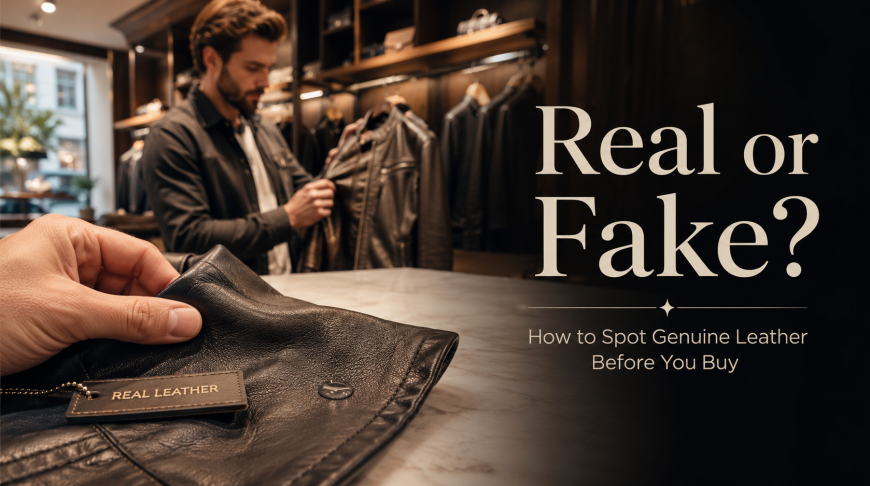
The labeling on a real leather jacket tells you almost nothing useful. 'Genuine leather' is a legal term that covers every grade from bonded reconstituted fiber all the way down — it does not mean quality leather, and it does not exclude PU-coated synthetic materials that aren't leather at all. 'Top-grain' sounds like the best tier but is actually the second tier. 'Full-grain' is the quality descriptor you want, but it's also the one most frequently omitted or misused in product listings.
The problem is compounded by the fact that high-quality PU leather has become genuinely difficult to distinguish from real leather by sight. In photographs, some faux options fool even experienced buyers. In person, the gap is still detectable — but only if you're testing for multiple signals simultaneously. Any single test can be defeated by a well-made synthetic. Five tests, used together, are much harder to fool.
Test One: The Smell Test
Real leather has a distinctive organic smell — tannery-specific, sometimes earthy, sometimes slightly sweet, always complex. The smell varies by tannery process: vegetable-tanned leather smells different from chrome-tanned leather, and both smell different from suede. What they share is that the smell comes from the material itself, not from a coating.
Faux leather smells like plastic. Sometimes it's obvious — a sharp chemical smell that dissipates as soon as you step back. More often it's subtle and masked by additional scents applied during manufacturing to approximate leather smell. Hold the jacket close to your face and breathe in at the interior, away from any lining. The interior is less likely to have been treated with fragrance. A plastic note — even faint — is the tell.
The limitation of the smell test alone: some genuine leather is so heavily processed with coatings and finishing chemicals that the organic smell is significantly masked. The smell test is a good opening filter, but it shouldn't be the last word.
Test Two: Water Absorption
Real leather absorbs water; synthetic materials repel it. Place a small drop of water — from a fingertip is enough — on an inconspicuous part of the jacket, like the underside of a collar or the inside hem. Watch for 30 seconds.
On genuine leather, the water drop will darken the surface slightly and begin to absorb within 10–20 seconds. On full-grain leather with no surface coating, absorption is rapid and visible. On heavily finished leather, absorption is slower but still happens. On faux leather, the drop will bead, sit, and roll off. The behavior is consistent and reliable.
One important nuance: some genuine leathers have been treated with water-repellent finishes, which can cause a real leather jacket to bead water initially. In these cases, wipe the drop away, wait a few seconds, and look for the slight darkening where the water sat. If no darkening occurred, that's a meaningful data point, though not conclusive on its own.
Test Three: Grain Variation
Real leather comes from an animal. Animal hides have natural variation — subtle differences in grain pattern across the surface, slight variations in thickness, and occasionally visible marks from insect bites, scratches, or growth patterns. Full-grain leather shows this variation clearly. Look for it.
Faux leather — and corrected-grain leather — is embossed with an artificial grain pattern that's mechanically consistent. The grain repeat is exact: the same pattern, the same scale, the same depth, repeating across the surface like a tile. Hold the jacket at an angle to a light source and look along the surface. On real leather, the light catches differently across different sections. On faux leather, the light catches with uniform regularity.
This test is particularly useful for suede-finish and pebbled-grain jackets, where the surface texture can mask other tells. Under angled light, the mechanical consistency of a faux pebble grain becomes visible in a way that flat overhead light doesn't reveal.
Test Four: Edge Texture
Look at the cut edges of the leather — anywhere a seam or panel meets an external edge without being folded over or stitched closed. On genuine leather, cut edges reveal the fibrous structure of the hide: a slightly rough, almost woolly texture with visible cross-section fibers. This is the leather's internal structure exposed.
On faux leather, cut edges are clean and plasticky. Sometimes they show a distinct layering — a thin surface layer bonded to a fabric or foam backing — which is the dead giveaway for bonded and PU constructions. Even high-quality synthetic leathers show a non-fibrous edge under close inspection.
Look for edges at pocket openings, zipper backing flaps, or collar inner edges. Quality leather jacket construction often folds and stitches edges to present a clean finish — but there's almost always an exposed edge somewhere on the jacket if you look for it.
Test Five: Bend and Crease Behavior
Fold a section of the jacket firmly and hold it for five seconds, then release. Real leather, particularly full-grain, will crease with a pattern of fine wrinkles that partially relax when the fold is released — the leather remembers but doesn't hold the crease rigidly. The behavior looks organic. It's the same reason broken-in leather jackets develop their characteristic folds along the elbow and at the zipper pull area.
Faux leather creases differently. PU and vinyl materials tend to hold a sharp, mechanical crease or spring back too uniformly — either developing a crease that looks like it was put there with an iron, or returning to perfectly flat without the slight residual wrinkle real leather shows. Bonded leather does something worse: it cracks along the crease under even moderate fold pressure, with the surface coating separating from the backing. If you see surface cracking during the bend test in the store, walk away.
Buying Online: What Questions to Ask
None of these tests work on a screen, which is the honest limitation of online leather jacket shopping. The substitutes are: specific material questions directed to the seller ("Is this full-grain, top-grain, or corrected-grain leather, and what tannery does it come from?"), a return policy that gives you enough time to perform these tests at home, and the seller's willingness to answer.
A seller who can answer "full-grain, vegetable-tanned, from [named tannery]" without hesitation is selling something real. A seller who responds with "genuine leather" or "premium real leather" without specifying the grade is either uninformed about their product or choosing not to specify for a reason.
Among all leather jackets for men, the quality marker that matters most is whether the brand can tell you exactly what leather they use and where it comes from. That level of transparency is more diagnostic than any label.
NYC Leather Jackets uses only full-grain leather ethically sourced from reputable tanneries, and each jacket is hand-checked for quality before dispatch. When the material question has a specific, verifiable answer, the five tests above become a confirmation rather than an investigation. For more on the collection and sourcing, visit NYC Leather Jackets directly.