Polyvinyl Chloride Market Global Industry Report and Future Opportunities
Explore the Polyvinyl Chloride Market valued at US$75.59 billion in 2025 and projected to reach US$107.83 billion by 2035, expanding at a CAGR of 3.62%. Discover insights on market size, share, trends, product types, applications, regional analysis, construction demand, recycling initiatives, and future growth opportunities across the global PVC industry.
 sonicbolt20
Overview
The Polyvinyl Chloride Market achieved a market value of US$75.59 billion in 2025 and is forecast to reach US$107.83 billion by 2035, growing at a CAGR of 3.62% between 2026 and 2035. In 2025, Asia Pacific held the leading position with 69.14% share and US$52.27 billion in revenue. Increasing investments in infrastructure, expanding demand from construction and electrical applications, and rising recycled PVC adoption are expected to reinforce market growth throughout the forecast period.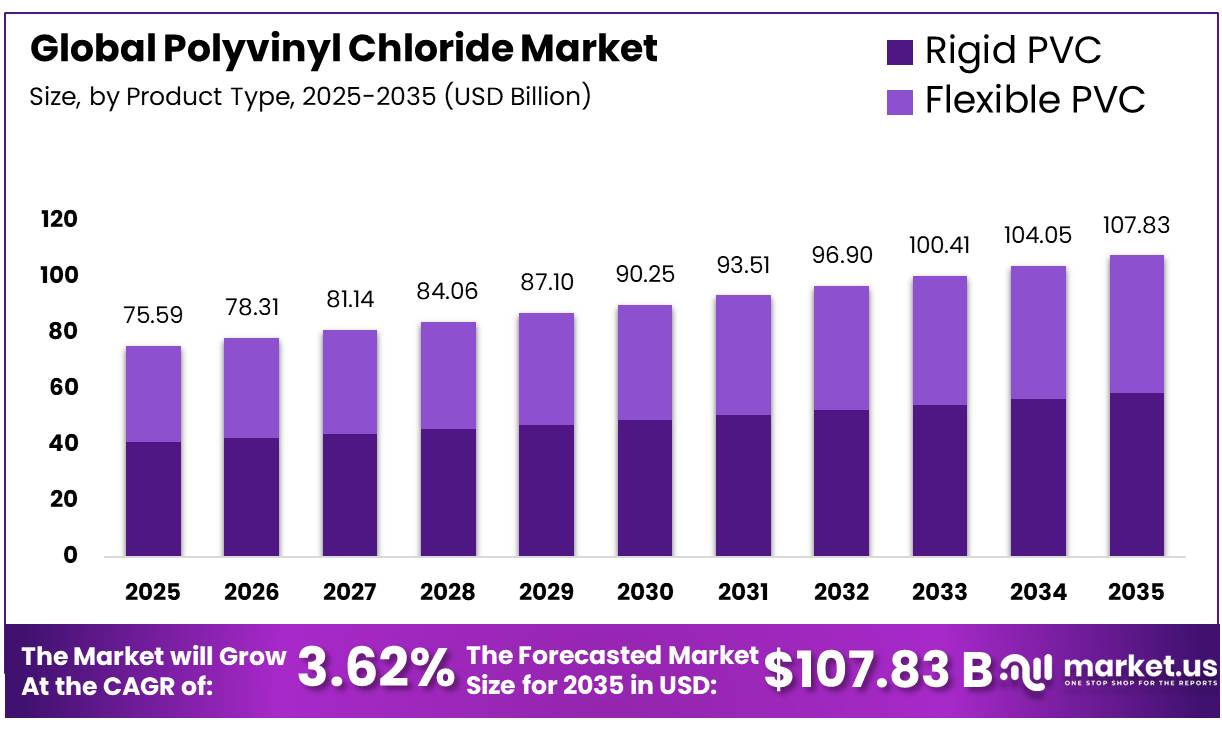
Key Takeaways
- The global Polyvinyl Chloride Market was valued at US$75.59 billion in 2025.
- The market is expected to reach US$107.83 billion by 2035.
- The market is projected to grow at a CAGR of 3.62% between 2026 and 2035.
- Asia Pacific accounted for 69.14% of the market in 2025, with revenue of US$52.27 billion.
- Rigid PVC dominated the product type segment with 54.23% share.
- Pipes, Profiles & Fittings led the application segment with 45.17% share.
- Calcium-based (Ca-Zn) Stabilizers held the largest stabilizer type share at 51.54%.
- Construction remained the leading end-use industry with 60.08% market share.
- Flexible PVC, Films & Sheets, and Electrical & Electronics emerged as the fastest-growing segments.
Product Type Analysis
Rigid PVC held a dominant 54.23% share of the global market in 2025 due to its extensive use in water supply pipes, sewer systems, window and door profiles, electrical conduits, and industrial applications requiring strength, corrosion resistance, and durability. Its long service life, low maintenance requirements, and cost-effectiveness continue to support widespread adoption in global infrastructure projects.
According to the U.S. Environmental Protection Agency (EPA), the 7th Drinking Water Infrastructure Needs Survey and Assessment, released in 2025, estimates the United States requires USD 625 billion in drinking water infrastructure investment over the next 20 years, supporting continued demand for rigid PVC products.
Flexible PVC is the fastest-growing product segment due to its lightweight structure, flexibility, and insulation performance. Increasing applications in wire and cable insulation, medical tubing, blood bags, flooring, automotive interiors, packaging films, and consumer products continue to strengthen demand, supported by investments in healthcare facilities, power infrastructure, and electric vehicle charging networks.
Application Analysis
Pipes, Profiles & Fittings accounted for 45.17% of the global market in 2025, driven by extensive use in water supply systems, drainage networks, electrical conduits, window profiles, door frames, and construction fittings. Strong residential, commercial, and public infrastructure development, combined with government-backed investments, sustained market demand throughout the year.
According to the U.S. Census Bureau and the U.S. Department of Housing and Urban Development, privately owned housing starts reached a seasonally adjusted annual rate of 1.177 million units in May 2026, supporting continued consumption of PVC-based construction materials.
Films & Sheets represent the fastest-growing application segment, supported by rising demand from packaging, healthcare, industrial manufacturing, and construction. Their transparency, durability, moisture resistance, and processing efficiency continue to expand their use in protective packaging, medical packaging, laminated sheets, and flexible building products.
Stabilizer Type Analysis
Calcium-based (Ca-Zn) Stabilizers dominated the market with a 51.54% share in 2025 due to growing demand for safer alternatives to traditional lead-based stabilizers. These stabilizers provide effective heat protection and are widely used in PVC pipes, flooring, cables, profiles, and other construction products while supporting compliance with stricter environmental regulations.
According to the World Health Organization, in June 2026, lead exposure was linked to more than 3.5 million deaths globally in 2023, reinforcing the transition toward lead-free PVC stabilizer technologies.
End Use Industry Analysis
The Construction industry remained the largest end-use segment, accounting for 60.08% of the global market in 2025. PVC continues to be widely used in pipes, roofing membranes, flooring, wall panels, drainage systems, window profiles, door profiles, and electrical conduits because of its durability, corrosion resistance, long service life, and low maintenance requirements.
According to the U.S. Census Bureau, total U.S. construction spending reached a seasonally adjusted annual rate of USD 2.1724 trillion in April 2026, including USD 909.9 billion in residential construction, supporting long-term demand for PVC building materials.
The Electrical & Electronics segment is the fastest-growing end-use industry, driven by expanding investments in power transmission, communication infrastructure, industrial electrical systems, and consumer electronics. According to the U.S. Energy Information Administration (EIA) in April 2026, U.S. electricity demand has increased by an average of 2.1% per year in recent years after nearly 15 years of relatively flat consumption, supporting increased use of PVC-insulated wires, cables, and conduits.
Key Market Segments
By Product Type
- Rigid PVC
- Flexible PVC
By Application
- Pipes, Profiles & Fittings
- Films & Sheets
- Cables & Wires
- Flooring
- Packaging
- Others
By Stabilizer Type
- Calcium-based (Ca-Zn) Stabilizers
- Lead-based Stabilizers
- Organotin Stabilizers
- Others
By End Use Industry
- Construction
- Electrical & Electronics
- Automotive
- Healthcare
- Others
Driving Factors
Growing investment in water infrastructure and rural pipe connectivity continues to drive PVC demand. India's Jal Jeevan Mission increased rural tap-water coverage from 17% at launch in August 2019 to approximately 15.69 crore connected households out of 19.36 crore, or 81.02%, by 10 February 2026, representing 12.56 crore additional household connections and more than 2.72 lakh villages reporting full coverage. Public infrastructure investment, lead-free PVC adoption, regional trade protection, regulatory-driven manufacturing upgrades, and chlor-alkali integration further strengthen long-term market growth.
Restraining Factors
The market continues to face challenges from slowing construction activity, particularly across North America and Europe. U.S. building permits in June 2026 reached 1.367 million SAAR, down 3.0% from May and 2.3% below June 2025. In the euro area, construction output declined 0.8% month-on-month in June 2025 after falling 2.1% in May. Lower construction activity reduces PVC demand across pipes, siding, flooring, window profiles, and electrical conduits while increasing inventory levels and delaying capacity expansion.
Growth Opportunity
Significant opportunities exist in integrated rural and urban water infrastructure projects. India's Jal Jeevan Mission has connected approximately 15.8 crore rural households by mid-2026, while AMRUT 2.0 carries an indicative investment of approximately ₹2.77 lakh crore to ₹2.99 lakh crore for urban water supply and sewerage infrastructure across statutory towns and 500 cities. Expanding integrated pipe-and-fitting packages, localized production, improved installation efficiency, and maintenance services could support approximately 1.9 percentage points of incremental CAGR over the baseline across India and neighboring South Asian markets.