Organic Maitake Mushroom Powder Sourcing: What B2B Buyers Should Evaluate Before Scaling
 greenjeeva
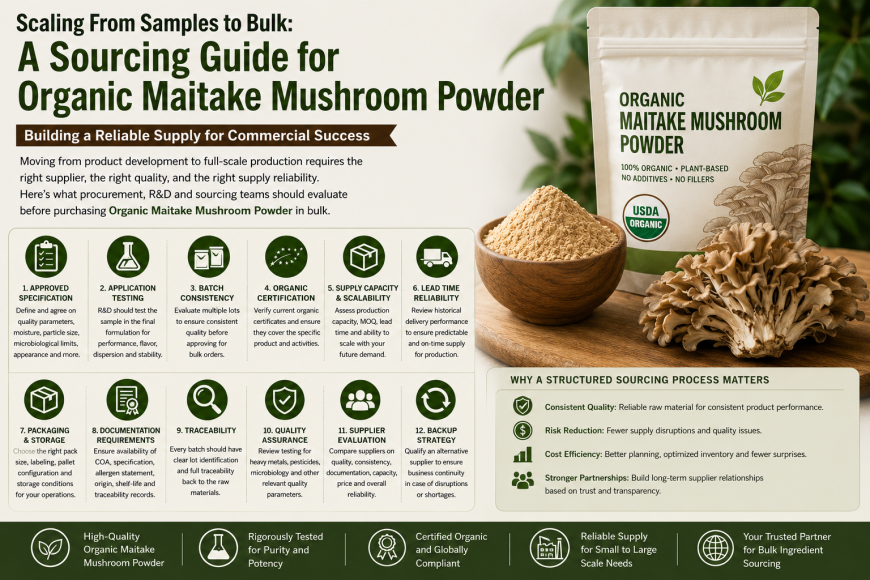
A common sourcing mistake with mushroom ingredients is treating the first approved sample as proof that a supplier can deliver the same material at commercial scale. In practice, the transition from a few kilograms to recurring bulk orders can expose differences in cultivation, drying, milling, moisture, particle size, and analytical testing. For procurement and formulation teams, these variables can affect both manufacturing performance and product consistency.
This is particularly relevant when qualifying Organic Maitake mushroom Powder for nutraceutical, functional food, or powdered beverage applications. The sourcing objective should not simply be securing the lowest bulk price. It should be establishing a raw material specification that can be reproduced from lot to lot.
Begin With Ingredient Identity
Maitake (Grifola frondosa) is an edible mushroom used as a food ingredient and in functional formulations. However, the commercial term “maitake powder” does not always tell a buyer enough about the material.
Before comparing suppliers, procurement teams should confirm whether the powder is produced from fruiting bodies, mycelium, or another mushroom-derived material. Cultivation substrate, country of origin, harvest conditions, and processing method should also be documented.
For an organic ingredient, certification should be verified for the actual material being purchased and for the market in which it will be sold. This prevents a common problem where an ingredient is described commercially as organic but the supporting documentation does not match the finished raw material.
Processing Has a Direct Effect on Formulation
Drying and milling conditions can strongly influence how mushroom powder behaves during manufacturing. Moisture levels that are acceptable on paper may still create practical issues if the powder develops caking during storage or loses flowability in automated equipment.
Particle-size distribution is another specification worth discussing early. A coarse powder may behave differently from a finely milled material in capsules, tablets, drink mixes, and dry blends. Differences in particle size can affect dispersion, blending uniformity, bulk density, and filling performance.
Sensory properties should not be overlooked. Maitake naturally has an earthy mushroom character, which can become noticeable depending on the inclusion rate and finished-product matrix. R&D teams should therefore evaluate the raw material inside the intended formulation rather than relying only on laboratory specifications.
What Should Be Included in a Bulk Specification?
When purchasing Organic Maitake mushroom Powder Bulk, a COA is necessary but should not be the only qualification document.
A useful specification may include identity, moisture, ash, particle size, microbiological parameters, heavy metals, pesticide residues, and other contaminant limits relevant to the application. Where specific nutritional markers are important, buyers should also establish the analytical method used to measure them.
This last point is often underestimated. Two suppliers may report similar results for a particular compound while using different analytical methods, making direct comparison unreliable.
Depending on the product and market, sourcing teams may also require organic certification, Non-GMO documentation, allergen statements, Kosher or Halal certification, country-of-origin information, SDS, and food-safety documentation.
The Real Sourcing Test Is Lot Consistency
One issue frequently encountered with agricultural ingredients is variation between production lots. Mushroom cultivation can be influenced by substrate composition, growing conditions, harvest timing, drying parameters, and storage.
For that reason, approving one sample and immediately committing to a large annual volume creates unnecessary risk. A stronger qualification process compares several lots and, where possible, evaluates material from different production dates.
I would look beyond the numerical specification and examine color, aroma, flowability, caking, bulk density, and dispersion. These practical characteristics can reveal processing differences that may not be obvious from a conventional COA.
Storage and logistics also deserve attention. Buyers should understand packaging configuration, recommended storage conditions, shelf-life validation, production lead times, and whether the supplier maintains finished inventory or produces against individual orders.
Match the Powder to the Application
Not every formulation requires the same type of maitake ingredient. Whole-mushroom powder may be appropriate when the objective is to incorporate the broader mushroom material, while an extract may be preferred when a more concentrated or defined fraction is required.
The decision should consider dosage, sensory profile, processing conditions, analytical requirements, cost-in-use, and the finished product's technical specification.
Ultimately, sourcing Organic Maitake mushroom Powder successfully requires coordination between procurement, quality, and R&D. The most reliable bulk supply is not necessarily the one with the lowest quoted kilogram price. It is the material with a clearly defined identity, transparent processing history, appropriate testing, and demonstrated lot-to-lot consistency. That foundation makes commercial scale-up far more predictable and reduces the likelihood that a formulation approved in the laboratory will need to be adjusted once regular production begins.