Online Dating Market to Reach USD 29.5 Billion by 2035 | AI Matching and Safety Features Expand
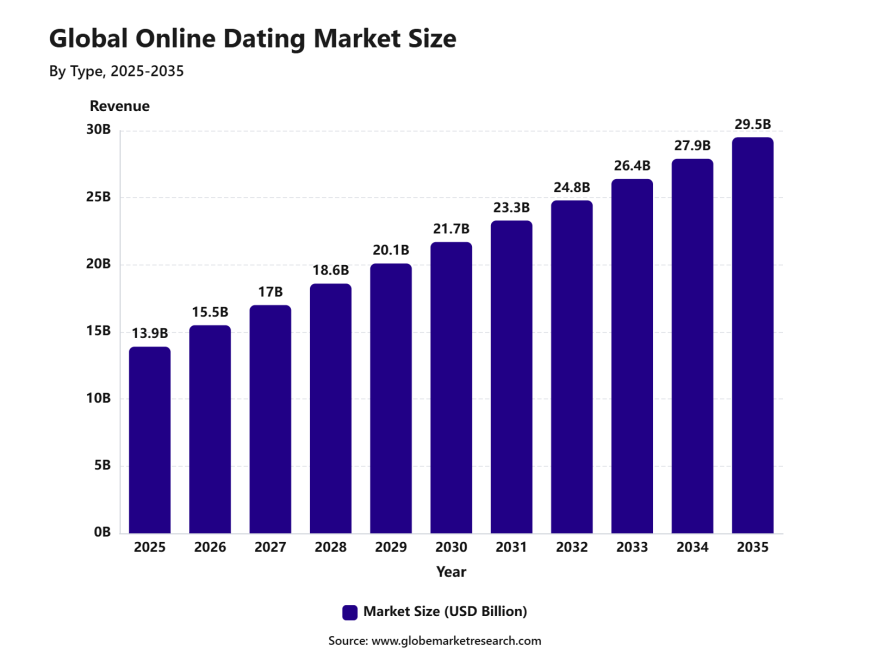
According to Globe Market Research, the global Online Dating Market was valued at USD 13.9 billion in 2025 and is projected to reach approximately USD 29.5 billion by 2035, growing at a CAGR of 7.7% from 2025 to 2035. Applying the reported growth rate indicates an estimated market value of approximately USD 15.0 billion in 2026. Asia Pacific led the market with a 35.6% share in 2025.
 globemarketresearch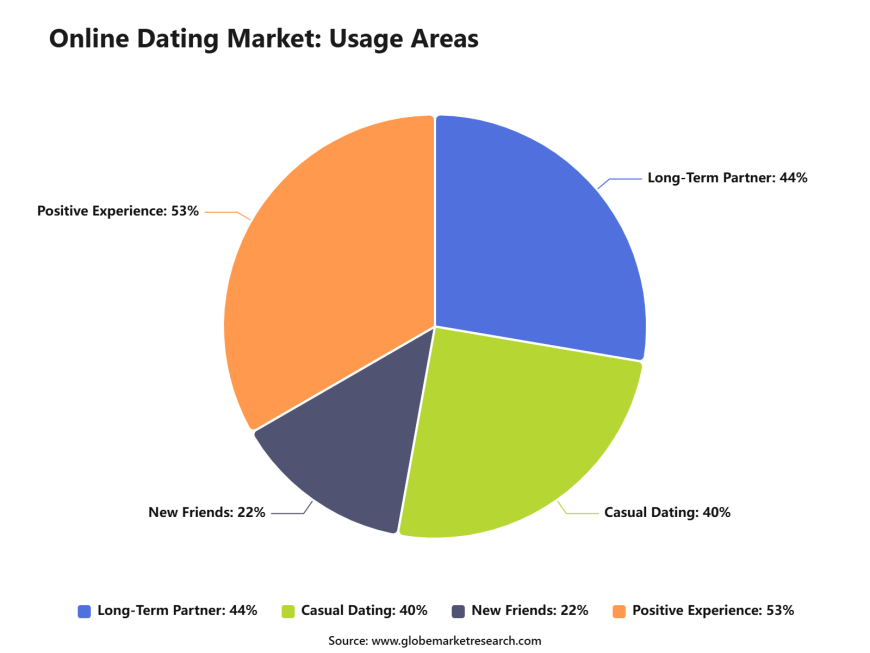
According to Globe Market Research, the global Online Dating Market was valued at USD 13.9 billion in 2025 and is projected to reach approximately USD 29.5 billion by 2035, growing at a CAGR of 7.7% from 2025 to 2035. Applying the reported growth rate indicates an estimated market value of approximately USD 15.0 billion in 2026. Asia Pacific led the market with a 35.6% share in 2025.
Online dating platforms include mobile applications and web portals that help users discover, communicate with and meet potential partners. The platforms generate revenue through subscriptions, premium visibility, profile boosts, advertising, verification tools and other in-app purchases.
Market Size and Growth
The market is expanding as app-based matchmaking becomes more widely accepted across different age groups and regions. Paying online dating accounted for 70.5% of market revenue, while subscription plans represented 55.5%, indicating that users are willing to pay for advanced search, improved visibility, stronger privacy and better-quality interactions.
Commercial performance is increasingly being determined by revenue per paying user rather than user volume alone. Match Group reported first-quarter 2026 revenue of USD 864 million, up 4% year over year, while its payer base declined by 5% to 13.5 million. Revenue per payer increased by 10% to USD 20.90.
Key Market Drivers
- Mobile-first dating behavior: Applications held an 86.3% market share, supported by location-based matching, push notifications, instant messaging, profile discovery and integrated payments.
- Demand for premium features: Paying services represented 70.5% of the market. Users are purchasing advanced filters, profile boosts, unlimited interactions, privacy controls and verification features when these services provide clear value.
- AI-based matching: Dating platforms are using AI to improve profile recommendations, conversation quality and compatibility assessment. Match Group reported that Tinder’s conversation coverage increased by 6% year over year in March 2026 following product and recommendation improvements.
- Greater focus on safety: Identity verification, automated moderation and fraud detection are becoming important purchasing and retention factors. Hinge’s Face Check feature reduced interactions with harmful or deceptive accounts by approximately 20% to 30% in major markets.
- Growth of localized and niche platforms: Regional-language services and applications developed for specific relationship intentions, communities and demographic groups are increasing user relevance. Match Group’s USD 100 million investment in Sniffies reflects rising commercial interest in specialized dating platforms.
Market Segmentation
- Type Insights: Paying online dating led with a 70.5% share, supported by demand for advanced matching, ad-free experiences, privacy controls and increased profile visibility.
- Revenue Model Insights: Subscription plans held a 55.5% share. Monthly, weekly and annual memberships provide recurring income while supporting continuous product, moderation and safety investment.
- Platform Insights: Applications represented 86.3% of market revenue because users increasingly prefer smartphone-based discovery, communication and payments.
- Age Group Insights: Millennials accounted for 35.9% of the market, supported by high smartphone adoption, comfort with online communication and willingness to purchase digital subscriptions.
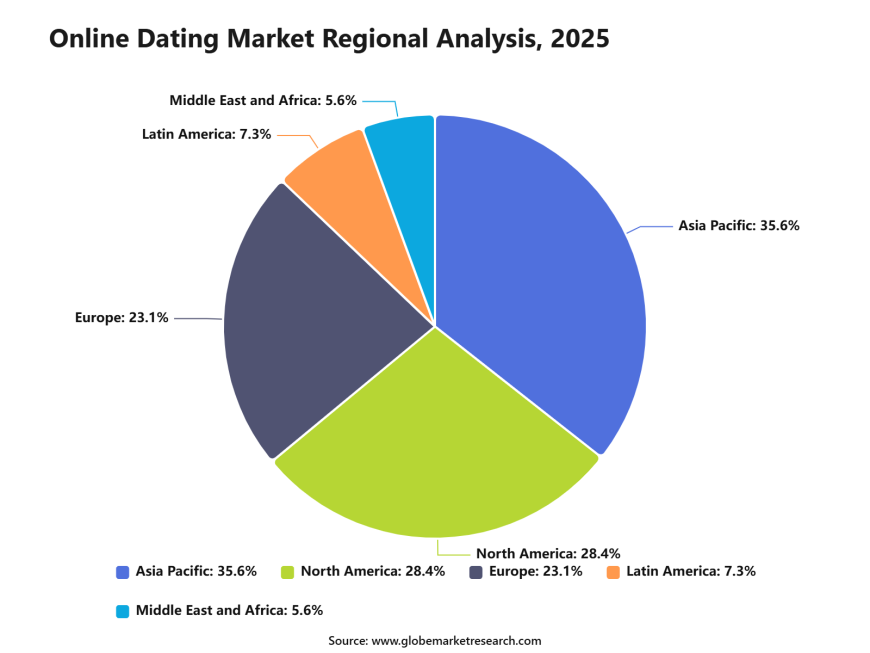
- Regional Insights: Asia Pacific led with a 35.6% share, driven by large urban populations, expanding internet access, mobile-first behavior and growing acceptance of digital matchmaking.
Technology and Adoption Trends
- AI-curated recommendations: Machine-learning systems analyze profiles, interests, communication patterns and user preferences to present more relevant potential matches. Tinder introduced improved recommendations and interest-based discovery modes as part of its 2026 product strategy.
- Biometric identity verification: Facial verification is being used to reduce bots, fake profiles and impersonation. Tinder reported that Face Check produced a reduction of more than 50% in interactions with harmful accounts in markets where it was deployed.
- Agentic dating assistance: AI tools can help users prepare profiles, select photographs, suggest opening messages, screen matches and plan dates. Platforms must ensure that assistance remains transparent and does not replace genuine human interaction.
- Intent-based discovery: Dating services are reducing dependence on continuous swiping by adding relationship goals, interest categories, curated matches and lower-pressure social formats. Tinder’s 2026 product updates included Astrology Mode, Music Mode and continued investment in conversation-focused discovery.
- Real-time location-based platforms: Sniffies uses an interactive map to connect users according to proximity and current intent. The platform had an estimated three million monthly active users and supported more than 20 million messages per day when Match Group announced its investment in April 2026.
Regional Breakdown and Supply Chain
- Asia Pacific: The region held 35.6% of global revenue in 2025. Local-language applications, flexible payment plans and culturally relevant matchmaking models are supporting adoption across China, India, Japan, South Korea and Southeast Asia.
- North America: The region remains a major market for premium subscriptions, AI-supported discovery and safety features. Match Group, Bumble and Grindr continue to invest in product improvements and higher-value paid services.
- Europe: Demand is supported by high smartphone penetration and acceptance of digital relationship platforms. Providers must comply with strict requirements concerning consent, personal information, recommendation systems and user safety.
- Latin America: Urban populations, younger users and expanding digital payment access are supporting application adoption. Hinge expanded into Mexico and Brazil during 2025 and became the second-most downloaded dating app in both countries by December 2025.
- Supply chain structure: The market connects cloud providers, application developers, payment processors, AI model providers, identity-verification companies, advertising networks, app stores and trust-and-safety specialists. Reliance on mobile app stores and hosting providers can directly affect distribution costs and platform profitability.
Future Outlook, 2026–2035
The Online Dating Market is expected to increase from an estimated USD 15.0 billion in 2026 to USD 29.5 billion by 2035. Applications, subscriptions and paid dating services will remain the main commercial categories, while AI-based discovery, verified profiles and niche communities will create additional revenue opportunities.
The market is expected to move from high-volume swiping toward more intentional and guided matchmaking. AI will be used to improve recommendations, profile quality, conversation support and fraud identification. However, users are likely to reject products that appear automated, manipulative or unclear about how personal data is being used.
Commercial success will increasingly depend on measurable user outcomes. Platforms that improve the number of genuine conversations, safe meetings and successful connections will be better positioned to retain users and justify premium subscription prices.
Key Opportunities
- AI compatibility matching: Platforms can use relationship goals, communication styles, interests and behavioral signals to deliver more relevant recommendations.
- Verified dating communities: Identity checks, facial verification and profile-quality controls can attract users seeking safer and more serious interactions. Hinge’s Face Check produced a measurable reduction in exposure to deceptive accounts.
- Niche dating applications: Platforms designed for specific communities, age groups, religions, professions or relationship intentions can provide stronger product relevance and user loyalty.
- Regional-language platforms: Local-language interfaces, culturally suitable profile fields and regional payment options can increase adoption across Asia Pacific, Latin America and the Middle East.
- Offline events and date planning: Dating services can expand into curated events, restaurant bookings, activity recommendations and verified public meeting locations.
Challenges and Restraints
- Romance scams and fake accounts: The FBI reported that victims across its San Francisco division lost more than USD 40 million to romance scams during 2025, demonstrating the financial and reputational importance of fraud prevention.
- Declining paying-user numbers: Bumble’s total paying users declined by 21.1% year over year to 3.2 million in the first quarter of 2026, indicating pressure on engagement and subscriber retention.
- Subscription fatigue: Users may cancel services when profile quality, match relevance or communication outcomes do not justify recurring fees. Platforms must offer clearly differentiated premium benefits.
- Data privacy concerns: Dating applications process sensitive information covering identity, location, photographs, sexual orientation and relationship preferences. A breach or improper data use can create significant regulatory and reputational risks.
- AI-generated deception: Generative AI can be used to create fake photographs, automated messages and fraudulent identities. Platforms require stronger detection systems, human review and transparent AI policies.
Prominent Global Market Leaders
Match Group, Inc.
Bumble Inc.
The Meet Group
Cupid Media Pty Ltd.
Happn SAS
TrulyMadly Matchmakers Pvt. Ltd.
Grindr Inc.
eHarmony
Coffee Meets Bagel
Matrimony.com Limited
Other Key Players
Strategic Implications
Dating platforms should measure product performance through genuine conversations, user retention and successful offline meetings rather than relying only on registrations and swipe volume. Match Group’s first-quarter 2026 results showed that improved conversations and registrations can support revenue growth even when total payer numbers decline.
Safety should be treated as a revenue and retention function. Verification and fraud-detection systems can reduce harmful interactions, improve confidence and strengthen the value of premium memberships.
A diversified monetization structure should be maintained. Subscription plans can be combined with one-time profile boosts, premium filters, incognito browsing, events and AI-assisted services. However, essential reporting and safety features should remain available to all users.
Regional expansion should be supported by localized language, payment and moderation systems. Relationship expectations, profile preferences and acceptable communication practices differ significantly between markets.
Top Use Cases
- Long-term relationship search: Users can find potential partners based on values, lifestyle, location and relationship intentions.
- Casual dating: Applications support users seeking short-term or less formal connections through location-based and interest-based discovery.
- Community-specific dating: Niche platforms serve religious, cultural, professional, age-based and LGBTQ+ communities.
- Friendship and social discovery: Some users use dating platforms to expand their social circles, meet people after relocation or find companions for activities.
- AI-supported profile and date planning: AI can help improve bios, recommend photographs, suggest conversation starters and identify suitable public meeting locations.
Latest Case Study: Match Group Improves Dating Safety and Engagement
Business Challenge
Major dating applications have faced weaker user growth, concerns about fake accounts and dissatisfaction with repetitive swiping. Match Group entered 2026 with a strategy focused on improving genuine conversations, user outcomes and trust across Tinder and Hinge.
Product Solution
Tinder introduced improved recommendation systems, interest-based discovery modes and additional trust-and-safety features. Hinge fully deployed Face Check in key markets to identify deceptive or automated accounts before they could interact extensively with users.
Measurable Results
Hinge’s Face Check reduced interactions with bad actors by approximately 20% to 30%, with limited impact on revenue. Tinder’s conversation-coverage indicator increased by 6% year over year in March 2026, while new-user registrations returned to growth for the first time in nearly two years.
Match Group generated USD 864 million in revenue during the first quarter of 2026, representing 4% annual growth. Hinge’s direct revenue increased by 28%, supported by product development and international expansion.
Strategic Learning
The case demonstrates that online dating platforms can improve commercial performance by addressing match quality and safety rather than increasing swipe volume alone. Verification, better recommendations and lower-pressure discovery can strengthen both engagement and willingness to pay.
Recent Developments
- February 2026: Match Group reported that Tinder’s Face Check feature had reduced interactions with harmful accounts by more than 50% in markets where it was introduced. Hinge also continued its international expansion across Europe and Latin America.
- April 2026: Match Group invested USD 100 million in Sniffies, acquiring a significant minority stake and an option for future full ownership. Sniffies remained independently managed following the investment.
- May 2026: Match Group reported first-quarter revenue of USD 864 million, up 4%, with adjusted EBITDA increasing by 25% to USD 343 million. Tinder registrations returned to annual growth during March.
- May 2026: Bumble reported first-quarter revenue of USD 212.4 million and 3.2 million paying users. Average revenue per paying user increased by 8.9% to USD 22.04 despite the decline in subscribers.
- May 2026: Grindr reported first-quarter revenue of USD 130 million, representing annual growth of 38%. Net income reached USD 27 million, while adjusted EBITDA reached USD 58 million.
Conclusion
The Online Dating Market is expected to maintain steady growth as mobile applications, premium subscriptions and AI-based matching become more widely adopted. Paying services, application-based platforms and millennial users currently represent leading market categories, while Asia Pacific holds the largest regional share.
The next phase of competition will be shaped by trust, match relevance and measurable relationship outcomes. Platforms that reduce fake profiles, improve user control and provide meaningful premium benefits will be better positioned to expand revenue through 2035.
Contact Us
Global Business Development Team
Email: [email protected]
Web: www.globemarketresearch.com
Explore More