"Invisalign vs Traditional Braces: Which One Fits Your Lifestyle?"
Compare Invisalign and traditional braces to discover which option best suits your lifestyle, smile goals, comfort, appearance, treatment needs, and everyday routine.
 Menddentalau

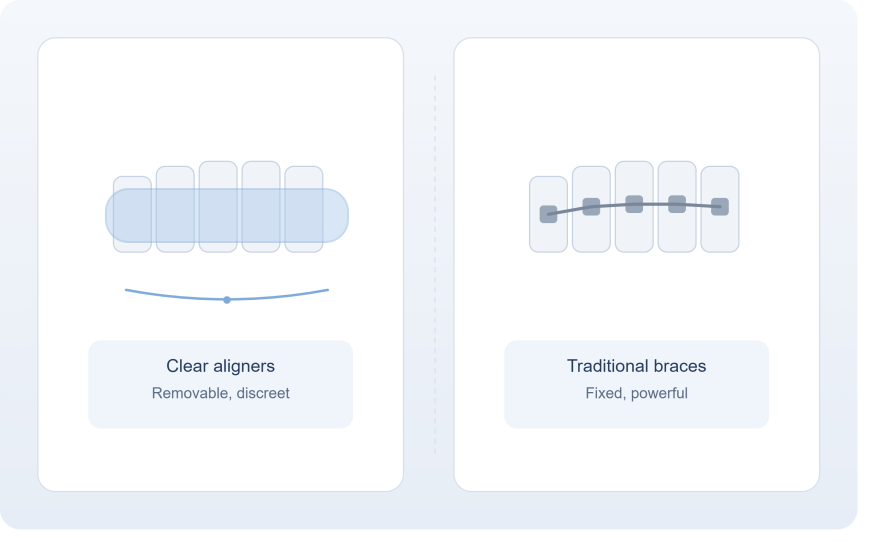
Clear aligners like Invisalign offer a removable, nearly invisible way to straighten teeth, while traditional braces remain the more powerful option for complex misalignment, and the right choice comes down to your specific bite issue, lifestyle, and how discreet you need treatment to be. Clear aligners suit mild to moderate cases well and fit around an active, social lifestyle, while braces handle more complex corrections that aligners sometimes can't. Below, we compare the two directly across the factors that actually affect day-to-day life during treatment.
What's the Basic Difference Between Clear Aligners and Traditional Braces?
Clear aligners are a series of custom-made, removable plastic trays that gradually shift teeth into position, replaced every couple of weeks as treatment progresses, while traditional braces use fixed metal or ceramic brackets bonded to the teeth and connected by a wire that's adjusted at each appointment. This fundamental difference — removable versus fixed — is what drives most of the practical lifestyle differences between the two options, from what you can eat to how visible the treatment is day to day. Clinics offering clear aligner systems, including SureSmile at Mend Dental, provide a modern alternative to metal brackets and wires for patients who qualify.
Which Option Is More Effective for Complex Cases?
Traditional braces are generally more effective for complex orthodontic cases, since the fixed brackets and wire allow for more precise, powerful control over tooth movement, including rotations and bite corrections that some clear aligner systems handle less effectively. Clear aligners have improved significantly and now treat a wide range of cases, including moderate crowding, gaps, and mild bite issues, but severe crowding, significant bite discrepancies, or cases requiring substantial tooth rotation are often still better suited to braces. A dental assessment is the only reliable way to determine which category your specific case falls into, since the right answer depends entirely on the details of your individual bite.
How Do the Two Options Compare for Daily Life and Convenience?
Clear aligners are removable, which means you can take them out to eat, drink, and brush normally, giving you far more flexibility around meals and oral hygiene compared to fixed braces, which require extra care to clean around brackets and wires. This removability is one of the most commonly cited lifestyle advantages of clear aligners, particularly for patients who don't want to give up certain foods or adjust their eating habits for the length of treatment. Braces, on the other hand, work continuously without requiring any daily discipline to wear them, which suits patients who might otherwise forget to put aligners back in consistently throughout the day.
Do Clear Aligners Require More Discipline Than Braces?
Clear aligners require more daily discipline than braces, since they need to be worn for 20 to 22 hours a day to stay on track, and results depend entirely on consistent wear. Braces work passively in the background without any action required from the patient day to day, which removes the risk of a treatment delay caused by inconsistent wear. Patients who know they'll struggle to keep aligners in consistently, particularly through busy or social periods, sometimes find braces the more reliable option precisely because there's no discipline required to keep treatment on schedule.
How Do Clear Aligners and Braces Compare in Appearance?
Clear aligners are virtually invisible, made from clear, smooth plastic that's far less noticeable than the metal brackets and wires of traditional braces, making them the more discreet option for adults or teens who prefer treatment that doesn't stand out. This is one of the main reasons clear aligners have become popular with working adults specifically, since the appearance is a significant factor for patients in client-facing roles or those simply less comfortable with the visible look of metal braces. Ceramic braces offer a less noticeable alternative to metal for patients who need the strength of fixed braces but still want a more subtle appearance.
Which Option Is More Comfortable?
Clear aligners are generally more comfortable on a day-to-day basis, since the smooth plastic doesn't have the sharp edges or wires that can occasionally irritate the inside of the cheeks and lips with traditional braces. Both options cause some discomfort when a new aligner or adjustment is introduced, as teeth begin shifting into their new position, but this typically settles within a day or two either way. Braces can occasionally require an emergency visit if a wire breaks or pokes uncomfortably, an issue that simply doesn't arise with a removable aligner system.
How Long Does Treatment Take With Each Option?
Treatment time with clear aligners and braces is often broadly comparable for similar cases, generally ranging from 6 to 24 months depending on the complexity of the correction needed, though straightforward cases can sometimes move faster with aligners due to more frequent tray changes. More complex cases often take longer regardless of which option is used, since the treatment timeline is driven primarily by how much movement the teeth need, not simply which appliance is doing the moving. Your dentist can give a more specific estimate once your bite has been fully assessed.
What Happens After Treatment Finishes With Either Option?
Both clear aligners and traditional braces require a retainer afterward to maintain the new position of your teeth, since teeth naturally drift back toward their original position without ongoing support once active treatment ends. Retainers come in both removable and fixed varieties, and your dentist will recommend the type and wear schedule best suited to your specific case. Our retainers page covers the different retainer options available and how long you can expect to need one after finishing treatment.
Which Option Is Right for an Active Lifestyle?
Clear aligners tend to suit an active lifestyle particularly well, since they can be removed for sports, and there are no brackets or wires that could be damaged or cause injury during physical activity. Braces are still manageable for active patients with the use of a properly fitted mouthguard, but the added protection required makes clear aligners the more straightforward option for anyone playing regular contact sport during treatment. Patients who travel frequently also often prefer aligners, since there's no risk of a broken bracket or wire needing urgent attention while away from their regular dentist.
Which Option Costs More?
Cost between the two options varies by case complexity and provider, and it isn't always the case that one option is consistently more expensive than the other, since pricing depends heavily on the length and difficulty of your specific treatment plan. It's worth discussing cost directly during a consultation, since your dentist can provide an accurate quote once they understand exactly what your treatment involves, rather than relying on general assumptions about which option costs more.
How Do You Decide Which Option Is Right for You?
The right choice comes down to weighing your priorities: choose clear aligners if discretion, removability, and convenience around eating and cleaning matter most to you, or choose traditional braces if you have a more complex case, want a treatment that works without requiring daily discipline, or simply prefer a fixed solution. A consultation is the best way to get a clear picture of which option suits your specific bite, since your dentist can assess the complexity of your case and talk through how each option would fit into your day-to-day routine.
Frequently Asked Questions
Can adults get clear aligners, or are they mainly for teens?
Clear aligners are widely used by adults and are often specifically marketed toward adult patients, since the discreet appearance appeals particularly to working professionals. Many clear aligner systems, including SureSmile, are available to both adults and teens who qualify based on their specific case.
Do clear aligners work as well as braces for crowded teeth?
Clear aligners can effectively treat mild to moderate crowding, though more severe crowding cases sometimes respond better to the greater force and control offered by traditional braces. A dental assessment will confirm whether your specific level of crowding is well-suited to aligners or better addressed with braces.
Is it painful to switch to a new set of aligners?
Switching to a new set of aligners typically causes mild pressure or discomfort for a day or so, as the new tray begins shifting your teeth slightly further into position. This sensation is generally mild compared to the adjustment discomfort some patients experience with a braces tightening appointment.
Can I switch from braces to clear aligners partway through treatment?
Switching from braces to clear aligners partway through treatment is sometimes possible, depending on how much movement remains and the complexity of what's left to correct. This decision needs to be assessed by your dentist, since not every case is suitable for a mid-treatment switch between the two systems.