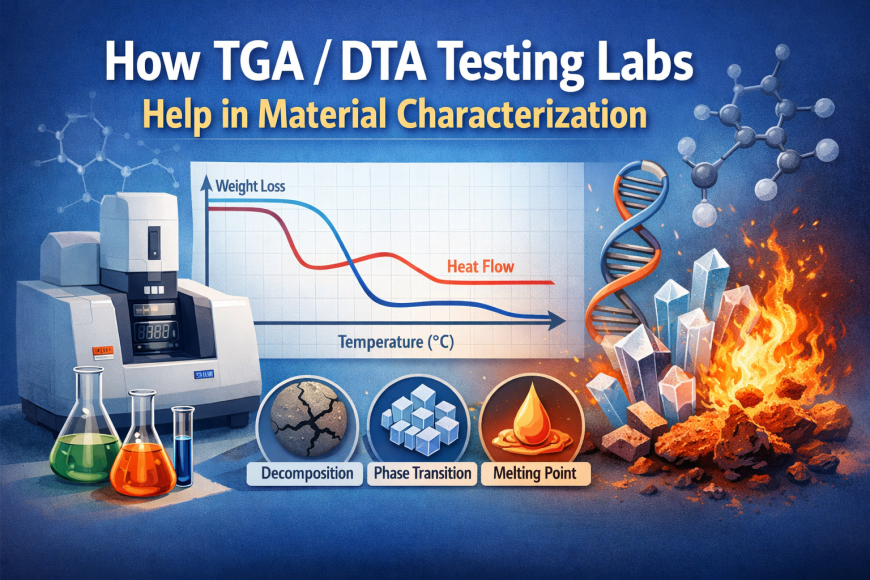
How TGA / DTA Testing Labs Help in Material Characterization
 labatoz
Material characterization is the foundation of product reliability, safety, and innovation. Before a material is approved for manufacturing, engineering, or commercial use, it must be thoroughly analyzed for stability, composition, and performance under different environmental conditions. Among the most powerful tools used for this purpose are TGA (Thermogravimetric Analysis) and DTA (Differential Thermal Analysis).
Professional TGA/DTA testing laboratories play a crucial role in generating precise thermal data that helps industries understand how materials behave under heat. In this detailed guide, we explore how these labs contribute to comprehensive material characterization.
Understanding the Basics of TGA and DTA
What is Thermogravimetric Analysis (TGA)?
Thermogravimetric Analysis (TGA) is a thermal analysis technique that measures changes in a material’s weight as a function of temperature or time under a controlled atmosphere (such as nitrogen, oxygen, or air).
As the sample is heated, cooled, or held at a constant temperature, any mass loss or gain is recorded. These changes provide critical information about:
-
Moisture content
-
Volatile components
-
Thermal decomposition
-
Oxidation reactions
-
Filler or ash content
-
Thermal stability
The output is typically presented as a thermogram, which plots weight percentage versus temperature.
What is Differential Thermal Analysis (DTA)?
Differential Thermal Analysis (DTA) measures the temperature difference between a sample and an inert reference material while both are subjected to identical heating or cooling conditions.
When the sample undergoes a physical or chemical change—such as melting, crystallization, or phase transformation - heat is either absorbed or released. This creates a temperature difference that is recorded as a peak in the DTA curve.
DTA helps identify:
-
Melting points
-
Glass transition temperatures
-
Crystallization temperatures
-
Phase transitions
-
Oxidation and reduction reactions
The Importance of Thermal Analysis in Material Characterization
Material characterization involves understanding a material’s physical, chemical, mechanical, and thermal properties. Thermal properties are especially critical because temperature fluctuations occur during:
-
Manufacturing processes
-
Storage and transportation
-
Real-world operating conditions
-
Sterilization and curing processes
Without accurate thermal data, materials may fail prematurely, degrade, or become unsafe.
TGA/DTA testing labs provide the scientific validation needed to predict material behavior under thermal stress.
How TGA / DTA Testing Labs Support Material Characterization
1. Evaluating Thermal Stability
Thermal stability determines how well a material resists degradation at elevated temperatures.
TGA testing labs identify:
-
Onset decomposition temperature
-
Multi-step degradation processes
-
Residual mass after decomposition
-
Oxidative stability
For example:
-
Polymers must withstand extrusion or injection molding temperatures.
-
Pharmaceuticals must remain stable during drying or sterilization.
-
Aerospace materials must tolerate extreme operational heat.
Testing labs provide accurate degradation profiles that help engineers select materials suitable for specific applications.
2. Determining Material Composition
TGA is highly effective in identifying and quantifying components in complex materials.
Testing labs can determine:
-
Filler content in plastics
-
Carbon black concentration
-
Moisture and volatile content
-
Ash content in fuels
-
Additive percentages
By analyzing weight-loss steps at specific temperature ranges, labs can break down the composition of multi-component systems. This is especially valuable for:
-
Quality control
-
Supplier verification
-
Reverse engineering
-
Regulatory submissions
3. Studying Phase Transitions and Thermal Events
DTA testing labs detect endothermic and exothermic reactions, enabling the identification of critical thermal transitions such as:
-
Melting
-
Crystallization
-
Solid-solid transitions
-
Dehydration
-
Oxidation
In ceramics and metallurgy, phase transitions significantly influence mechanical strength and durability. DTA helps researchers optimize processing temperatures to achieve desired material properties.
4. Supporting Research & Development
R&D teams rely heavily on thermal analysis data when developing new materials or modifying formulations.
TGA/DTA labs assist in:
-
Comparing raw material batches
-
Testing prototype formulations
-
Optimizing curing cycles
-
Evaluating thermal aging behavior
-
Studying compatibility of blended materials
Accurate thermal data reduces trial-and-error experimentation and accelerates product development.
5. Failure Analysis and Root Cause Investigation
When products fail in the field, thermal analysis often reveals the underlying issue.
Common causes identified through TGA/DTA testing include:
-
Unexpected thermal degradation
-
Material contamination
-
Incorrect filler ratios
-
Oxidative instability
-
Improper processing temperatures
Testing labs provide detailed analytical reports that help manufacturers correct design flaws and prevent recurrence.
6. Assessing Oxidation and Combustion Behavior
Under oxidative atmospheres, TGA can evaluate:
-
Oxidation onset temperature
-
Combustion characteristics
-
Flame-retardant efficiency
-
Thermal aging performance
This is particularly important for:
-
Electrical components
-
Automotive parts
-
Construction materials
-
Packaging products
Understanding oxidation behavior ensures safety and compliance with fire-resistance standards.
7. Ensuring Regulatory and Quality Compliance
Industries such as pharmaceuticals, aerospace, automotive, and food packaging must adhere to strict quality standards.
Professional TGA/DTA testing labs offer:
-
Standardized methods (ASTM, ISO, USP)
-
Calibrated instrumentation
-
Validated procedures
-
Traceable documentation
-
Audit-ready reports
This ensures regulatory compliance and supports certification processes.
Key Industries Benefiting from TGA / DTA Testing
Polymers & Plastics
-
Degradation analysis
-
Filler quantification
-
Stability during processing
Pharmaceuticals
-
Drug stability studies
-
Excipient compatibility
-
Hydrate and solvate analysis
Metals & Alloys
-
Oxidation resistance
-
Phase transformations
-
Thermal reaction studies
Ceramics & Minerals
-
Sintering behavior
-
Decomposition analysis
-
Structural transitions
Petrochemicals
-
Volatile content analysis
-
Thermal cracking evaluation
Electronics
-
Reliability under thermal stress
-
Insulation material testing
Advantages of Using Professional Testing Labs
Outsourcing TGA/DTA testing offers several advantages:
-
High-precision microbalances
-
Controlled heating rates
-
Inert and reactive gas environments
-
Advanced data interpretation
-
Experienced material scientists
-
Fast turnaround time
Professional labs ensure reproducibility, accuracy, and unbiased results.
How TGA and DTA Work Together
Although TGA measures weight changes and DTA measures thermal energy changes, combining both techniques provides a more complete understanding of material behavior.
For example:
-
A DTA peak may indicate melting.
-
A simultaneous TGA weight loss may indicate decomposition.
Together, these results help differentiate physical transitions from chemical reactions.
Conclusion
TGA and DTA testing labs are indispensable in modern material characterization. They provide deep insights into thermal stability, composition, phase transitions, oxidation behavior, and degradation mechanisms.
By leveraging advanced instrumentation and expert analysis, these laboratories help industries:
-
Improve product reliability
-
Ensure regulatory compliance
-
Optimize manufacturing processes
-
Reduce failure risks
-
Accelerate innovation
In an increasingly performance-driven and safety-focused world, TGA/DTA testing is not just a laboratory service - it is a strategic tool for material excellence.