Food Thickeners Market Growth Forecast by Region and Application
Explore the Food Thickeners Market report covering market size of USD 13.11 billion in 2025 and projected growth to USD 22.75 billion by 2035 at a CAGR of 6.3%. Gain insights into product types, sources, applications, regional performance, growth drivers, restraints, opportunities, and emerging industry trends shaping the global food ingredients market.
 sonicbolt20
Overview
Food Thickeners Market was valued at USD 13.11 billion in 2025 and is forecast to reach USD 22.75 billion by 2035, expanding at a CAGR of 6.3% during 2026 to 2035. Asia Pacific emerged as the leading regional market in 2025, securing a 39.0% share and generating USD 5.11 billion in revenue. Strong growth in food manufacturing, increasing demand for processed and convenience foods, expanding clean-label product development, and the broad use of starches, gums, pectin, and gelatin continue to strengthen the global market.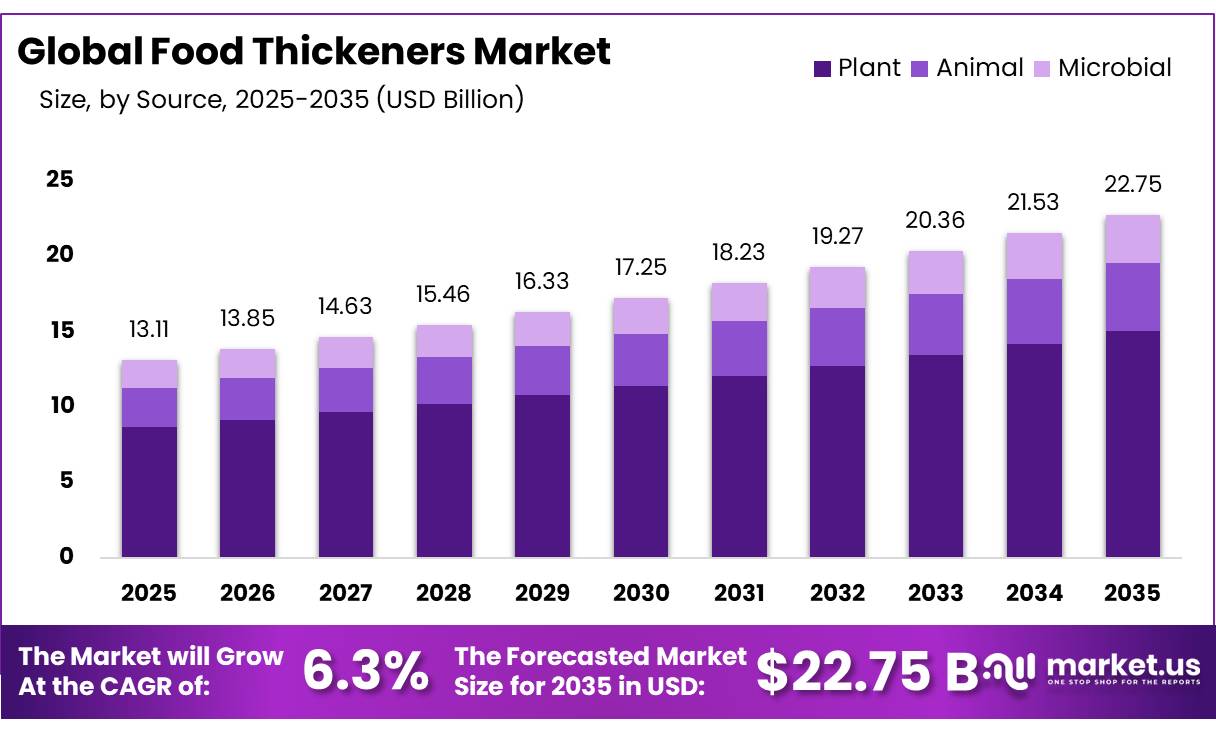
Key Takeaways
- The global Food Thickeners Market was valued at USD 13.11 billion in 2025.
- The market is projected to reach USD 22.75 billion by 2035.
- The market is expected to expand at a CAGR of 6.3% between 2026 and 2035.
- Asia Pacific held the leading regional position with a 39.0% share in 2025.
- Asia Pacific generated USD 5.11 billion in revenue during 2025.
- Starch-Based Thickeners accounted for 37.0% of the market by product type.
- Corn Starch represented 18.5%, Potato Starch 9.3%, Cassava 7.4%, and Others 1.8%.
- Plant-Based sources dominated with a 66.0% market share.
- Bakery and Confectionery represented 39.0% of total application demand.
Product Type Analysis
Starch-Based Thickeners dominated the market with a 37.0% share due to their affordability, wide availability, processing versatility, and regulatory acceptance across global food manufacturing. Corn starch remained the largest individual product with 18.5% share, followed by Potato Starch at 9.3%, Cassava at 7.4%, and Others at 1.8%. These ingredients are extensively used in sauces, soups, gravies, confectionery, bakery fillings, and dairy products because they provide reliable viscosity and texture at a competitive cost.
The availability of raw materials continues to support this segment. In January 2026, Starch Europe reported that 70 manufacturing facilities across 18 EU countries produced approximately 9.8 million tonnes of starch and starch derivatives annually while processing nearly 22 million tonnes of maize, wheat, and starch potatoes. Hydrocolloids represent the fastest-growing product category because they offer superior gel formation, stability across varying temperatures and pH conditions, and compatibility with low-calorie and sugar-free formulations.
Source Analysis
Plant-Based thickeners held the leading market position with 66.0% of total demand. Their dominance reflects increasing consumer preference for natural ingredients, clean-label formulations, sustainable sourcing, and plant-based diets. Starches derived from corn, potato, cassava, and wheat, together with hydrocolloids such as carrageenan, agar, pectin, guar gum, and xanthan gum, continue to serve a broad range of food manufacturing applications.
Commercial innovation further supports this segment. In July 2025, Tate & Lyle reported that its plant-derived CLARIA G® clean-label starch was produced using 35% fewer carbon emissions and 34% less water. The company also introduced 4 food and beverage prototypes featuring plant-based texturants including pectin, carrageenan, citrus fibre, gellan gum, and modified starch at IFT FIRST 2025. Although Animal-Based thickeners remain important for gelatin, collagen, premium desserts, confectionery, and sports nutrition, plant-derived ingredients continue to dominate global demand.
Application Analysis
Bakery and Confectionery represented the largest application segment with 39.0% of total market demand. Thickening ingredients play a critical role in fillings, icings, glazes, custards, cream-based products, chocolates, pastries, and sugar confectionery by controlling viscosity, preventing syneresis, and maintaining texture throughout production, packaging, transportation, and retail shelf life.
Growing food production continues to strengthen application demand. In July 2025, Eurostat reported that the EU food, beverage, and tobacco manufacturing industry achieved a sold production value of €1.081 trillion in 2024, increasing 1.8% from €1.061 trillion in 2023. According to Eurostat's December 2025 food-chain publication, the EU also produced 258 million tonnes of cereals and 162 million tonnes of raw milk in 2024, supporting both starch production and dairy processing applications that rely heavily on food thickeners.
Key Market Segments
By Product Type
- Starch-Based Thickeners
- Corn Starch
- Potato Starch
- Cassanava
- Others
- Hydrocolloids
- Xanthan Gum
- Guar Gum
- Pectin
- Others
- Protein-Based Thickeners
- Egg White
- Collagen
- Gellatins
By Source
- Plant
- Animal
- Microbial
By Application
- Bakery & Confectionery
- Sauces, Dressings, & Gravies
- Dairy & Frozen Desserts
- Beverages & Convenience Foods
- Others
Driving Factors
Growing demand for texture-modified foods among ageing populations is a major growth driver for the Food Thickeners Market. The U.S. Census Bureau reported that the population aged 65 and older reached 61.2 million in 2024, increasing 3.1% year over year. The Population Reference Bureau projects this population will rise from 58 million in 2022 to 82 million by 2050, increasing its share from 17% to 23%. Meanwhile, the World Health Organization projects the global population aged 60 years and above will increase from 1.1 billion in 2023 to 1.4 billion by 2030.
Growing demand for clinical nutrition products, easy-to-swallow meals, and thickened beverages is increasing consumption of starch- and gum-based food thickeners. Rising convenience food consumption, urbanisation, and expanding foodservice activity also continue to support demand. In June 2026, the USDA Economic Research Service reported total U.S. food spending reached USD 2.51 trillion in 2025, including USD 1.41 trillion spent on food-away-from-home, reinforcing demand across restaurants, catering, and institutional food preparation.
Restraining Factors
Increasing regulatory requirements surrounding food additives and contaminant limits present a significant restraint for market participants. Stricter specifications covering gums such as guar gum, gum arabic (E 414), xanthan gum (E 415), and related stabilisers require manufacturers to invest in improved purification, laboratory testing, filtration, and analytical control systems.
Compliance with lower contaminant limits can increase conversion costs by 5–10 percent, while enhanced microbiological testing may extend production lead times by 1–3 days. Exporters in India and other supplying regions also face greater risks of border rejections and additional laboratory expenses, reducing operating margins by an estimated 100–200 basis points in EU-directed trade and limiting long-term supply commitments.
Growth Opportunity
The increasing adoption of plant-based foods and alternative protein products presents a significant growth opportunity for the Food Thickeners Market. According to OECD-FAO projections, changing dietary preferences and sustainability initiatives are expected to expand demand for plant and novel proteins, creating an adjacent addressable market valued at USD 20–30 billion in finished products where texture remains a critical purchasing factor.
Manufacturers can strengthen their market position by developing integrated texture systems that combine hydrocolloids, fibres, and proteins for alternative dairy, meat substitutes, and high-protein beverages. These solutions can deliver 10–15 percentage point higher margins, reduce reformulation cycles by 20–30%, lower customer research and development costs by 10–20% per new SKU, and improve freeze-thaw stability and processing performance. Capturing 20–25% of incremental alternative protein growth by 2035 could contribute approximately 2.5 percentage points of additional CAGR potential, particularly across APAC and Europe.