Offshore Mooring System Market Industry Analysis for 2025 to 2035
Explore the Offshore Mooring System Market, valued at USD 1.6 billion in 2025 and projected to reach USD 2.3 billion by 2035, expanding at a CAGR of 3.9%. Discover insights on market size, share, growth trends, FPSO demand, deepwater developments, floating offshore wind, regional analysis, key segments, and future opportunities across the global offshore energy industry.
 sonicbolt20
Overview
Offshore Mooring System Market was valued at USD 1.6 billion in 2025 and is forecast to reach USD 2.3 billion by 2035, advancing at a CAGR of 3.9% between 2026 and 2035. Asia Pacific held the dominant regional position with a 31.0% market share and USD 0.49 billion in revenue in 2025. Continued expansion of offshore oil and gas projects, increasing floating offshore wind installations, and ongoing investments in advanced mooring materials, anchors, and monitoring systems are expected to support steady market growth.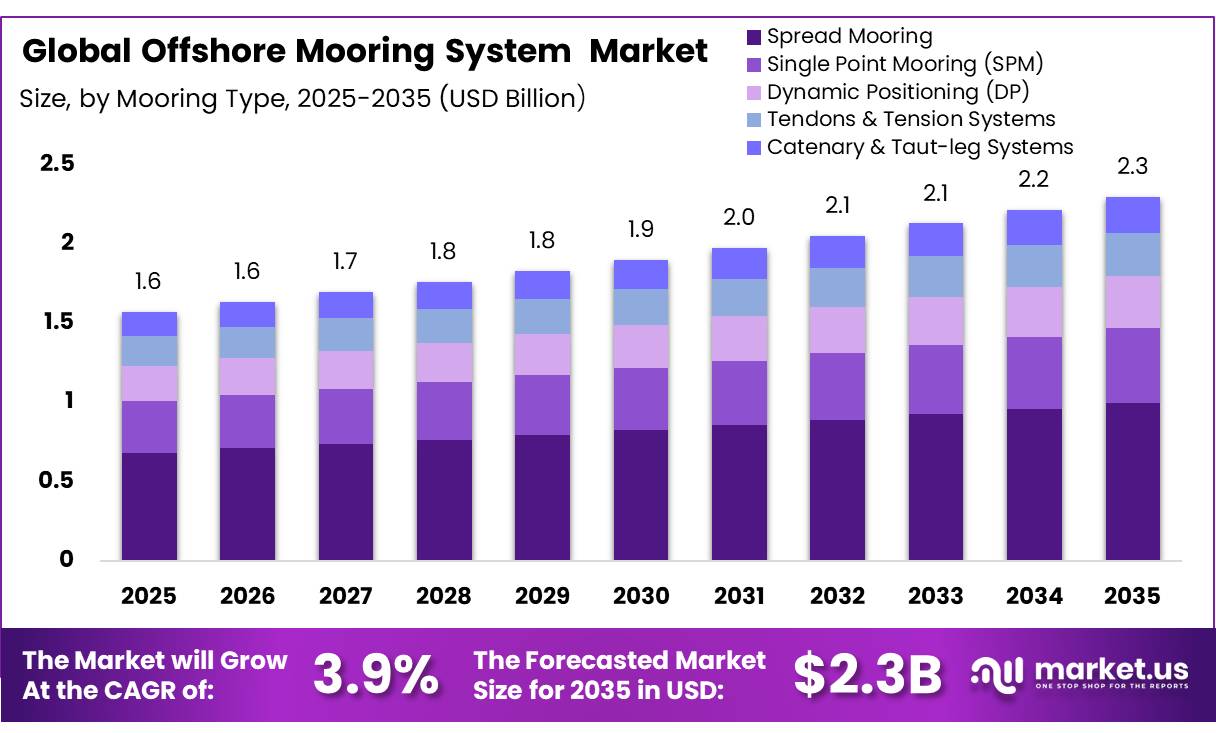
Key Takeaways
- The Global Offshore Mooring System Market was valued at USD 1.6 billion in 2025.
- The market is projected to reach USD 2.3 billion by 2035, growing at a CAGR of 3.9% during 2026–2035.
- Asia Pacific held the leading regional position with a 31.0% market share, generating USD 0.49 billion in revenue in 2025.
- Spread Mooring dominated the market with a 43.40% share.
- Drag Embedment Anchors accounted for the largest 48.40% share by anchorage type.
- Deep Water (400 to 1,500 meters) represented 45.20% of the market.
- Floating Production Storage & Offloading (FPSO) led applications with a 36.50% share.
- Oil & Gas Exploration remained the leading end-use industry with a 46.20% revenue share.
- Increasing deepwater developments and floating renewable energy projects continue to support demand for advanced offshore mooring systems.
Mooring Type Analysis
Spread Mooring dominated the market with a 43.40% share in 2025 due to its dependable station-keeping capabilities across floating production, storage and offloading units, semi-submersibles, drillships, and other offshore facilities. The system distributes mooring lines around the vessel, enabling operators to manage environmental loads, reduce vessel movement, and improve operational safety. Its proven engineering design, flexibility, and suitability for deepwater developments continue to support widespread adoption across offshore production projects.
According to MODEC, in April 2025, the company received a limited notice to proceed for the Hammerhead FPSO project, which is planned to utilize a SOFEC Spread Mooring System, reinforcing the continued preference for this mooring configuration.
Single Point Mooring (SPM) represents the growing segment because it enables vessels to rotate around a single connection point, allowing alignment with changing wind, waves, and current conditions. Its efficient transfer arrangement, smaller seabed footprint, simplified installation, and suitability for offshore terminals and tanker loading operations continue to increase adoption across offshore developments.
Anchorage Type Analysis
Drag Embedment Anchors captured more than 48.40% of the market in 2025, making them the leading anchorage solution. Their popularity is driven by reliable holding performance, cost efficiency, straightforward installation, retrievability, and compatibility with a wide range of seabed conditions. These anchors provide dependable support for floating production units, drilling rigs, semi-submersibles, and offshore platforms requiring permanent mooring systems.
According to Acteon, in August 2025, Bruce Anchor supplied drag embedment anchors for the SHEN LAN TAN SUO rig, demonstrating the continued industry preference for proven anchoring technologies.
Suction Anchors continue to gain momentum as offshore projects expand into deeper waters requiring accurate placement, high-capacity foundations, and reliable resistance against vertical and horizontal loads. Their controlled installation process and suitability for soft clay seabeds support increasing deployment across floating production facilities and offshore wind developments.
Water Depth Analysis
Deep Water (400 to 1,500 meters) remained the dominant water-depth segment with a 45.20% market share in 2025. Growth is supported by increasing offshore production activities where floating production units, semi-submersibles, and drillships require advanced mooring systems capable of withstanding strong currents, waves, and environmental loading. Engineered anchors, chains, synthetic ropes, and wire lines ensure safe long-term operations while supporting complex subsea infrastructure and remote offshore developments.
According to Allseas, in March 2025, its anchor-positioned Sandpiper barge completed nearshore construction work for the Darwin Pipeline Duplication project, highlighting dependable positioning capabilities during offshore operations.
Shallow Water (≤ 400 meters) is emerging as the fastest-growing segment due to increasing nearshore oil, gas, and renewable-energy developments, lower installation complexity, shorter project timelines, and more economical mooring requirements.
Application Analysis
Floating Production Storage & Offloading (FPSO) accounted for 36.50% of the market in 2025, making it the leading application segment. FPSO facilities combine offshore production, processing, storage, and tanker loading within a single floating installation, making them highly suitable for remote offshore fields where fixed platforms may not be practical. Reliable mooring systems are essential to maintain vessel stability, protect risers, and ensure safe offshore operations under changing marine conditions.
According to MODEC, in March 2025, Shell reached the final investment decision for the Gato do Mato FPSO project, while MODEC secured agreements covering vessel delivery and long-term operations.
Tension Leg Platforms (TLP) continue to experience increasing demand because vertically tensioned tendons minimize heave movement, improve well access, enhance riser performance, and support stable production in deeper offshore environments.
End Use Analysis
Oil & Gas Exploration dominated the end-use segment with a 46.20% revenue share in 2025. Floating production units, offshore drilling rigs, semi-submersibles, and offshore terminals rely heavily on dependable mooring systems to maintain position, protect transfer infrastructure, and ensure operational safety under continuously changing offshore conditions. Established engineering standards and long operating lifecycles continue to reinforce demand across offshore exploration activities.
According to the United Kingdom Government, in March 2026, funding support of up to 64 million was announced for a Port Talbot offshore wind hub intended to strengthen infrastructure supporting floating projects in the Celtic Sea.
Offshore Renewable Energy (Floating Wind, Wave, & Tidal) continues to grow as developers increasingly deploy floating energy platforms in deeper waters where fixed foundations are less practical. Expanding technology trials, port development, and supply-chain investments are creating opportunities for advanced anchors, synthetic ropes, connectors, and monitoring systems.
Key Market Segments
Mooring Type
- Spread Mooring
- Single Point Mooring (SPM)
- Dynamic Positioning (DP)
- Tendons & Tension Systems
- Catenary & Taut-leg Systems
Anchorage Type
- Drag Embedment Anchors
- Suction Anchors
- Vertical Load Anchors
- Gravity Anchors
- Driven Piles
Water Depth
- Shallow Water (≤ 400 meters)
- Deep Water (400 to 1,500 meters)
- Ultra-deep Water (> 1,500 meters)
Application
- Floating Production Storage & Offloading (FPSO)
- Tension Leg Platforms (TLP)
- Semi-submersibles
- SPAR Platforms
- Floating Liquefied Natural Gas (FLNG)
- Drillships
End-Use Industry
- Oil & Gas Exploration
- Offshore Renewable Energy (Floating Wind, Wave, & Tidal)
Driving Factors
Growing deepwater FPSO developments continue to drive demand for offshore mooring systems. In 2025, the global FPSO fleet included 185 active units, 12 idle units available for redeployment, and 23 units on order or under construction. Each floating production project creates demand for engineering services, anchors, chains, connectors, installation activities, monitoring systems, and long-term integrity management, supporting sustained market growth throughout the forecast period.
Restraining Factors
Market expansion remains affected by fluctuations in upstream oil and gas capital expenditure. The International Energy Agency (IEA) estimated upstream oil investment at approximately USD 570 billion in 2025, while scenarios including a 6% decline due to softer oil prices and moderated demand expectations could delay deepwater projects. Longer tender cycles, underutilized fabrication capacity, fluctuating input costs, and postponed final investment decisions continue to create uncertainty for offshore mooring suppliers.
Growth Opportunity
A major opportunity lies in developing integrated lifecycle platforms combining structural health monitoring, predictive analytics, remote integrity inspection, and performance-based maintenance services. Converting 10–20% of existing FPSO and floating offshore wind mooring assets into subscription-based monitoring services valued at USD 0.5–1 million per asset per year could create a significant long-term addressable market. Software and digital monitoring services with 25–35% EBITDA margins, compared with traditional hardware businesses, also provide opportunities to improve profitability while reducing customer operating costs by 5–10% through optimized maintenance and failure prevention.