Spacer Fluid Market Research, Trends and Industry Growth Analysis
Explore the Spacer Fluid Market, valued at USD 251.7 Million in 2025 and projected to reach USD 431.7 Million by 2035 at a CAGR of 5.5%. https://market.us/report/spacer-fluid-market/
 sonicbolt20
Overview
Spacer Fluid Market was valued at USD 251.7 Million in 2025 and is projected to attain USD 431.7 Million by 2035, registering a CAGR of 5.5% between 2026 and 2035. North America dominated the global market with a 63.9% share, generating USD 160.8 Million in revenue during 2025. Spacer fluids are essential for effective well cementing by separating drilling mud from cement slurry, improving mud removal, and supporting durable cement bonds. Strong upstream oil and gas investment, offshore resource development, and well-abandonment initiatives continue to provide favorable market growth conditions.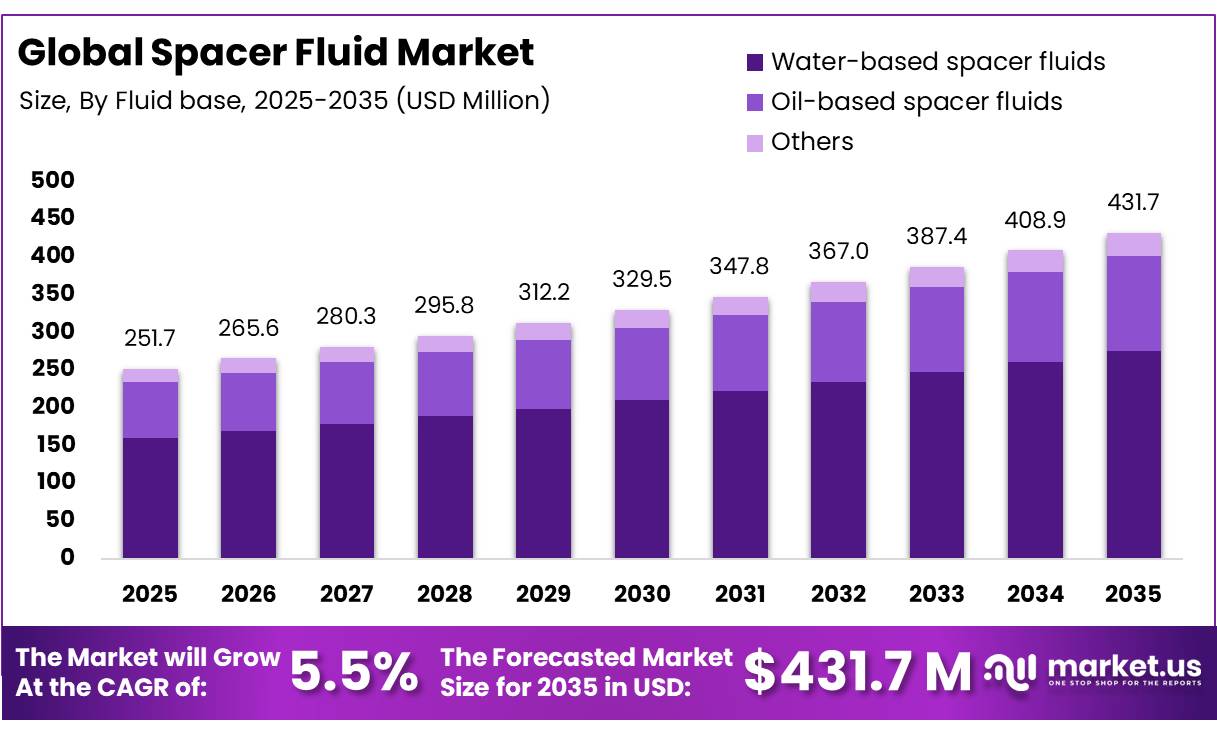
Key Takeaways
- The Global Spacer Fluid Market was valued at USD 251.7 Million in 2025.
- The market is projected to reach USD 431.7 Million by 2035 at a CAGR of 5.5% during 2026–2035.
- North America held the leading regional position with a 63.9% market share, accounting for USD 160.8 Million in revenue in 2025.
- Water-based Spacer Fluids dominated the market with a 63.8% share.
- Onshore applications accounted for the largest market share of 73.8% in 2025.
- Offshore operations are expected to register the fastest growth during the forecast period.
- Rising upstream oil and gas investments continue to support demand for spacer fluids.
- Regulatory initiatives for well plugging and offshore lease sales are expected to sustain long-term market demand.
Analysis Sections
Spacer fluid is a specially formulated liquid pumped between drilling mud and cement slurry during primary cementing, remedial cementing, and well-abandonment operations. It prevents incompatible fluids from mixing, removes residual mud and filter cake, water-wets the casing and formation, and supports a reliable cement bond. Product performance depends on rheology, density, chemical compatibility, solids suspension, and environmental safety. Halliburton reports that its Tuned Prime spacer reduces crystalline silica by more than 93% while performing at temperatures up to 280°F.
According to the International Energy Agency, global upstream oil and gas investment reached approximately USD 570 billion in 2025, with nearly 90% of annual spending since 2019 dedicated to offsetting production declines. The agency also reported average post-peak decline rates of 5.6% for conventional oil fields and 6.8% for conventional gas fields, highlighting the continued need for drilling and well construction activities that support spacer fluid demand.
The U.S. Energy Information Administration (EIA) reported that active oil and natural gas rig counts in the Lower 48 states declined from 750 in December 2022 to 517 in October 2025. Oil-directed rigs decreased 33% to 397, while natural gas-directed rigs fell 23% to 120. The November 2025 Short-Term Energy Outlook projected West Texas Intermediate crude oil averaging 51 U.S. dollars per barrel in 2026, while Henry Hub natural gas prices are expected to increase to 4.02 U.S. dollars per million British thermal units, influencing future drilling activity.
The Bureau of Ocean Energy Management (BOEM) states that the Gulf of America contributes approximately 14% of United States crude oil production. Offshore leasing generated more than 7 billion U.S. dollars for the U.S. Treasury during Fiscal Year 2024 through bonuses, rentals, and royalties. BOEM also estimates that the region contains nearly 30 billion barrels of undiscovered technically recoverable oil and more than 50 trillion cubic feet of natural gas, supporting long-term demand for well construction and cementing services.
Government policies continue to reinforce drilling and abandonment activities. The One Big Beautiful Bill Act (OBBBA) requires the Department of the Interior to conduct at least 30 offshore lease sales in the Gulf of America and 6 in Alaska's Cook Inlet through 2040. Additionally, the Bipartisan Infrastructure Law allocates 4.7 billion U.S. dollars for plugging orphaned oil and gas wells across the country, maintaining demand for spacer fluids in well construction and abandonment projects.
Key Market Segments
By fluid base
- Water-based spacer fluids
- Oil-based spacer fluids
- Others
By location
- Onshore
- Offshore
Driving Factors
Growing investment in natural gas development continues to strengthen demand for spacer fluids. The International Energy Agency expects global energy investment to reach USD 3.3 trillion in 2025, with fossil fuel spending totaling around USD 1.1 trillion. Upstream natural gas spending in 2026 is projected to increase 8% compared to 2025, even as oil investment declines for the third consecutive year. Expanding LNG projects, sour gas developments, offshore drilling, and deeper wells require efficient cementing operations where spacer fluids improve mud removal, gas migration control, and annular seal quality. This trend contributes an estimated +1.2 percentage-point impact on market CAGR, particularly across the Middle East, North America, and APAC LNG corridors.
Restraining Factors
Local-content regulations and fragmented approval processes continue to slow the introduction of new spacer fluid formulations across MENA and APAC markets. National oil companies and regulatory agencies increasingly require locally sourced chemicals, regional testing, certification, and partnerships with domestic manufacturers before commercial deployment. These requirements can extend product qualification timelines by 6–12 months, increase regional development costs, and reduce economies of scale. The resulting delays in product launches and adoption of advanced chemistries create an estimated -0.8 percentage-point impact on overall market CAGR.
Growth Opportunity
Enhanced geothermal systems (EGS) and next-generation geothermal drilling present a significant growth opportunity for spacer fluid manufacturers. These projects utilize oil and gas drilling technologies but operate under much higher bottomhole temperatures, requiring advanced spacer fluids with improved thermal stability and high-temperature rheological performance. Commercial deployment remains at an early stage, with only a limited number of demonstration projects, including Fervo's Project Red, operating as of March 2026. Global geothermal investment is expected to grow at approximately 20% annually through 2030, while geothermal drilling capital expenditure is projected to reach the low-double-digit billions by the early 2030s. Suppliers developing qualified high-temperature spacer chemistries can benefit from an estimated +1.7 percentage-point CAGR opportunity across North America, the EU, and the East African Rift geothermal corridor.