Custom Mobile App vs. Ready-Made Solution: Which One Is Right for Your Business?
Mobile app development services aren’t just for big names. Today, startups, hospitals, banks, schools, textile firms, and other businesses opt for mobile applications
 jmaxx
jmaxx 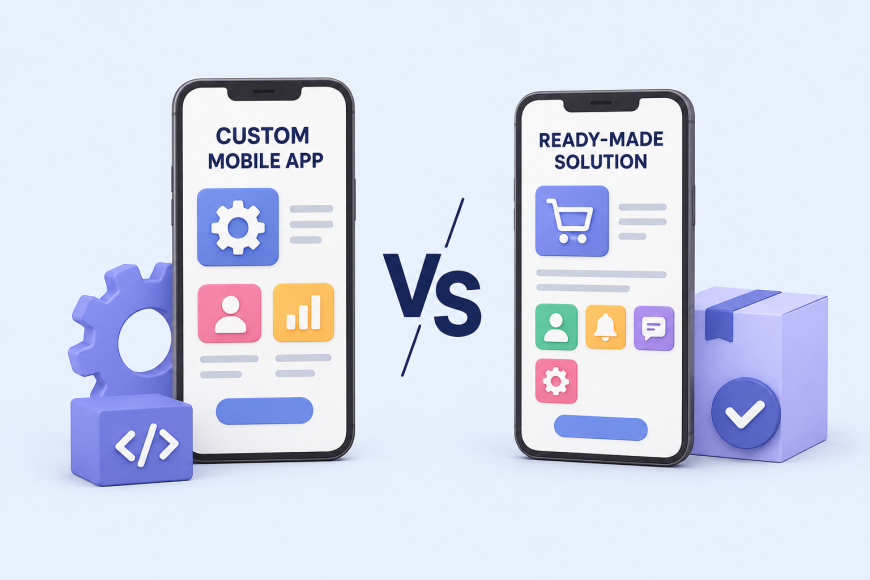
Mobile app development is no longer limited to large corporations. Startups, hospitals, banks, educational institutions, textile companies, and businesses across various industries now rely on mobile applications to serve customers and improve their operations. However, when a business decides to build an app, one of the first questions it faces is whether to choose a custom mobile app or a ready-made solution.
Both options have their own advantages. A ready-made application can help businesses launch faster while reducing the initial development effort. A custom application, on the other hand, offers greater flexibility and more opportunities to create a unique product that stands out from competitors. The right choice ultimately depends on the company's goals, specific requirements, budget, and long-term development plans.
Cost should not be the only factor when comparing these two approaches. Businesses should also evaluate scalability, integration capabilities, user experience, security, maintenance requirements, ownership, and the total cost of using the application over time.
What Is a Custom Mobile App?
A custom mobile application is developed specifically around the requirements of a particular business, product, or target audience. Instead of starting with a fixed set of features, the development process begins by understanding the company's objectives, customers, workflows, technical requirements, and future plans.
With custom development, businesses have greater control over how their applications work. Everything from the user interface and functionality to the application architecture, backend infrastructure, APIs, and database can be designed according to the company's specific business model.
For example, consider a logistics company that needs an application to manage several processes, including connecting customers with dispatchers, processing payments, tracking deliveries, and supporting internal communication. A standard application may not provide all of these capabilities in one place. A custom solution can be designed specifically around the company's operational requirements.
Similarly, white label mobile app development can be valuable for businesses that want to introduce features or experiences that are not commonly available in competing applications. Unique functionality can help a company differentiate its product and create a stronger competitive position.
However, custom development usually requires more planning, resources, and development time before the application is ready for launch.
What Is a Ready-Made Mobile App Solution?
A ready-made mobile app solution is an existing application, SaaS product, white-label platform, or software solution that a company can purchase or use instead of developing an application from scratch.
Businesses exploring ready-made approaches to app development can also consider Clone App Development Solutions when they need a foundation that can be adapted to their business model. Depending on the project, features, integrations, and user experiences can be adjusted to support the way the business operates.
The biggest advantage of this approach is speed.
Since many of the necessary components have already been developed, businesses can bring their applications to market much faster than they typically could with custom development. This can be particularly useful for startups and companies entering a new market where validating an idea and receiving early customer feedback are important.
Ready-made solutions can also reduce the amount of development work required. Common features such as user registration, profiles, dashboards, messaging, payment processing, notifications, and administrative functions may already be included.
However, convenience can come with limitations. Businesses are generally restricted by the features and architecture offered by the existing platform. If a company requires a highly specific function, additional customization may be necessary.
There may also be some dependence on the provider. Changes to pricing, technology, support, features, or platform policies can affect the business using the solution.
Custom App vs. Ready-Made Solution: What Is the Difference?
| Factor | Custom Mobile App | Ready-Made Solution |
|---|---|---|
| Development time | Usually longer | Usually faster |
| Initial investment | Generally higher | Generally lower |
| Customization | Extensive | Limited to moderate |
| User experience | Designed for specific users | Based on an existing framework |
| Integrations | Built according to business requirements | Dependent on available integrations |
| Scalability | Can be planned around future growth | Depends on platform capabilities |
| Control | Greater control | Often dependent on the provider |
| Maintenance | Greater control over maintenance | Often shared with or dependent on provider |
| Differentiation | Strong potential | More limited |
| Deployment | Requires a development cycle | Usually faster |
When these factors are considered together, there is no universal winner. For example, a small startup with a straightforward app idea and a limited budget may benefit more from launching quickly with an existing platform.
In contrast, a business developing an application that is central to its competitive advantage may discover that the limitations of an off-the-shelf solution become costly as the business grows.
When Should You Choose a Custom Mobile App?
Custom development becomes a stronger choice when the application is closely connected to a company's business model, operations, or competitive strategy.
One of the main reasons to choose custom development is unique functionality. If an application requires workflows or features that standard platforms cannot provide, a custom solution gives the business the freedom to build them according to its needs.
Custom development is also worth considering when a company expects its application to grow significantly over time. An app might start with basic functionality and later require advanced analytics, artificial intelligence, complex APIs, multiple user roles, payment gateways, location-based services, enterprise integrations, or sophisticated administrative tools.
User experience is another important factor. For businesses where the mobile experience is a major part of the product, custom development allows designers and developers to create user journeys around the behavior and expectations of their specific audience rather than adapting those journeys to an existing platform.
A custom application can also be a better option when a business needs greater control over its data, infrastructure, security, and integrations. Companies operating in industries with specific operational, privacy, or regulatory requirements may need this additional level of control.
Overall, custom development is generally more suitable when flexibility, scalability, differentiation, and long-term control are more important than launching an app as quickly as possible.
When Is a Ready-Made Solution the Better Choice?
A ready-made solution can be a practical option for businesses with straightforward requirements, limited development time, or restricted budgets.
For example, a startup may want to test whether customers are interested in a new service before investing heavily in development. In such cases, spending a large amount on a fully customized application may not make sense before the business has validated its idea. A ready-made solution can help the company launch sooner, gather customer feedback, and determine whether further investment is justified.
Pre-built solutions can also work well for businesses that only need standard features such as user accounts, profiles, content management, notifications, booking functionality, payments, and basic administration.
Budget allocation is another consideration. Businesses with limited resources may prefer to invest their available funds in marketing, customer acquisition, operations, or market testing rather than spending heavily on application customization during the early stages.
However, businesses should look beyond the initial price when evaluating a ready-made solution. Although the upfront cost may appear lower, expenses can increase when customization, integrations, subscriptions, upgrades, maintenance, provider fees, and other requirements are taken into account.
For this reason, businesses should evaluate the total cost of ownership rather than focusing only on the initial development price. A ready-made solution may be the most economical choice for a simple short-term project, while a custom application could provide better value for a business with complex requirements and long-term growth plans.