Camera Based Profile Projector: A Complete Practical Guide for Accurate Non-Contact Measurement in Australia
Explore camera based profile projectors for accurate, non-contact measurement of rubber, cable, tools, and plastic parts in Australia.
 sipconinstrument
In modern manufacturing, dimensional accuracy is no longer a quality advantage—it is a basic requirement. As component geometries become smaller, softer, and more complex, traditional contact-based measurement tools often fail to deliver consistent results. This is where a camera based profile projector plays a critical role. Designed for fast, non-contact profile measurement, these systems are increasingly adopted across Australian industries such as automotive, cable & wire, rubber processing, plastics, electronics, and precision tooling.
This in-depth guide explains what a camera based profile projector is, how it works, where it is used, how it compares with conventional profile projectors, and what factors Australian manufacturers should consider before investing.
What Is a Camera Based Profile Projector?
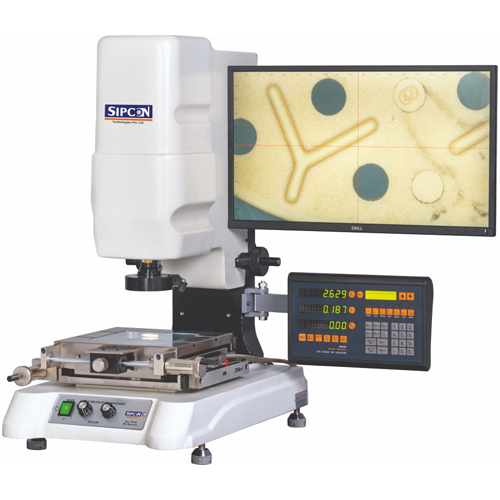
A camera based profile projector is an advanced optical measurement system that uses a high-resolution industrial camera instead of a traditional projection lens and screen. The camera captures the silhouette or edge profile of a component and displays it digitally on a monitor, where measurement software calculates dimensions with high precision.
Unlike conventional optical projectors, camera based systems eliminate manual tracing, visual fatigue, and operator subjectivity. Measurements are performed digitally, making the process faster, repeatable, and suitable for modern quality control environments.
How a Camera Based Profile Projector Works
The working principle is straightforward but highly effective. The component is placed on a precision stage under controlled illumination. Light passes around or through the part, creating a sharp contrast between the object and the background. A high-resolution camera captures this profile, and specialized software detects edges and calculates dimensions automatically.
Because the measurement is fully non-contact, the system is ideal for soft, flexible, or delicate components where physical probing could cause deformation or damage.
Why Manufacturers Are Moving Away from Conventional Profile Projectors
Traditional profile projectors rely heavily on operator skill. Manual focusing, screen reading, and overlay comparison introduce inconsistency, especially during high-volume inspection. Camera based systems remove these limitations.
Digital profile measurement ensures:
-
Faster inspection cycles
-
Higher repeatability across shifts
-
Reduced dependency on skilled operators
-
Easy data storage and reporting
For Australian manufacturers aiming to meet international quality standards, these advantages translate directly into better process control and reduced rejection rates.
Key Industries Using Camera Based Profile Projectors in Australia
Camera based profile projectors are not limited to a single sector. Their versatility makes them suitable for a wide range of applications.
Rubber and Polymer Components
Soft rubber parts, O-rings, seals, and gaskets deform easily under contact measurement. Non-contact optical inspection ensures true shape measurement without compression errors.
Cable and Wire Manufacturing
Profile inspection of cable insulation thickness, concentricity, and outer diameter is critical. Camera based systems provide clear edge detection even on dark or transparent insulation materials.
Cutting Tools and Precision Machining
Tool angles, edge radii, and flute profiles can be measured accurately without touching sharp cutting edges, improving tool life and safety.
Plastic Injection Moulded Parts
Complex profiles, flash detection, and dimensional verification are performed quickly, helping reduce moulding defects and rework.
Electronics and Micro Components
Small connectors, stamped parts, and miniature components require high magnification and digital measurement accuracy that camera based projectors provide.
Camera Based Profile Projector vs Optical Profile Projector
The fundamental difference lies in measurement approach. Optical projectors rely on visual comparison, while camera based systems use digital image processing.
Camera based systems offer better consistency, faster results, and easier data integration with modern quality systems. They are also more suitable for statistical process control and traceability requirements.
Key Features to Look for Before Buying
Choosing the right system depends on application needs, part size, and accuracy requirements.
Camera Resolution and Optics
Higher resolution cameras provide sharper edge detection and better measurement repeatability, especially for small components.
Illumination Quality
Uniform backlight and contour illumination are critical for clean profiles. Poor lighting leads to inaccurate edge detection.
Measurement Software
User-friendly software with automatic edge detection, GD&T tools, and report generation saves time and reduces human error.
Stage Stability and Movement
A smooth, backlash-free stage ensures precise positioning and long-term accuracy.
Calibration and Accuracy Standards
Ensure the system complies with relevant measurement standards and offers easy calibration support in Australia.
Common Mistakes Buyers Make
Many buyers focus only on camera resolution and overlook illumination quality and software capability. Others choose systems without considering after-sales support, training, and local service availability. A camera based profile projector is a long-term investment, not just a one-time purchase.
Maintenance and Long-Term Reliability
Camera based profile projectors require minimal maintenance compared to mechanical measurement systems. Regular cleaning of optics, periodic calibration, and software updates are usually sufficient to maintain accuracy over years of operation.
Why Camera Based Profile Projectors Are Ideal for Australian Manufacturing
Australian manufacturers often operate in high-mix, low-volume environments where flexibility matters. Camera based systems adapt easily to different part types without extensive re-tooling. Their digital nature also supports remote audits, data sharing, and compliance with international customers.
Future Trends in Profile Measurement
Integration with vision measurement systems, AI-based edge detection, and automation compatibility are shaping the future of camera based profile projectors. These developments will further reduce inspection time and improve consistency across production lines.
Frequently Asked Questions (FAQs)
Is a camera based profile projector suitable for rubber parts?
Yes. Non-contact measurement makes it ideal for soft and flexible materials without deformation.
Can it replace a traditional profile projector?
In most applications, yes. Camera based systems offer faster, more repeatable, and digitally traceable results.
What accuracy can be expected?
Accuracy depends on optics, camera resolution, and calibration, but modern systems achieve micron-level precision for most industrial applications.
Is operator training required?
Basic training is sufficient. Most systems are designed for ease of use with minimal manual intervention.
Can measurement data be exported?
Yes. Digital systems support report generation and data export for quality audits and process analysis.
Conclusion
A camera based profile projector is no longer a luxury—it is a practical solution for manufacturers seeking speed, accuracy, and consistency in dimensional inspection. For Australian industries working with complex, delicate, or high-precision components, this technology provides measurable advantages in quality control and productivity.
By selecting the right system with proper illumination, software, and local support, manufacturers can future-proof their inspection process and maintain competitive quality standards in global markets.
Call Now: +61 426 368 868
Email: [email protected]