AI-Enhanced Medical Coding Services for Smarter Healthcare
AI-enhanced Medical Coding Services boost accuracy, speed, and compliance—helping healthcare providers achieve smarter, faster, and error-free billing.
 Jaxonknox
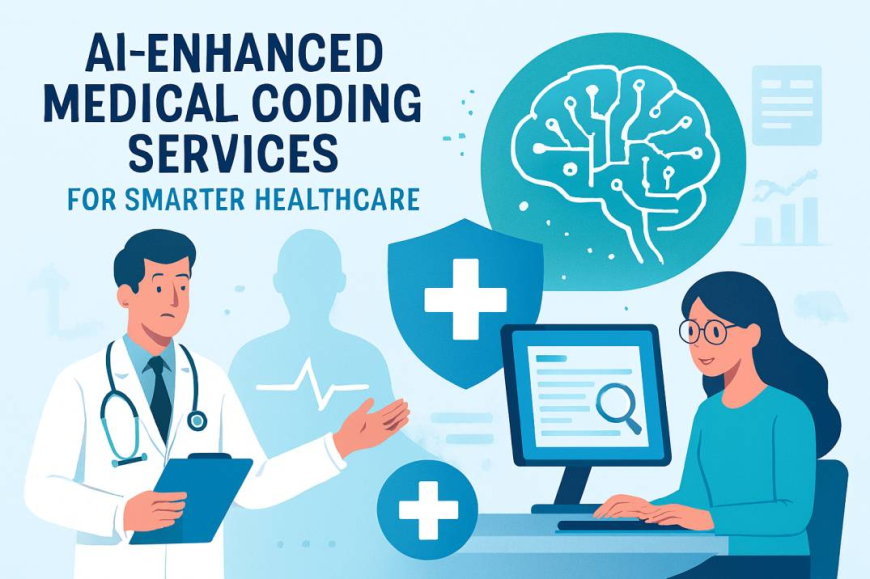
In healthcare, accuracy and speed define how well a system serves both patients and providers. Every diagnosis, treatment, and procedure relies on proper documentation — a task often handled through Medical Coding Services. Traditionally, this has been a manual and time-intensive process. But with artificial intelligence (AI) becoming more accessible and precise, medical coding has entered a new phase of innovation and efficiency.
AI-enhanced coding doesn’t just mean automation — it means smarter, context-aware processing that helps coders, clinicians, and billing teams work more effectively. Let’s explore how AI is reshaping the landscape of medical coding and what it means for the future of healthcare organizations.
Understanding the Role of Medical Coding
Medical coding is the process of converting healthcare diagnoses, procedures, and treatments into standardized alphanumeric codes. These codes are used in billing, insurance claims, and record management. They ensure that healthcare providers get reimbursed correctly and that patient data is accurately recorded for future use.
Errors in coding can lead to claim rejections, compliance risks, and financial losses. That’s why Medical Coding Services are critical for hospitals, clinics, and private practices — they act as the bridge between clinical documentation and administrative efficiency.
The Limitations of Traditional Coding
Despite being essential, traditional coding methods are prone to human error. Manual processes can lead to:
-
Inaccurate code selection due to oversight or misunderstanding of documentation.
-
Delays in claims submission, impacting revenue cycles.
-
Inconsistent coding practices across different departments or teams.
-
Burnout among coders, who handle thousands of entries daily.
These limitations make it difficult for healthcare providers to maintain both accuracy and speed, especially as medical data continues to grow exponentially.
How AI Transforms Medical Coding
AI introduces a paradigm shift — not by replacing human coders, but by empowering them. Here’s how AI-enhanced Medical Coding Services are changing the game:
1. Automated Code Prediction
AI algorithms trained on millions of medical records can automatically predict the most relevant codes based on a physician’s notes or clinical reports. This reduces the time spent on manual lookups and minimizes human error.
2. Contextual Understanding
Natural Language Processing (NLP) enables AI systems to interpret unstructured clinical notes. They don’t just look for keywords; they understand the context — such as whether a procedure was diagnostic or therapeutic — and assign codes accordingly.
3. Real-Time Error Detection
AI tools can instantly flag discrepancies or missing data in medical documentation. This ensures that claims are complete and accurate before submission, reducing rejections and denials.
4. Continuous Learning
Modern AI systems improve over time. They learn from coding corrections, claim feedback, and audit results — becoming more accurate and reliable with every use.
5. Enhanced Compliance
AI ensures adherence to ever-changing coding standards such as ICD-10, CPT, and HCPCS. It automatically updates its coding database and flags any non-compliant entries, helping organizations stay audit-ready.
Benefits for Healthcare Providers
The integration of AI into Medical Coding Services creates measurable benefits across the healthcare ecosystem:
-
Faster Turnaround Time: Coding tasks that once took hours can now be completed in minutes.
-
Higher Accuracy: Fewer errors mean more successful claims and better compliance.
-
Improved Revenue Cycle Management: Clean claims lead to faster reimbursements and better cash flow.
-
Reduced Administrative Burden: Coders can focus on complex cases rather than repetitive tasks.
-
Scalability: AI systems can handle large volumes of medical data without compromising quality.
When combined with skilled human oversight, AI becomes a productivity multiplier — improving both operational efficiency and patient outcomes.
The Role of Human Coders in the AI Era
While AI brings automation and intelligence, human expertise remains central to the coding process. Coders interpret clinical nuances, apply judgment to ambiguous cases, and ensure ethical and regulatory compliance.
AI acts as an assistant — performing initial code suggestions and error checks — while the human coder validates and finalizes each record. This collaborative workflow enhances productivity while maintaining the highest standards of accuracy.
Integration with Electronic Health Records (EHRs)
AI-driven coding platforms can seamlessly integrate with existing Electronic Health Record (EHR) systems. This integration allows instant access to clinical notes, lab results, and patient histories — helping AI engines assign the right codes automatically.
EHR integration also supports analytics and reporting. Hospitals can identify coding patterns, track claim performance, and make data-backed decisions to optimize their revenue cycles.
Security and Data Privacy Considerations
AI systems in healthcare must operate within strict privacy frameworks like HIPAA. Reputable Medical Coding Services that use AI ensure:
-
Data Encryption: All patient information is stored and transmitted securely.
-
Access Control: Only authorized personnel can view or modify coding data.
-
Anonymization: Sensitive details are masked or anonymized for model training.
-
Regular Audits: Systems are routinely checked for compliance and security vulnerabilities.
These safeguards ensure that technology enhances trust rather than compromising it.
Challenges and Future Outlook
Despite the advantages, implementing AI-enhanced coding is not without challenges. Organizations must invest in training, integration, and ongoing system updates. Data quality also matters — poor documentation can limit the accuracy of AI predictions.
However, as healthcare becomes more digital and data-driven, the role of AI will only grow. Future systems may combine predictive analytics, voice recognition, and real-time feedback to create fully autonomous coding workflows.
AI will also support predictive billing — identifying patterns that indicate claim denial risks before submission. This proactive approach could transform revenue management across the healthcare sector.
Conclusion
AI-enhanced Medical Coding Services represent the next leap toward smarter, faster, and more reliable healthcare operations. By combining the precision of AI with the expertise of certified coders, healthcare organizations can achieve unmatched accuracy and efficiency in medical documentation and billing.
This blend of technology and human insight is redefining how coding teams work — creating a future where administrative tasks no longer slow down patient care but support it intelligently and seamlessly.