What Does a Zero Downtime Migration Actually Look Like?
But here’s what most migration horror stories have in common: they were avoidable. Zero Downtime Cloud Migration is not a marketing promise, it’s a repeatable outcome for businesses that approach the process with the right strategy. This blog will show you exactly what that looks like.
 Lency_Korien
What’s at Stake?
Let’s break down the risks of migration downtime into terms that resonate with you, it's not just about servers and databases, but about your bottom line, your brand, and your relationships with customers.
Imagine an hour of downtime for your e-commerce business during peak sales season, it could translate to tens of thousands of dollars in lost revenue. For a SaaS platform, even a brief outage can lead to SLA penalties and erode customer trust, consequences that can take months to mend. The risk of data loss during migration is even more concerning; corrupted or missing records don’t just cause operational turmoil, they can lead to compliance issues and permanently damage the trust of the customers who rely on you to safeguard their information.
These aren't just rare occurrences; they represent the genuine costs associated with a migration that hasn’t been meticulously planned.
Beyond the immediate financial hit, there’s another cost that often goes unnoticed: your team. Engineers may find themselves racing against time to recover, account managers will be dealing with frustrated clients, and leadership will be distracted from strategic initiatives. A botched migration isn't merely an IT headache—it sends shockwaves across the entire organization.
The good news? All of these risks can be managed effectively with the right strategy.
Why Do Most Migrations Falter?
The stakes are significant. McKinsey suggests that cloud adoption could unlock $1 trillion in business value, yet about $100 billion of that is projected to be squandered over the next three years due to poorly managed migrations. The potential is vast, but the room for errors is slim.
So, where do things typically stumble? Businesses that face downtime or data loss during a cloud migration often share common pitfalls, and none of them are unavoidable.
1. Rushing the process:
The urge to “just get it done” often leads to skipping crucial discovery phases, overlooking dependencies, and facing unwelcome surprises on cutover day.
2. Underestimating complexity:
Many organizations underestimate the intricacies of their systems. Legacy systems, custom integrations, and undocumented workflows can derail a migration when they're not given the attention they deserve.
3. Choosing the wrong partner:
Collaborating with a migration partner who has limited experience is risky compared to working with one that has successfully managed large-scale migrations across various industries, complete with documented outcomes. The difference becomes glaringly obvious when things get tough.
4. Viewing it as merely an IT project:
This is perhaps the most widespread error. Cloud migration is fundamentally about business transformation. The choices made during planning have repercussions for customers, operations, and growth, not just the infrastructure team. Companies that treat it as a mere checklist item for IT are often the ones that make headlines for the wrong reasons.
The silver lining in recognizing these pitfalls is that if they are avoidable, so too are their potential repercussions.
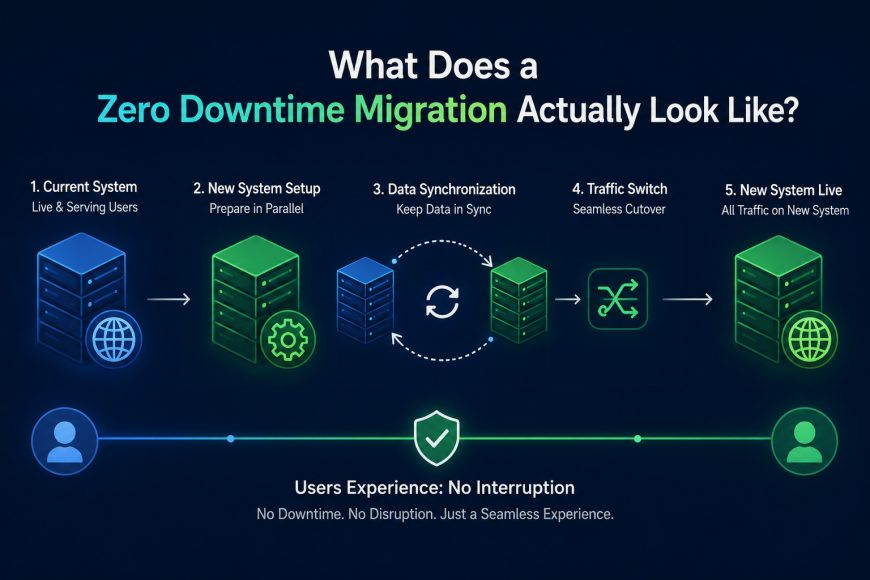
What Does a Zero Downtime Migration Actually Look Like?
Is zero downtime cloud migration achievable? Absolutely! And it’s not just a fantasy. Achieving Zero Downtime Cloud Migration requires meticulous planning: workloads are moved in phases, old and new environments run side by side during the transition, and the switchover occurs only after the new setup has been thoroughly validated. With comprehensive rollback strategies and constant monitoring at every phase, businesses can progress without sacrificing availability.
Here’s how a smoothly executed migration unfolds from a business standpoint:
Phased Migration, Not a Big Bang
Instead of transferring everything in one fell swoop, workloads are shifted in logical clusters, starting with lower-risk systems and saving critical applications for last. Each phase boosts your team's confidence before proceeding to the next.
Parallel Running
Throughout the transition, both the current systems and the new cloud environment operate simultaneously. Your customers remain completely unaware of the change since there’s never a period where services are offline.
Rollback Capability
Should any unexpected issues arise, the plan incorporates a well-defined, tested route back. This isn’t negativity; it’s professionalism. Having a rollback strategy is one of the most evident indicators of a sophisticated migration approach.
Business Continuity Checkpoints
Before any final switchover, the migration team ensures that customer-facing services are functioning correctly in the new environment, not just in technical terms but with regard to actual business outcomes.
AWS Cloud Migration offers the essential infrastructure that enables this process. AWS services are specifically designed for seamless continuity during migration, providing automated replication, traffic routing controls, and validation tools that experienced partners like OpsTree Global utilize to keep your operations running smoothly throughout the transition.
Here's how we enabled a prominent e-commerce company to achieve impressive 70–80% cost savings during their cloud migration without any downtime.
A leading Dubai-based e-commerce firm sought to transition its entire infrastructure from Azure to GCP, requiring a flawless execution with no room for service interruptions. OpsTree accomplished this complex migration in just two months, maintaining continuous service without any downtime throughout the process. To enhance reliability, we implemented an automated rollback mechanism, which safeguarded ongoing services and ensured business continuity at every stage.
The migration was carried out smoothly, with full service availability, zero data loss, and no impact on customers. Besides providing uninterrupted operational reliability, crucial for a business that cannot afford downtime, this transformation significantly reduced the client's operational costs by 70–80%, achieving both stability and substantial cost savings at scale.
For more info : zero-down-time cloud migration strategy