XL Mens Leather Jacket Fit Guide: What to Look For When Standard Sizing Lets You Down
Most XL leather jackets fail at the shoulder, sleeve, or waist — not the chest. Here's what to measure and what to look for before you buy.
 mananiyerr
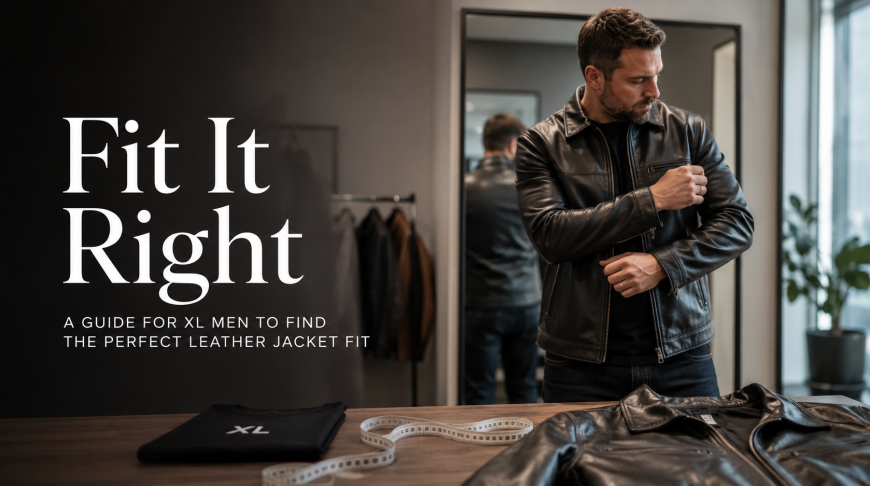
Every fall, I watch the same pattern play out. A guy sized XL or XXL picks up a leather jacket that looks incredible on the hanger — right weight, great color, convincing hardware — brings it home, and spends a week trying to convince himself it fits. Then it goes back. The xl mens leather jacket market is glutted with options that photograph beautifully and fit poorly. The reason isn't sizing dishonesty. It's that most leather jacket patterns were drafted for a 40-inch chest and scaled mechanically outward — and mechanical scaling doesn't account for how larger bodies are actually shaped.
The consequences show up in three places that buying guides almost never discuss: shoulder seam position, the relationship between chest room and waist taper, and sleeve length. Get any one of these wrong on a leather jacket and the whole silhouette collapses. Unlike a cotton shirt you can stretch or bunch, leather holds its shape. That's the material's greatest strength and, for XL buyers, its most unforgiving quality.
Where the Fit Actually Breaks — and Why It Matters on Leather
Shoulder seam drop is the most common culprit for returns and the least discussed in product listings. On a correctly fitted jacket, the shoulder seam sits at the exact edge of the shoulder — the bony point where the arm begins. When a jacket is scaled up from a smaller base pattern, that seam migrates toward the arm. Half an inch doesn't sound significant. In leather, it reads as a completely different silhouette: the chest bunches, the sleeves look too long, and the jacket appears to swallow the wearer rather than sit on him.
Chest room versus waist taper is the second failure point. A well-designed XL jacket gives adequate chest room without eliminating the waist entirely. The midsection of a larger man's jacket should still taper — not aggressively, but enough to suggest a torso rather than a tent. Most scaled-up production jackets either have insufficient chest room (causing the front to pull open) or eliminate the taper entirely to give that room, producing a boxy silhouette that reads as casual even on premium leather.
Sleeve length is the third. Standard XL jackets are typically cut for a 33–34 inch sleeve. Men above average height in XL — a common combination — need 35 or 36 inches. Short sleeves on a leather jacket are immediately visible and difficult to hide. Unlike a sport coat, you can't push up leather sleeves stylishly.
The Measurements That Actually Matter Before You Buy
Chest measurement gets all the attention, but it's the least reliable predictor of fit for XL buyers. The more useful numbers are: chest at the widest point (usually nipple line), shoulder width point-to-point across the back, sleeve length from shoulder seam to wrist bone, and — critically — your natural waist versus your hip circumference. Leather jackets that hit at the hip, not the waist, need to account for the widest point, not the narrowest.
Before buying anything online, measure yourself with a fabric tape and write down all four. Then compare against the garment's actual measurements, not the size label. A jacket listed as XL from one manufacturer may have a 48-inch chest; another's XL may measure 51 inches. The label is a starting point, not a guarantee.
Pay specific attention to listed sleeve lengths, which many brands omit entirely — a red flag in itself. If a product page doesn't list sleeve length, contact the seller before purchasing. A brand that can't answer that question quickly probably didn't think carefully about how the jacket fits at scale.
Reading an Online Listing Before You Commit
Product photography is not neutral. Most leather jacket images are shot on slim models in a medium or large, sometimes pinned at the back to create a tailored appearance. What you see in the photograph is not what you receive in XL. The two things worth scrutinizing are the garment measurement chart (not the model's measurements) and the return policy — because even with careful measurement work, the first jacket from an unfamiliar brand is sometimes a calibration purchase.
Look for brands that provide actual garment measurements rather than size-to-body-measurement conversion charts. Those conversion charts assume proportionality that doesn't hold at larger sizes. What you need to know is: how wide is this jacket at the chest, how wide at the waist, and how long are the sleeves. If those numbers aren't available, ask. If the seller can't provide them, shop elsewhere.
I'll be honest: there's a segment of the XL market — particularly jackets in the $150–$250 range from volume retailers — where the fit math simply doesn't add up for most larger buyers. The leather is typically corrected-grain or bonded, the patterns are minimally adapted, and the return rates are high. The better XL options either come from specialists or from brands with made-to-measure options.
Why a Well-Fitted XL Jacket Looks Better Than a Sized-Down One That Almost Fits
This is the opinion worth defending: a correctly fitted XL jacket looks more intentional and sharper than a medium or large worn by an XL man. The instinct to size down — to avoid the boxy look — almost always produces a worse result. A jacket that's too small reads as strained. The chest seams pull. The shoulder seams creep inward. The front zipper or button stance looks stressed. The garment is fighting the body instead of cooperating with it.
A properly proportioned XL jacket, particularly one where the waist takes in even modestly, creates a silhouette that is substantial without being formless. Leather's natural drape helps here — it falls with gravity in a way synthetic materials don't, and on a correctly structured larger jacket, that drape contributes to an authoritative, settled look rather than a disheveled one.
The fit problem is real but solvable. The solution isn't wearing smaller; it's finding jackets cut for your actual proportions.
When Made-to-Measure Is Worth the Premium
For most leather jacket buyers at any size, made-to-measure is a want, not a need. At XL and above, it crosses into a serious option worth evaluating. The core calculation is: how many times have you returned or kept-but-not-worn a leather jacket because the fit was off? If the answer is twice or more, the premium on a made-to-measure jacket likely costs less than the accumulated loss on those purchases.
The specific advantage for XL buyers is that made-to-measure eliminates the shoulder seam problem entirely. Your shoulder measurement determines the pattern, and every other dimension follows from a body that's been measured rather than estimated. Sleeve length is dialed in. Chest room is correct. Waist shaping reflects your actual torso.
The made-to-measure option from NYC Leather Jackets includes a size-confirmation step before the order is fulfilled — meaning the most common reason XL buyers return leather jackets is removed from the transaction before the jacket is even built. For someone who has been through the return cycle more than once, that step changes the math significantly.
The category of leather jackets for men has expanded considerably in the last few years to include more XL-specific options, but quality varies widely. The difference between a brand that genuinely thinks about XL proportions and one that scales mechanically is visible the moment you put the jacket on — and usually visible in the product listing if you know what questions to ask.