What Are the 3 Main Types of PGT Testing for Embryos?
A PGT test is among the most powerful things modern IVF has to offer, and "PGT" is not one test at all.
 adminadmin1
Written by Ram Prakash, Clinical Embryologist
A PGT test is among the most powerful things modern IVF has to offer, and "PGT" is not one test at all. It is a family of three screening approaches, and each of them is aimed at a different kind of genetic problem. Working out which one applies to a given couple is where any real conversation about genetic testing in an IVF cycle has to start.
What Does PGT Actually Test For?
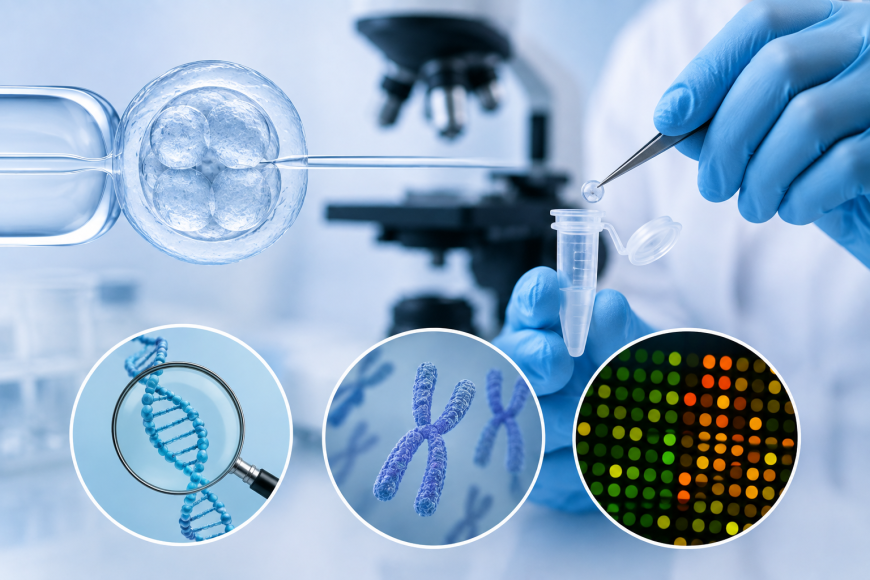
Preimplantation genetic testing means taking a small number of cells from the outer layer of a day 5 or day 6 blastocyst, the trophectoderm, which is the part that goes on to become the placenta, and analysing their genetic material before that embryo is transferred. The embryo stays frozen while the testing runs, and it is thawed and transferred if the result comes back favourable. What separates the three types is the question each one is asking:
There is a pattern in that list worth pointing out before we go through them individually, because it is what determines which one you will be offered. Each successive type requires you to already know more about the family than the one before it.
|
PGT Type |
What It Screens |
Best Suited For |
|
PGT-A (Aneuploidy) |
Correct number of chromosomes in the embryo |
Advanced maternal age, recurrent miscarriage, repeated IVF failure |
|
PGT-M (Monogenic) |
A specific single-gene condition known to run in the family |
Couples who are carriers of conditions like thalassaemia, cystic fibrosis, or Huntington's disease |
|
PGT-SR (Structural Rearrangements) |
Chromosomal rearrangements inherited from a parent |
Patients with a known balanced translocation or inversion |
What Is PGT-A and Who Needs It?
PGT-A asks the question that needs no prior knowledge of the family at all, which is whether the embryo has the right number of chromosomes: 46, in 23 pairs. An embryo with an abnormal count is aneuploid, and aneuploidy is the single biggest cause of early pregnancy loss and of IVF cycles that fail. Because the rate of it climbs sharply with maternal age, PGT-A is most often discussed with women over 35, and with anyone who has had recurrent miscarriage or repeated IVF failure nobody has been able to explain.
What Do PGT-A Results Mean?
A result comes back euploid, meaning chromosomally normal, or aneuploid, meaning abnormal, or mosaic, which is a mixture of normal and abnormal cells within the biopsied sample. Euploid embryos go first. A mosaic result needs individual counselling rather than a rule, because some mosaic embryos have gone on to healthy pregnancies and discarding them automatically is not current practice. Aneuploid embryos are not transferred.
What Is PGT-M and When Is It Used?
PGT-M is the second step up in prior knowledge, because it can only look for a single-gene condition that has already been identified in the family. It is not a general screen of genetic health. Before a cycle can even begin the laboratory has to build a bespoke test for the exact mutation that family carries, which takes several weeks and needs genetic counselling behind it to be sure the mutation has been characterised correctly.
Common conditions prompting PGT-M include:
-
Autosomal recessive conditions where both partners are confirmed carriers, thalassaemia and sickle cell disease and cystic fibrosis and spinal muscular atrophy among them
-
Autosomal dominant conditions where one partner is affected or carries the mutation, such as Huntington's disease, or BRCA1/2 in particular clinical contexts
-
X-linked conditions with the mother confirmed as a carrier
Even after a PGT-M cycle we still recommend confirmatory testing in the pregnancy itself, by CVS or amniocentesis, because an embryo biopsy is a screening step and not the final diagnostic word.
What Is PGT-SR and Who Does It Apply To?
PGT-SR sits at the far end of that same progression, since it applies only where a parent is already known to carry a structural chromosomal rearrangement, a balanced translocation most commonly, meaning segments of two chromosomes have swapped places. That parent is usually unaffected themselves. Their embryos, though, carry a raised risk of inheriting an unbalanced arrangement, and that is what leads to miscarriage or to significant developmental abnormality. What PGT-SR does is find the embryos that inherited a balanced or a normal complement, and those are the ones worth transferring.
What Are the Limitations All Three Types Share?
None of them guarantees a pregnancy. A euploid PGT-A result lowers the risk of miscarriage without removing it, because whether an embryo implants depends on the uterus and on a good deal else besides its chromosomes. No form of PGT screens for every genetic condition either. Each finds only what it was built to find. And the biopsy is itself a procedure, safe in experienced hands, but it involves taking cells from an embryo and a small proportion can be affected if it is not done properly.
Knowing what each of these tests looks for, and being equally clear about what it cannot see, is the foundation of an honest conversation about genetic testing in IVF.
This article is for general educational purposes and is not a substitute for personalised medical advice from a fertility specialist, embryologist, or genetic counsellor.