Top 10 US Imports: A Complete Guide to Products, Countries & Companies
To better understand how the US trade landscape functions, it is essential to examine the top 10 US imports across categories such as HS codes, countries, and companies.
 usimportdata
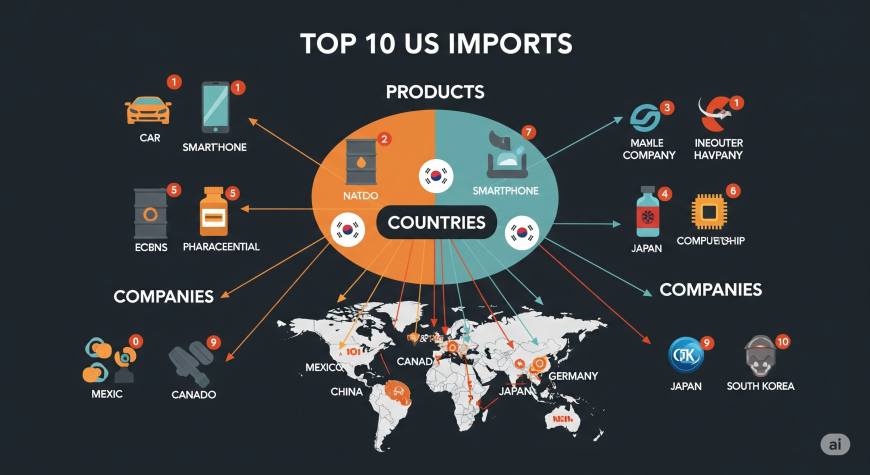
The United States stands as the world’s largest importer of goods, with a trade volume that shapes global economic trends. With an import value of $3.2 trillion in 2023, the US accounted for nearly 13.2% of all global imports, making its purchasing behavior a significant factor in international commerce. Despite a 6% decline compared to 2022, the US import market remains robust, with $2.48 trillion worth of goods imported in the first three quarters of 2024 alone.
To better understand how the US trade landscape functions, it is essential to examine the top 10 US imports across categories such as HS codes, countries, and companies. By analyzing US import data, businesses, policymakers, and researchers can uncover patterns in consumer demand, supply chain dependencies, and international trade policies.
Why US Import Data Matters
US import data provides vital insights into the flow of goods entering the country. Each shipment is tracked with details such as:
-
Date of import
-
Country of origin
-
Product description
-
HS code (Harmonized System code)
-
Bill of Lading (B/L) number
-
Quantity of goods
-
Port of entry and exit
This US import statistics framework helps businesses identify new opportunities, track competitor sourcing, and anticipate price shifts. For policymakers, this data influences decisions on trade agreements, tariffs, and supply chain resilience.
Exclusive US Import Trends
The US import market reflects both consumer needs and industrial demand. Some of the latest trends include:
-
Automobiles: Imports of vehicles, engines, and parts hit $458.4 billion in 2023, a record high.
-
Consumer Goods: Imports totaled $760.9 billion, the lowest since 2020, reflecting post-pandemic adjustments.
-
Other Goods: The US imported $129.5 billion worth of miscellaneous items in 2023, the highest since 2017.
-
Import Prices: The US import price index rose 1.3% between Nov 2023 – Nov 2024, driven by energy prices.
-
Fuel Imports: Rising petroleum and natural gas prices pushed energy import costs higher.
These trends underscore the reliance of the US economy on international markets for critical products, from technology to energy resources.
Top 10 US Imports by HS Code
The top 10 US imports reveal which goods are most critical for the American economy. Based on US import data, here is the breakdown for 2023:
-
Electrical Machinery & Equipment (HS 85) – $463.36B (14.61%)
Includes computers, telecommunication gear, and transformers. -
Nuclear Reactors & Machinery (HS 84) – $459.19B (14.47%)
Covers industrial machinery, engines, and generators. -
Vehicles (HS 87) – $381.03B (12.01%)
Passenger cars, trucks, and automotive parts. -
Mineral Fuels & Oils (HS 27) – $266.59B (8.4%)
Petroleum, crude oil, and natural gas imports. -
Pharmaceutical Products (HS 30) – $177.84B (5.61%)
Includes vaccines, medicines, and healthcare supplies. -
Special Nomenclature Commodities (HS 99) – $124.97B (3.94%)
Miscellaneous items grouped under HS 99. -
Optical & Medical Instruments (HS 90) – $118.32B (3.73%)
Equipment for healthcare, labs, and precision industries. -
Precious Stones & Metals (HS 71) – $89.54B (2.82%)
Diamonds, gold, silver, and pearls. -
Plastics & Articles (HS 39) – $72.34B (2.28%)
Materials for packaging, manufacturing, and consumer goods. -
Furniture & Bedding (HS 94) – $69.00B (2.18%)
Includes home and office furniture, mattresses, and bedding products.
This distribution reflects how the US economy depends heavily on imports to power technology, transport, healthcare, and consumer industries.
Top 10 US Import Partners by Country
Looking at US import statistics by country, the biggest suppliers of goods to the US in 2023 were:
-
Mexico – $480.08B (15.1%) – Vehicles lead imports ($130.03B).
-
China – $448.03B (14.1%) – Electrical machinery is the top category ($126.67B).
-
Canada – $431.19B (13.6%) – Mineral fuels dominate ($131.90B).
-
Germany – $163.08B (5.1%) – Machinery leads at $34.59B.
-
Japan – $151.58B (4.8%) – Vehicles make up $50.80B.
-
South Korea – $119.72B (3.8%) – Vehicles total $38.42B.
-
Vietnam – $118.94B (3.7%) – Electrical machinery worth $41.78B.
-
Taiwan – $89.91B (2.8%) – Machinery at $34.51B leads imports.
-
India – $87.28B (2.8%) – Precious stones & metals worth $12.36B.
-
Ireland – $82.71B (2.6%) – Pharmaceuticals worth $36.02B.
The top 10 US imports by country highlight the geographic diversity of sourcing, with North America, Asia, and Europe playing key roles.
Top 10 Importer Companies in the USA
The US importers database shows that retail and consumer goods giants dominate. The leading companies include:
-
Walmart Inc. – $50B (720,000 TEUs)
-
Target Corporation – $30B (450,000 TEUs)
-
The Home Depot – $25B (400,000 TEUs)
-
Lowe’s Companies – $20B (350,000 TEUs)
-
Amazon.com, Inc. – $18B (300,000 TEUs)
-
Samsung Electronics America – $15B (250,000 TEUs)
-
IKEA North America Services – $12B (200,000 TEUs)
-
Ashley Furniture Industries – $10B (180,000 TEUs)
-
Costco Wholesale Corporation – $9B (150,000 TEUs)
-
Dollar Tree, Inc. – $8B (140,000 TEUs)
This list underscores how retail, e-commerce, and consumer demand drive US imports at scale.
US Import Statistics: A 10-Year Overview
A look at the past decade shows steady growth in imports:
-
2013 – $2.32T
-
2014 – $2.41T
-
2015 – $2.31T
-
2016 – $2.24T
-
2017 – $2.40T
-
2018 – $2.60T
-
2019 – $2.56T
-
2020 – $2.40T (pandemic decline)
-
2021 – $2.93T
-
2022 – $3.37T
-
2023 – $3.17T
This long-term view of US import statistics shows resilience, with imports bouncing back strongly after global disruptions.
Conclusion
The top 10 US imports provide a clear picture of the country’s dependence on global supply chains for technology, vehicles, energy, and healthcare products. By analyzing US import data, companies can identify sourcing opportunities, policymakers can refine trade strategies, and researchers can track shifting economic patterns.
With imports spread across multiple categories and trading partners, the US economy reflects the deeply interconnected nature of global commerce. Staying informed about US imports and leveraging accurate US import statistics ensures that stakeholders remain competitive in a rapidly evolving trade landscape.