The Component Inside Your Welder That Most People Never Think About
High-performance welding machine bridge rectifiers for stable arcs, reduced spatter, and long service life. Trusted industrial solutions from Insel Rectifiers.
 inselrectifiers
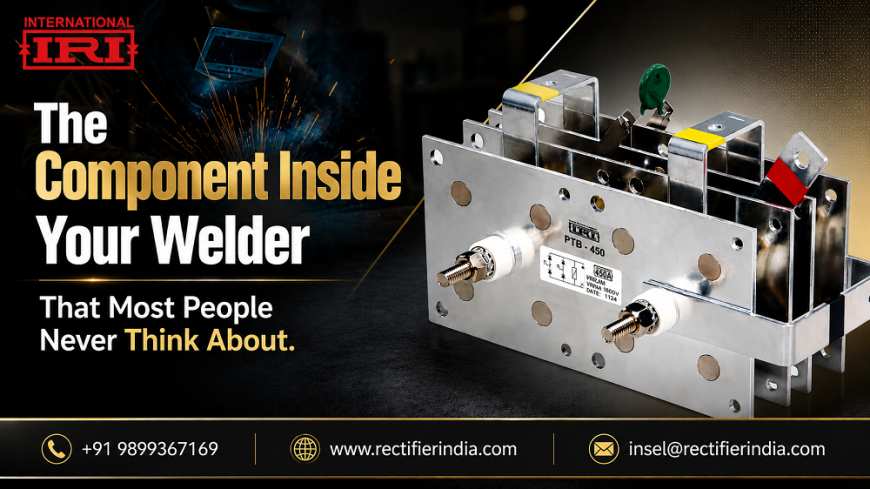
Welding machines take a beating. High current, continuous load, heat that builds up fast — it's one of the more demanding electrical environments a component can live in. And sitting right in the middle of that environment, converting AC mains power into the DC your arc actually needs, is the welding machine bridge rectifier.
Most welders never think about it. Until it fails.
What a Welding Bridge Rectifier Actually Does?
Your welder needs DC for a stable, consistent arc. AC input from the mains doesn't give you that directly. The welding bridge rectifier takes that alternating current and converts it — full wave, both half cycles used — into the smooth DC that makes clean welds possible.
It sounds straightforward. In practice, the demands are brutal. Every time you strike an arc, current spikes hard. The rectifier absorbs that repeatedly, session after session, often in dusty workshops with poor ventilation and ambient heat already working against it. A rectifier that's merely adequate on paper becomes a liability in those conditions pretty quickly.
The arc quality you get — steady, clean, predictable — is directly connected to how well that rectifier handles those conditions without degrading.
Why the Rectifier Quality Shows Up in Your Welding?
Bad rectifiers don't always fail dramatically. More often they degrade slowly. The arc gets slightly less stable. Spatter increases. You compensate with settings. The welds still pass but the process gets harder than it should be.
That's a rectifier problem, not an operator problem.
Insel Rectifiers builds their welding machine bridge rectifiers specifically for high-current industrial applications. Proper thermal ratings, consistent forward voltage characteristics, and manufacturing quality that holds up under repeated load cycles — not just on the first day but months into daily use.
For workshop owners and maintenance engineers who've chased intermittent welding problems before, the rectifier is often the last thing checked and the first thing that should have been. Get it right from the start with IRI.
Frequently Asked Questions
Why does a welding machine need a bridge rectifier?
Welding arcs need DC to stay stable and controllable. The bridge rectifier converts AC mains input into the DC that the machine actually runs on — without it, arc quality becomes inconsistent and unpredictable.
How do I know if my welding bridge rectifier is failing?
Unstable arc, increased spatter, inconsistent penetration despite correct settings — these are the usual signs. Sometimes it's a complete failure, but more often it's a gradual degradation that makes welding harder without an obvious cause.
Does the rectifier brand matter for a welding machine?
More than most people realise. Welding puts sustained high-current stress on components that most rectifiers aren't built to handle long-term. Insel Rectifiers components are rated and tested for exactly these conditions — the difference shows up in how long they last and how consistently the machine performs between services.