Does Testosterone Therapy Improve Male Fertility?
Does testosterone therapy improve male fertility? Learn the clinical truth and get expert male infertility treatment at the best IVF centre in Tanjore.
 suryakumar
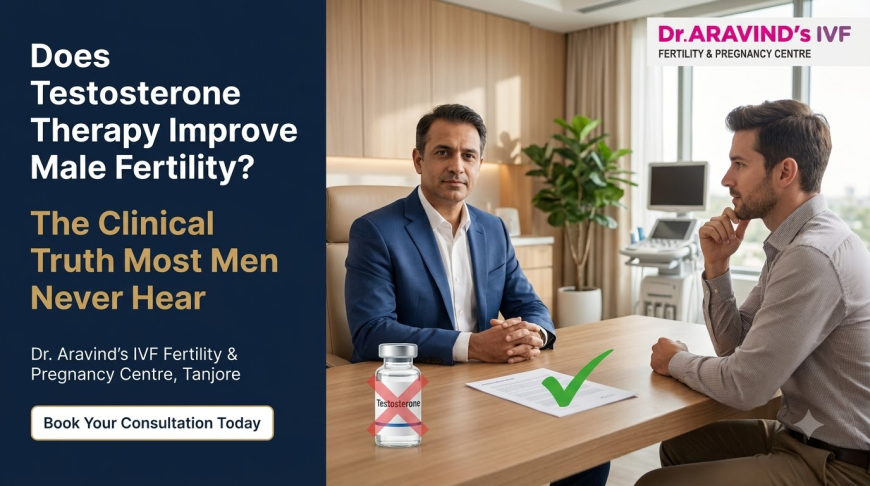
The answer is no — and this is one of the most clinically important myths in male fertility treatments.
Many men with low testosterone and fertility concerns reach for testosterone therapy as an obvious solution — assuming that more testosterone means better sperm production. It does not. In fact, testosterone therapy fertility consequences are often the opposite of what men expect. Understanding why this happens — and what actually works — is essential for any man navigating male infertility treatment. The best IVF centre in Tanjore consistently sees men whose fertility has been significantly worsened by well-intentioned but clinically incorrect testosterone replacement therapy.
The Myth: Testosterone Therapy Will Fix My Fertility
This myth is understandable — and dangerously wrong.
The logic seems straightforward. Low testosterone is associated with reduced sperm production. Testosterone therapy raises testosterone levels. Therefore testosterone therapy should improve sperm production. Every step of this reasoning is correct — except the conclusion.
The relationship between testosterone and sperm production is not direct. It is mediated through the brain's hormonal signalling system — and testosterone replacement therapy disrupts that system in a way that actively suppresses sperm production rather than stimulating it.
This is the myth that the best IVF centre in Tanjore addresses in almost every consultation with men who have been on TRT and are now struggling to conceive.
What Testosterone Therapy Actually Does to Sperm Production
TRT sperm count suppression is one of the most consistent findings in male reproductive medicine.
When testosterone is introduced externally — through injections, gels, patches, or pellets — the brain detects elevated circulating testosterone levels and responds by reducing its own hormonal signalling. Specifically:
- The hypothalamus reduces GnRH (gonadotropin-releasing hormone) secretion
- Reduced GnRH signals the pituitary to produce less FSH and LH
- FSH is the primary driver of sperm production in the testes
- LH drives testosterone production within the testes — separate from the external testosterone being administered
The result — the testes receive no signal to produce either natural testosterone or sperm. In many men on TRT, sperm count drops to near zero within weeks to months of starting therapy. This is not a side effect. It is the predictable physiological consequence of the therapy itself.
The Science Behind Why TRT Suppresses Fertility
Testosterone replacement infertility follows a well-established hormonal mechanism.
The male reproductive system is regulated by the hypothalamic-pituitary-gonadal axis — a three-way feedback loop. The hypothalamus signals the pituitary, the pituitary signals the testes, and the testes produce both testosterone and sperm. The system self-regulates based on circulating testosterone levels.
When external testosterone is introduced:
- Circulating testosterone rises
- The hypothalamus reads this as overproduction and reduces GnRH
- The pituitary reduces FSH and LH in response
- Without FSH — sperm production stops
- Without LH — natural testicular testosterone production stops
- The testes become functionally inactive — a condition called hypogonadotropic hypogonadism
This is also why anabolic steroids — which are synthetic testosterone derivatives — have the same fertility-suppressing effect as prescribed TRT. The hormonal mechanism is identical.
Signs of Male Infertility Linked to Testosterone Misuse
Men on TRT who are trying to conceive may notice specific signs of male infertility that were caused or worsened by the therapy itself.
Clinical signs to watch for:
- Azoospermia — no sperm detected in semen analysis — the most severe and common finding in men on TRT
- Testicular atrophy — testicles reduce in size as they cease natural production — a visible sign of FSH and LH suppression
- Reduced semen volume — less fluid produced as accessory glands receive less stimulation
- Paradoxically — low libido despite exogenous testosterone — because intratesticular testosterone is far lower than circulating testosterone
If you are on TRT and noticing any of these — a formal male infertility treatment evaluation is the right immediate step. Recovery of sperm production after stopping TRT is possible — but timelines vary significantly and are not guaranteed in every case.
What Actually Treats Low Testosterone and Preserves Fertility
Low testosterone male fertility concerns can be addressed through treatments that stimulate natural testosterone production — rather than replacing it externally.
Fertility-preserving alternatives to TRT:
Clomiphene citrate:
A selective oestrogen receptor modulator that blocks oestrogen feedback at the hypothalamus — causing increased GnRH, LH, and FSH release. This stimulates the testes to produce both natural testosterone and sperm simultaneously. It treats low testosterone without suppressing the hypothalamic-pituitary axis.
HCG (Human Chorionic Gonadotropin):
Mimics LH — directly stimulating testicular testosterone production and maintaining testicular size and function. Often used alongside FSH therapy for men with hypogonadotropic hypogonadism who want to preserve or restore sperm production.
FSH therapy:
For men with pituitary-level insufficiency — direct FSH stimulation drives sperm production without suppressing the reproductive axis.
Anastrozole:
An aromatase inhibitor that reduces oestrogen levels — improving the testosterone-to-oestrogen ratio and stimulating natural testosterone production in men with elevated oestrogen from adipose tissue.
These male fertility treatments address low testosterone in a way that supports rather than suppresses the reproductive system.
Male Fertility Treatments That Work Without Harming Sperm
For men whose fertility has already been suppressed by TRT — recovery is possible with the right clinical approach.
Post-TRT fertility recovery protocol typically includes:
- Stopping exogenous testosterone immediately — essential before any recovery can begin
- HCG therapy — to restart testicular function and stimulate natural testosterone and sperm production
- FSH therapy — combined with HCG for men with severely suppressed counts
- Clomiphene — to stimulate the hypothalamic-pituitary axis back into function
- Antioxidant supplementation — CoQ10, zinc, and vitamin E support sperm quality during recovery
- Serial semen analysis every eight to twelve weeks — to track recovery progress
Recovery timelines vary from three months to over a year depending on duration of TRT use, age, and pre-treatment sperm parameters. Some men with very long TRT history do not fully recover natural sperm production — making pre-TRT sperm banking an important conversation for any man starting testosterone therapy who plans to father children in the future.
Where to Get the Right Advice in Tanjore
Testosterone therapy and male fertility decisions should never be made without specialist input.
At Dr. Aravind's IVF Fertility & Pregnancy Centre — the best IVF centre in Tanjore — men receive complete hormonal evaluation before any treatment affecting fertility is recommended. Whether the concern is low testosterone, TRT-suppressed sperm production, or broader male infertility treatment, the specialist team provides evidence-based, fertility-preserving clinical guidance. With 30 years of experience across Tamil Nadu and branches across Tanjore, Madurai, Chennai, Coimbatore, and beyond — expert reproductive care is always within reach.
Testosterone therapy does not improve male fertility — it suppresses it. This is not a minor clinical nuance. It is a fact that changes the reproductive outcome for every man who chooses TRT without understanding its fertility consequences. At Dr. Aravind's IVF Fertility & Pregnancy Centre — the best IVF centre in Tanjore — every man receives honest, evidence-based guidance on male fertility treatments that protect reproductive health rather than compromise it.
Get Evidence-Based Male Fertility Advice Today
Dr. Aravind's IVF Fertility & Pregnancy Centre — Tanjore
Phone: (+91) 90 2012 2012
Email: [email protected]
https://www.draravindsivf.com/book-your-appointment
Frequently Asked Questions
Does Testosterone Therapy Improve Male Fertility?
No — testosterone therapy suppresses male fertility by shutting down the hormonal signals that drive sperm production. External testosterone reduces FSH and LH from the pituitary — causing the testes to stop producing sperm. Men in Tanjore, Madurai, and Tamil Nadu concerned about low testosterone and fertility should seek male infertility treatment evaluation at the best IVF centre in Tanjore before starting any testosterone therapy.
Can TRT Cause Zero Sperm Count?
Yes. TRT sperm count suppression to zero — called azoospermia — is a well-documented and common consequence of testosterone replacement therapy. The timeline varies but most men on TRT develop significantly reduced or absent sperm within months. Recovery after stopping TRT is possible but not guaranteed — particularly after prolonged use. Men across Chennai, Coimbatore, and Tamil Nadu on TRT trying to conceive should seek immediate clinical evaluation.
What Treats Low Testosterone Without Harming Fertility?
Clomiphene citrate, HCG therapy, and FSH stimulation all treat low testosterone by stimulating natural production — without suppressing the hypothalamic-pituitary axis. These male fertility treatments raise both testosterone and sperm production simultaneously — making them the appropriate choice for men with fertility goals. The best IVF centre in Tanjore evaluates which option suits individual hormonal profiles before recommending any treatment approach.
How Long Does Sperm Recovery Take After Stopping TRT?
Recovery of sperm production after stopping testosterone replacement therapy takes three months to over a year depending on duration of use, age, and pre-TRT sperm parameters. Some men with long TRT history do not fully recover. Serial semen analysis every eight to twelve weeks tracks recovery. Men across Tamil Nadu and India who have stopped TRT and are trying to conceive should seek guidance from male infertility treatment specialists at Dr. Aravind's IVF Fertility & Pregnancy Centre.
What Are the Signs of Male Infertility Caused by Testosterone Therapy?
Signs of male infertility from TRT include azoospermia on semen analysis, testicular atrophy — reduced testicular size — reduced semen volume, and paradoxically low libido despite exogenous testosterone. These signs appear because the testes have stopped natural production entirely. Men in Tanjore, Coimbatore, Chennai, and across Tamil Nadu noticing these signs after starting testosterone therapy should seek immediate evaluation at the best IVF centre in Tanjore.