Why Supply Chain Agility Has Become a Competitive Advantage Rather Than a Luxury
Discover why supply chain agility is now essential for resilience, customer satisfaction, and long term business growth.
 Antoni
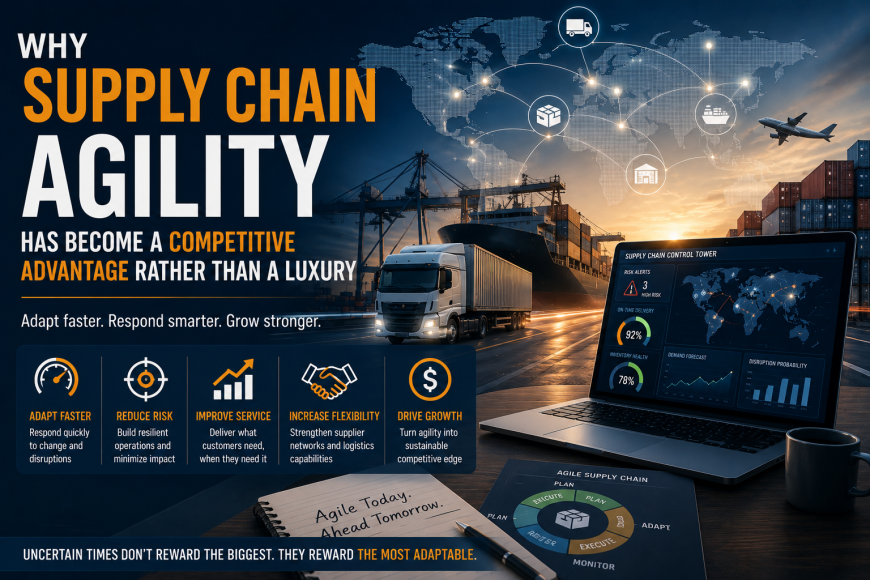
Not long ago, supply chain agility was considered a premium capability.
Large enterprises invested in backup suppliers, alternative transportation routes, and additional inventory buffers while smaller businesses focused almost entirely on efficiency and cost reduction.
That mindset has changed.
Today, agility is no longer a luxury reserved for global corporations.
It has become one of the most important competitive advantages a business can build.
The organizations that adapt quickly outperform those that simply operate cheaply.
The Business Environment Has Changed
Modern supply chains operate in an environment defined by uncertainty.
Demand changes faster than forecasting models expect.
Geopolitical tensions affect sourcing strategies.
Extreme weather disrupts transportation networks.
Consumer expectations continue rising while product lifecycles become shorter.
The result is simple.
Businesses that cannot adapt quickly often struggle to maintain service levels and profitability.
Efficiency Alone Is No Longer Enough
For years, supply chains were optimized around efficiency.
Lean inventories.
Single sourcing strategies.
Minimal redundancy.
These approaches worked exceptionally well in stable environments.
The challenge appears when disruptions occur.
A highly efficient supply chain can become surprisingly fragile if it lacks flexibility.
This explains why many executives are shifting from asking:
"How efficient are we?"
to
"How quickly can we respond when conditions change?"
What Supply Chain Agility Actually Means
Agility does not mean reacting faster after a problem occurs.
It means having the ability to adjust operations before disruptions create significant damage.
Agile organizations typically have:
- Multiple sourcing options.
- Flexible transportation strategies.
- Better visibility across operations.
- Faster decision making processes.
- Stronger collaboration with suppliers and logistics partners.
The objective is resilience without sacrificing performance.
Customer Expectations Are Driving Change
Customers increasingly expect:
- Faster delivery times.
- Reliable order fulfillment.
- Real time shipment visibility.
- Consistent service levels.
Businesses unable to adapt to changing customer expectations risk losing market share to more responsive competitors.
Agility directly affects customer experience.
Customer experience directly affects growth.
Technology Is Accelerating Agility
Artificial intelligence, predictive analytics, and supply chain control towers are giving organizations the ability to identify disruptions earlier and respond faster.
Modern platforms can detect:
- Supplier risks.
- Transportation bottlenecks.
- Inventory shortages.
- Demand fluctuations.
- Capacity constraints.
The businesses gaining the greatest value from these technologies are often those combining digital investments with expert 3PL logistics consulting services, third party logistics advisory expertise, and supply chain transformation specialists capable of aligning technology with operational strategy.
Why External Expertise Matters
Building agility requires more than software implementation.
Network design, inventory strategy, supplier diversification, and transportation planning all influence responsiveness.
Many organizations work with logistics outsourcing consultants, freight optimization advisors, distribution strategy professionals, and 3PL consulting partners to identify vulnerabilities and improve operational flexibility.
These initiatives frequently uncover opportunities that remain hidden inside traditional cost focused reviews.
Organizations interested in understanding how operational expertise contributes to business performance can explore additional perspectives in Why Logistics Consultants Drive Business Growth.
Leaders preparing for increasingly volatile markets may also appreciate the insights shared in Predictable Supply Chains Are Over. Now What?.
Agility Creates Financial Value
Businesses often assume agility increases costs.
The reality is more nuanced.
Agility can reduce:
- Revenue loss during disruptions.
- Emergency transportation spending.
- Production interruptions.
- Customer churn.
- Inventory obsolescence.
The financial impact of avoiding a major disruption frequently outweighs the cost of building flexibility.
The Competitive Divide Is Growing
Over the next decade, businesses will increasingly separate into two categories.
Organizations that continue optimizing exclusively for efficiency.
Organizations that optimize for adaptability, resilience, and responsiveness.
The second group is likely to outperform during periods of uncertainty because they can pivot faster and recover sooner.
Final Thoughts
Supply chain agility is no longer optional.
It influences customer satisfaction, revenue protection, operational resilience, and long term growth.
The companies gaining market share today are rarely the businesses with the lowest costs.
They are the businesses that respond the fastest.
As uncertainty becomes a permanent feature of global trade, demand will continue growing for 3PL logistics consulting services, logistics strategy advisors, outsourced logistics specialists, and supply network consultants capable of helping organizations build supply chains designed for change rather than stability.