Relaxed Leather Jacket Styling: The Three Proportions That Actually Make It Work
A relaxed leather jacket needs deliberate styling to look effortless — not just any combination works. Here are the three proportions that make the difference.
 mananiyerr
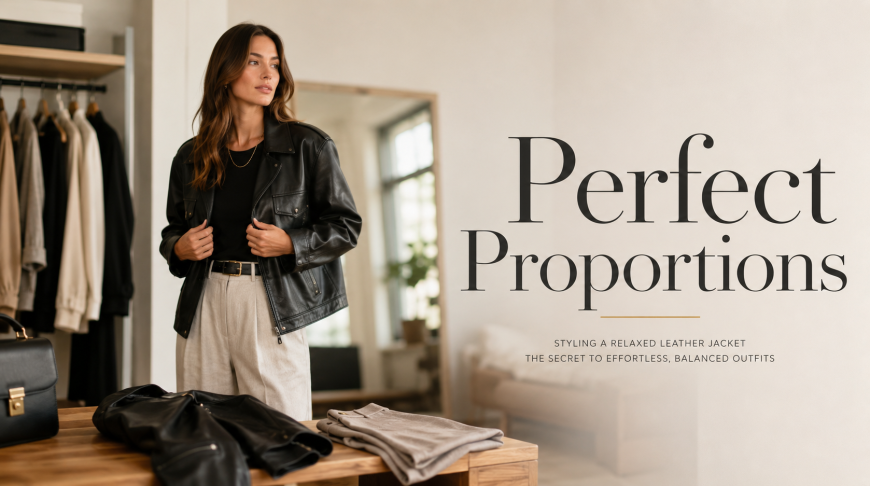
The relaxed leather jacket is a silhouette that looks effortless on women who understand how to wear it and slightly accidental on women who don't — and the difference has nothing to do with body type. It's entirely about proportion management, and the specific proportions involved are not intuitive.
The central paradox of the relaxed leather jacket, and the thing worth stating at the beginning: a relaxed-fit jacket requires more deliberate styling than a fitted one. The ease of the look lives in the finished result, not in the act of getting dressed. Getting dressed in a relaxed leather jacket correctly takes more thought than getting dressed in a slim one.
Why the Relaxed Jacket Fails When It Fails
The failure mode is visual width. A relaxed leather jacket adds bulk across the shoulders and chest; it sits away from the waist; it has volume through the sleeve. When the bottoms and footwear don't counterbalance that width, the silhouette reads as sloppy rather than intentional — not because the jacket is wrong, but because the visual weight is concentrated in one zone of the outfit without anything to balance it.
The most common version of this failure: oversized leather jacket + wide-leg or straight-leg trousers + sneakers. Every element in that combination is individually wearable. Together, they create a shape where the width is consistent from shoulder to ankle with no visual interruption, which reads as one undifferentiated mass rather than an intentional outfit. The jacket gets blamed, but it was the styling.
The second failure mode is hem length. A relaxed jacket that hits at the hip bone — particularly on a shorter frame — shortens the visual line of the torso while adding width. If nothing in the bottom half compensates for this, the result is a proportional problem that makes the wearer look significantly shorter and wider than they are.
The First Proportion: Narrow the Bottom
A slim or straight-leg trouser, a slim-cut jean, or a midi or maxi skirt with a straight or fitted silhouette will anchor the relaxed jacket by narrowing the lower half of the outline. The eye reads the overall shape, not just the jacket: wide on top, narrow below = intentional. Wide on top, wide below = undefined.
Skinny jeans are the most reliable pairing because they provide maximum contrast to the jacket's shoulder width. The criticism of skinny jeans in recent fashion discourse is largely about them being unflattering when worn alone; when worn under a relaxed jacket, they're a proportional tool, not a style statement in themselves.
For skirts: a leather jacket over a full circle skirt creates a different problem than a leather jacket over a midi pencil skirt. The circle skirt adds volume at the hip to match the jacket's shoulder volume, which can work as a deliberate maximalist look but fails as a casual-effortless look. The pencil or column silhouette — narrow at the hip — does what the skinny jean does but in a more elevated register.
The Second Proportion: Address the Top Layer
What's underneath the jacket either counterbalances its volume or compounds it. A fitted or cropped top, fully tucked in, removes visual mass from the waist area and provides a reference point for the jacket's relaxed silhouette to read against. A loose or boxy top under a relaxed jacket creates a stacking effect where the layers read as one oversized shape.
Cropped tops work particularly well because they expose the waist between the top's hem and the trouser's waistband — even an inch or two of visible waist creates a reference point that breaks the top-to-bottom visual continuity and prevents the outfit from reading as one undivided mass. Tucked tops achieve the same effect less dramatically.
This is the rule that feels counterintuitive to buyers who purchase a relaxed jacket because they want to hide their midsection. A fitted top under the jacket doesn't expose anything that the jacket doesn't cover; it creates the proportional contrast the outfit needs. The jacket is still doing its covering work — the fitted element underneath is a styling tool, not a revelation.
The Third Proportion: Add Vertical Weight at the Foot
Footwear that adds visual weight and height at the bottom of the outfit grounds the silhouette and prevents the relaxed jacket from making the wearer look like they're sinking into their clothes. A chunky-soled boot or trainer, a platform sandal, a heeled ankle boot with a block heel — any of these adds a visual base that the outfit reads against.
Flat, lightweight footwear — ballet flats, thin-soled mules, simple flip flops — removes visual weight from the bottom and allows the jacket's shoulder mass to dominate the proportions without balance. This can work for very tall women with a lean build; for most frames, it reads as the outfit wearing the person rather than the reverse.
The specific footwear doesn't matter as much as the visual weight it provides. A clean white leather chunky sneaker, a lug-sole Chelsea boot in tan leather, a platform loafer — these are all different aesthetically, but they're all performing the same proportional function. The common characteristic is a sole with visible thickness.
How the Same Jacket Looks Different on Different Frames
Women with an athletic build — broader shoulders, narrower hips — will find that the relaxed jacket's shoulder volume creates a pronounced inverted-triangle silhouette. The fix is to maximize the hip area in the bottom half: a straight-leg trouser rather than a skinny jean, a slight flare at the ankle, or a skirt with a minimal flare. The goal is not to add volume at the hip but to prevent the bottom from looking narrow relative to the jacket's shoulders.
Women with a pear-shaped build — narrower shoulders, wider hips — often assume the relaxed jacket is wrong for them because shoulder volume on a narrower frame can look disproportionate. In practice, the relaxed jacket can actually balance this proportion when worn open: the jacket's extra width at the shoulders brings the visual width of the upper half closer to the lower half's actual width, creating a more balanced silhouette than a slim jacket would.
For petite women, the hem length of the relaxed jacket becomes critical. A jacket that hits at the hip bone can cut the leg line in a way that reduces apparent height; a cropped relaxed jacket that ends above the hip, or a longer jacket that covers the hip entirely and is worn over high-waisted bottoms, avoids this issue. The worst option for most petite frames is a jacket that ends precisely at the widest point of the hip.
For those who want the proportions managed at the source rather than through styling, NYC Leather Jackets' made-to-measure service ensures the jacket's hem length and shoulder width are specified to the wearer's frame — so the 'relaxed' proportion is intentional from the start.
Among women's leather jackets, the relaxed silhouette consistently rewards the buyer who understands the three proportional levers: narrow bottoms, fitted top layer, weighted footwear. Get those right, and the jacket looks exactly as effortless as it's supposed to.