Packaging Resins Market Emerging Packaging Technologies and Market Insights
 sonicbolt20
Overview
The Packaging Resins Market is set for steady growth as demand increases for efficient packaging materials across global industries. The market is estimated to expand from USD 306.9 billion in 2025 to USD 620.9 billion by 2035, achieving a CAGR of 7.3% during 2026–2035. Asia Pacific maintained market leadership in 2025 with a 54.9% share and USD 168.5 billion in revenue. Rising demand from the food & beverage sector, e-commerce growth, and adoption of advanced resin technologies are key factors supporting market growth.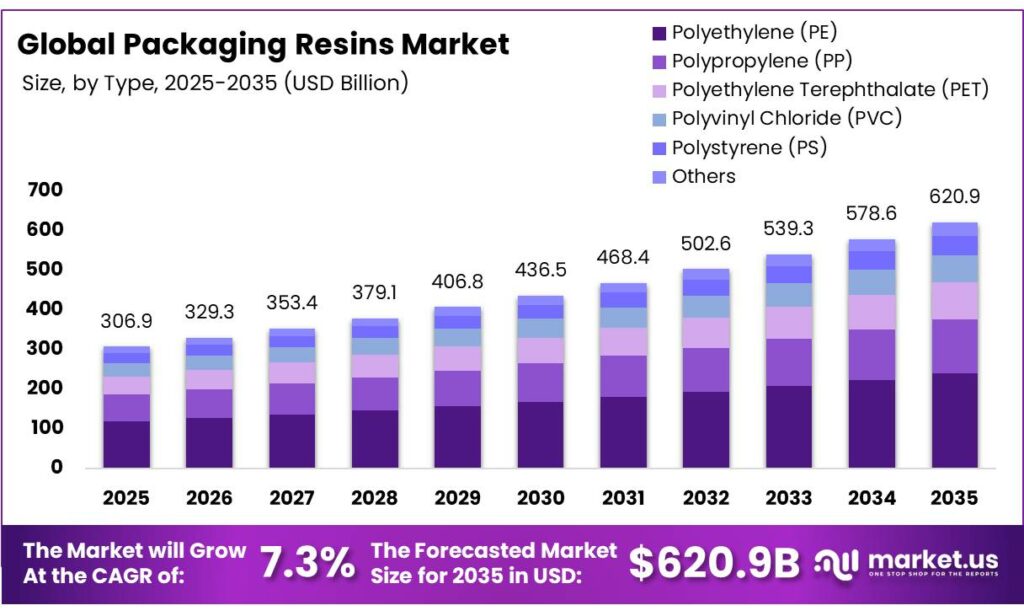
Key Takeaways
- The Packaging Resins Market was valued at USD 306.9 billion in 2025.
- The market is expected to grow at a CAGR of 7.3% and reach USD 620.9 billion by 2035.
- Based on resin type, polyethylene (PE) dominated the market, accounting for 38.6% of the total market share due to its versatility, processability, and regulatory compliance.
- By source, virgin packaging resins led the market with an 84.9% share, supported by consistent quality, performance, and regulatory acceptance.
- Among end-use industries, the food & beverage industry represented the largest segment, accounting for approximately 45.3% of global packaging resin consumption.
- In 2025, Asia Pacific was the leading region in the Packaging Resins Market, capturing 54.9% of global consumption.
- Type Analysis
Type Analysis
The Packaging Resins Market is segmented by type into polyethylene (PE), polypropylene (PP), polyethylene terephthalate (PET), polyvinyl chloride (PVC), polystyrene (PS), and others. Among these, polyethylene (PE) dominated the market with a 38.6% share due to its high versatility, easy processing capabilities, and compliance with packaging regulations.
According to FDA disclosures, PE is approved for various food-contact applications, including flexible pouches, films, and liners due to its chemical inertness and low extractability. Its thermal stability and compatibility with extrusion and blow molding processes enable manufacturers to produce thin films and complex packaging structures efficiently.
The moisture barrier properties of PE and its compatibility with multilayer packaging structures such as PE/EVOH laminates improve shelf-life performance for perishable products. Compared with materials such as PVC and PS, PE offers broader adaptability, recyclability advantages, and strong regulatory acceptance, making it a widely used resin across flexible and rigid packaging applications.
Source Analysis
Virgin Packaging Resins Maintained Market Dominance
Based on source, the market is categorized into virgin and recycled packaging resins. Virgin packaging resins dominated the market with an 84.9% share due to their consistent quality, predictable performance, and regulatory compliance.
FDA disclosures indicate that virgin polyethylene (PE), polypropylene (PP), and polyethylene terephthalate (PET) meet strict food-contact safety requirements due to their chemical stability, low extractables, and reduced contamination risks.
Although recycled resins are gaining adoption across non-food applications, variations in molecular weight, color consistency, residual additives, and mechanical performance can affect barrier properties and processing efficiency. Industries requiring strict hygiene, chemical stability, and compliance standards continue to prefer virgin resins for food, pharmaceutical, and sensitive product packaging applications.
End-Use Analysis
Food & Beverage Industry Held the Largest Share
The Packaging Resins Market is segmented into food & beverage, personal care & cosmetics, household products, pharmaceuticals, industrial, and others. The food & beverage industry accounted for the largest share, representing 45.3% of global packaging resin consumption.
The dominance of this segment is attributed to the growing requirement for safe, durable, and high-volume packaging solutions. FDA disclosures highlight that polyethylene (PE), polypropylene (PP), and polyethylene terephthalate (PET) provide essential properties such as chemical inertness, low extractables, and moisture or gas barrier protection required for preserving perishable goods.
Food and beverage manufacturers use packaging resins for producing flexible films, pouches, rigid bottles, trays, and multilayer packaging structures. Other industries, including personal care, cosmetics, household products, pharmaceuticals, and industrial applications, utilize specialized formulations or alternative materials depending on performance requirements.
Key Market Segments
By Type
- Polyethylene (PE)
- High-Density Polyethylene (HDPE)
- Low-Density Polyethylene (LDPE)
- Linear Low-density Polyethylene (LLDPE)
- Polypropylene (PP)
- Polyethylene Terephthalate (PET)
- Polyvinyl Chloride (PVC)
- Polystyrene (PS)
- Others
By Source
- Virgin
- Recycled
By End-Use
- Food & Beverage
- Personal Care & Cosmetics
- Household Products
- Pharmaceuticals
- Industrial
- Others
Driving Factors
Increasing Demand From Food & Beverage Packaging
The rising demand for packaged food products is a major factor supporting market growth. Polyethylene (PE), polypropylene (PP), and polyethylene terephthalate (PET) are widely preferred due to their barrier properties, durability, and regulatory compliance. According to the FDA, more than 80% of packaged food products in the U.S. used food-contact-compliant plastics such as PE and PP.
Growth of E-Commerce Packaging Requirements
Expansion of e-commerce activities has increased demand for lightweight, durable, and protective packaging materials such as HDPE and PET. U.S. e-commerce represented 16.1% of retail sales compared with 14.2% in 2021, while Amazon reported a 20% annual rise in shipment volumes requiring protective packaging.
Restraining Factors
Sustainability Concerns and Recycling Challenges
The market faces challenges due to increasing sustainability requirements, plastic waste concerns, and regulatory pressure for recyclable and bio-based alternatives. The EPA reported that only 8.7% of plastic containers and packaging were recycled in 2021, highlighting ongoing waste-management challenges.
Regulatory mandates are encouraging the adoption of alternatives such as Polylactic acid (PLA) and bio-PE, increasing pressure on conventional packaging resin manufacturers to develop sustainable solutions.
Growth Opportunity
Chemical Recycling-to-Resin Integration
Chemical recycling-to-resin integration represents a significant opportunity beyond standard recycled-content compliance. Packaging resin producers currently depend heavily on external recycled material suppliers, creating an estimated USD 50–75 billion opportunity in advanced recycling infrastructure.
Chemical recycling capacity is expanding at more than 25% annually, and advanced recycling revenues could exceed USD 15 billion by 2040. However, fewer than 12 major vertically integrated facilities were operating globally by mid-2026. A resin producer investing USD 120–180 million in a co-located pyrolysis or depolymerization facility could reduce feedstock costs by 18–22% compared with purchasing open-market rPET or rHDPE.
The EU Packaging and Packaging Waste Regulation becomes applicable in August 2026, while India’s Plastic Waste Management Rules require 30% recycled content in rigid plastic packaging during FY2025–26, increasing to 60% by FY2028–29. Companies integrating recycling assets between 2026 and 2029 could convert the existing USD 1.16 billion chemical recycling market into a proprietary feedstock advantage and potentially add 180–220 basis points to EBITDA margins.