7 Powerful Memoir vs Autobiography Truths
Learn memoir vs autobiography in simple terms, with key differences, examples, writing tips, and true story guidance.
 freyaparker
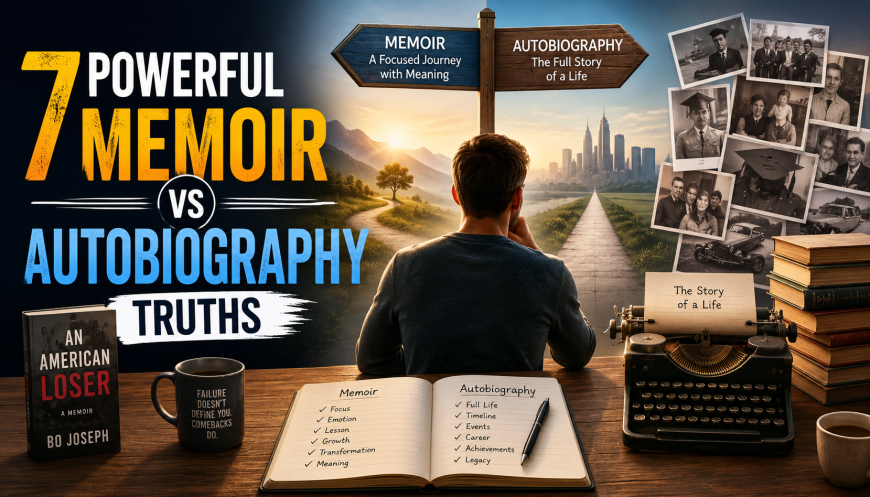
Key Takeaways
- A memoir focuses on a clear theme, lesson, or life change, while an autobiography usually follows a full life from birth to later years.
- Memoir writing often feels more emotional because it explores memory, meaning, fear, failure, healing, and growth.
- Autobiographies are helpful when readers want a wider record of a person’s life, career, family, and major events.
- A memoir author should choose one strong message before deciding which life events belong in the book.
- Personal Memoir Books often connect deeply with readers because they show how real people face hard moments and keep moving forward.
- Books like An American Loser show how stories about struggle, failure, and redemption can help readers think about hope and second chances.
Introduction
Real life can become a powerful story.
However, not every true story is told in the same way.
Many readers and writers search for memoir vs autobiography because both forms share real events, but they do not work the same way.
One form looks at a life through a focused message.
The other often covers a full life from beginning to later years.
This blog explains the difference in simple words.
It also shows how memoir writing, autobiography, personal stories, and Biography Memoir Books help readers understand real people.
In addition, it explains how a memoir author can choose the right path.
It also shares practical ideas about how to write a memoir, how long should a memoir be, and why stories about failure, courage, addiction, healing, and redemption matter.
Memoir vs Autobiography and the Main Difference
A memoir and an autobiography both tell true stories.
However, they do not have the same goal.
An autobiography usually tells the story of a whole life.
It may begin with birth, childhood, family, school, early dreams, work, success, problems, and later life.
It often follows time in order.
For example, a famous leader, actor, teacher, athlete, or business owner may write an autobiography to show the full path of life.
The reader learns where that person came from, what shaped that person, and how that person became known.
A memoir is different.
A memoir does not need to cover everything.
It often focuses on one part of life, one deep lesson, or one emotional journey.
A memoir may focus on grief, addiction, family conflict, fear of disappointment, faith, love, healing, or failure and redemption.
That is why the question of memoir vs autobiography matters so much.
A person may have many true events to share.
However, the right form depends on the purpose of the story.
If the goal is to record a full life, an autobiography may fit better.
If the goal is to explore one powerful change, a memoir may be stronger.
This is also why many Personal Memoir Books feel close and emotional.
They do not only tell what happened.
They show what the person felt, learned, lost, and gained.
A memoir is often built around meaning.
For example, a person may write about growing up poor, but the real story may be about hope.
Another person may write about addiction, but the real story may be about honesty and recovery.
Someone else may write about business failure, but the real story may be about courage and starting again.
This makes memoir writing more focused than a full life record.
The writer must choose the moments that support the main message.
Everything in the book should help readers understand the emotional truth.
What Is Memoir Writing
What Is Memoir Writing is a common question because memoirs can feel hard to define.
Memoir writing is the act of turning real memories into a clear story with purpose.
It is not just writing down every memory.
It is choosing the memories that show change.
A memoir author may ask simple questions before writing.
- What changed in the person’s life?
- What lesson should readers understand?
- What pain or problem shaped the journey?
- What moments best show that change?
- What truth can help someone else?
These questions help turn memory into story.
A memoir can include scenes, dialogue, reflection, and emotion.
However, it should still be honest.
The writer may not remember every word perfectly.
Still, the writer should not invent major events or mislead the reader.
Trust matters in true life writing.
That trust is part of EEAT because readers want experience, truth, and care.
A strong memoir shows real experience.
It also shows clear thinking and emotional honesty.
For example, Best Addiction Memoirs often work because the author does not only describe addiction.
The author shows denial, pain, broken trust, recovery, support, and the hard work of change.
That kind of story can help readers feel less alone.
It may also help families understand what recovery can look like.
In the same way, best memoirs about overcoming failure often do more than describe failure.
They show shame, fear, loss, learning, and the choice to keep going.
A failure and redemption author may help readers see that one bad season does not have to define a whole life.
This is why inspirational authors often write memoirs.
They use personal pain to offer light to others.
However, good memoir writing does not preach.
It shows.
It lets readers walk through scenes and understand the lesson through action.
A memoir author should avoid turning the book into a long lecture.
Instead, the story should show what happened, what it meant, and how the person changed.
This is also where Memoir Ghostwriters can help.
Some people have powerful stories but do not know how to shape them.
A ghostwriter may help organize memories, build chapters, keep the voice natural, and make the story easier to read.
However, the truth still belongs to the person who lived it.
The writer’s job is to protect the heart of the story.
How Purpose Shapes True Life Stories
Purpose is one of the biggest differences between memoir and autobiography.
An autobiography often has a public purpose.
It may explain a person’s career, legacy, achievements, family roots, and major life events.
A memoir often has a personal and emotional purpose.
It may explain how one season changed everything.
For example, a person may write an autobiography to record a life in education, sports, ministry, entertainment, or business.
That book may include many dates, places, awards, jobs, travels, and family details.
The reader gets a wide view.
However, a memoir may focus only on one part of that same life.
It may focus on a childhood wound, a broken relationship, a health scare, a spiritual journey, or a long battle with regret.
The reader gets a deep view.
This is why biography inspirational content can overlap with memoirs.
A biography is usually written by someone else about a person’s life.
An autobiography is written by the person about that person’s own life.
A memoir is also written from personal experience, but it is more focused on meaning.
Biography Memoir Books may blend these ideas because they often show real lives through story, struggle, and growth.
The phrase can describe books that feel both factual and emotional.
A reader may want facts, but also wants a reason to care.
That reason often comes from the inner journey.
A simple way to understand the difference is this.
An autobiography says, “This is the story of a life.”
A memoir says, “This is the story of what this part of life meant.”
Both can be useful.
Both can be powerful.
However, they serve different reader needs.
Readers who want full context may choose autobiography.
Readers who want emotional connection may choose memoir.
For example, a Bo Joseph biography may help readers understand the full background of Bo Joseph.
It may explain his early life, major struggles, personal choices, and public story.
However, the An American Loser book can also be discussed as a personal memoir book because it focuses on struggle, failure, resilience, and the search for meaning.
That kind of story can speak to readers who feel stuck or ashamed.
It may help them ask how to find redemption after painful choices or hard seasons.
Why Readers Connect With Personal Memoir Books
Readers connect with Personal Memoir Books because they often see parts of themselves in the story.
A person does not need to have the same life as the author.
The reader only needs to understand the feeling.
Fear is familiar.
Failure is familiar.
Disappointment is familiar.
Hope is familiar too.
A memoir can turn one person’s private experience into a shared human lesson.
That is why many readers look for Best Personal Memoir Books during difficult times.
They may want to understand grief.
They may want to understand addiction.
They may want to understand family pain.
They may want to believe that change is still possible.
Memoirs help because they do not always offer perfect answers.
Instead, they show honest movement.
A person may fall, rise, fall again, and keep trying.
That feels real.
Real growth is rarely clean.
It often comes through confusion, regret, and small brave choices.
This is also why the fear of disappointment can be a strong memoir theme.
Many people fear letting others down.
They fear failing their family, their children, their friends, or themselves.
A memoir can show how that fear shaped choices.
It can also show how a person learned to face it.
In addition, memoirs can help readers understand redemption.
How to Find Redemption is not only a religious or spiritual question.
It can also mean learning how to repair harm, accept truth, ask for forgiveness, and build a better future.
A memoir about redemption should not pretend that pain never happened.
Instead, it should show responsibility and growth.
This is where An American Loser and author Bo Joseph can fit naturally into the wider topic.
A story about falling short and searching for a better path can help readers think about their own lives.
It can show that a person’s lowest moment does not have to be the final chapter.
That kind of message supports inspirational reading.
It also gives a memoir clear purpose.
However, a memoir should not try to cover every event just because it happened.
The best memoirs choose the right scenes.
They focus on the moments that reveal the heart of the journey.
A short childhood memory may matter more than a major public event if it explains the author’s inner wound.
A quiet apology may matter more than a dramatic success if it shows real change.
This is the art of memoir writing.
The author must know what the book is truly about.
How Writers Choose the Right Form
A writer should choose memoir or autobiography based on the promise made to the reader.
If the book promises a full life story, it should give a wide view.
If the book promises a deep lesson, it should stay focused.
This choice affects every part of the book.
It affects the title, chapter order, tone, length, research, and marketing.
For example, a book called “My Life in Public Service” sounds like an autobiography.
Readers may expect childhood, education, first job, career, family, public work, challenges, and later reflection.
A book called “Learning to Stand Again” sounds more like a memoir.
Readers may expect a focused story about hardship, healing, and growth.
The writer should also think about the main reader.
Some readers want facts and full history.
Others want comfort, courage, or wisdom.
A memoir usually serves readers who are searching for meaning.
An autobiography often serves readers who want a complete record of a known person’s life.
However, the two forms can overlap.
An autobiography can include emotional scenes.
A memoir can include dates and facts.
The difference is not about whether facts exist.
The difference is about focus.
This is why memoir-vs-autobiography is a useful content topic for authors, editors, publishers, and readers.
It helps people understand what kind of book they are creating or buying.
It also helps with search intent.
A reader who searches for this phrase likely wants a clear answer, examples, and guidance.
That reader may be writing a book, choosing a genre, or comparing true life books.
A writer asking how to write a memoir should start with one clear theme.
The theme may be survival, forgiveness, identity, addiction recovery, grief, faith, family, courage, or second chances.
After that, the writer can choose scenes that support the theme.
The writer should not include every memory.
Too many events can make the story feel messy.
A strong memoir needs shape.
A simple memoir structure may include these parts.
- The life before the main problem
- The moment the problem became clear
- The struggle to face the truth
- The people, places, or choices that shaped the journey
- The lowest point or turning point
- The lesson learned through change
- The new understanding at the end
This structure helps readers follow the emotional path.
It also keeps the book from becoming a list of memories.
How Long Should a Memoir Be
Many writers ask how long should a memoir be before they begin.
There is no single answer for every story.
However, many memoirs are long enough to explore the journey with care but short enough to stay focused.
A personal memoir book does not need to include every year of life.
It only needs enough scenes to make the change believable.
A very short memoir may feel rushed.
A very long memoir may lose focus.
The right length depends on the story’s promise.
If the memoir covers one year of recovery, it may not need as many chapters as a memoir covering a twenty-year family journey.
If it explores addiction, loss, failure, and healing, it may need more space.
The writer should ask whether each chapter adds meaning.
If a chapter only adds information but no emotional value, it may not belong.
This is where editing becomes important.
A memoir author may love a memory because it feels personal.
However, the reader needs a reason to care.
The best chapters show conflict, choice, feeling, and change.
They also connect to the main theme.
For example, Best Addiction Memoirs often include moments of denial, harm, rock bottom, support, and recovery.
Each chapter should move the reader closer to understanding the whole journey.
In contrast, an autobiography may include more events because its purpose is wider.
It may include school years, jobs, moves, public moments, private family events, and later achievements.
The reader expects a broader record.
This does not mean an autobiography should be boring.
It still needs story, clarity, and reflection.
However, it has more room for timeline and background.
Memoir Ghostwriters often help writers make this choice.
They may listen to hours of stories and then find the strongest thread.
They may notice that the real book is not about a career, but about courage.
They may see that the real message is not success, but healing after shame.
This outside view can help because people are often too close to their own lives.
They may not know which memories matter most to readers.
A ghostwriter can also help keep the author’s voice.
That voice matters because memoirs should feel personal.
Readers want to feel close to the person telling the story.
A polished book should still sound honest and human.
Practical Tips for Memoir Authors
A memoir author should begin with the heart of the story.
Before writing chapters, the author should write one simple sentence about the book’s meaning.
For example, the sentence may say, “This is a story about finding hope after failure.”
Another sentence may say, “This is a story about learning to forgive a parent.”
Another may say, “This is a story about recovery after addiction.”
That sentence becomes the guide.
Every chapter should connect to it.
This helps the author avoid writing a book that wanders.
Many first drafts become too wide because life has many memories.
However, a memoir needs direction.
The writer should also choose a clear starting point.
A memoir does not always need to begin with birth.
It may begin with a powerful scene.
For example, it may open with a hospital room, a phone call, a court date, a family argument, a lost job, a quiet morning after a mistake, or a moment of truth.
The opening should pull readers into the main problem.
Then the book can move backward when needed.
This keeps the story active.
The writer should also use simple scenes.
A scene helps readers see what happened.
It includes place, people, action, feeling, and meaning.
Instead of saying, “He was afraid of disappointing his father,” the writer can show a scene where the person hides a report card, avoids a phone call, or lies about a mistake.
That scene makes the fear of disappointment real.
Good memoir writing also balances action and reflection.
Action shows what happened.
Reflection explains why it mattered.
Too much action can feel shallow.
Too much reflection can feel slow.
A strong memoir uses both.
The author should also protect other people’s dignity when possible.
Memoirs often include family, friends, teachers, partners, coworkers, or children.
Some people may be shown during painful moments.
The author should be honest, but also careful.
The goal is not revenge.
The goal is truth with purpose.
This builds trust with readers.
Using Real Examples Without Losing Focus
Examples help readers understand the difference between memoir and autobiography.
A person writing about a whole military career may be writing an autobiography.
However, a person writing about one battle with trauma after service may be writing a memoir.
A person writing about every stage of a music career may be writing an autobiography.
However, a person writing about losing fame and rebuilding identity may be writing a memoir.
A person writing about all family generations may be writing a family history.
However, a person writing about healing from one family wound may be writing a memoir.
The same life can create different books.
That is why the author must know the goal.
For readers, this also helps when choosing books.
A reader who wants a full Bo Joseph biography may look for details about his life path.
A reader who wants inspiration may look for An American Loser because the story connects to failure, resilience, and redemption.
A reader who wants biography inspirational books may enjoy both forms, depending on the writing style.
In addition, readers who search for Best Personal Memoir Books may be looking for emotional truth.
They may not need a famous person.
They may want an honest person.
This is important because memoirs do not have to be written only by celebrities.
Ordinary lives can carry deep lessons.
A parent, teacher, nurse, veteran, business owner, artist, pastor, student, or survivor can have a story worth telling.
The value is not only in fame.
The value is in meaning.
This is why What Is Memoir Writing matters for new authors.
Memoir writing is not about proving that a life was perfect.
It is about showing what was learned through real experience.
A strong memoir can include mistakes.
In fact, mistakes often make the story more useful.
Readers trust a voice that admits weakness.
They may feel encouraged when an author tells the truth about failure.
However, the author should not stay only in pain.
A memoir should offer movement.
That movement may be healing, acceptance, wisdom, peace, courage, or a fresh start.
This is where How to Find Redemption becomes a meaningful theme.
Redemption does not erase the past.
It changes how the person carries it.
A memoir can show that change in a way that feels honest and helpful.
FAQs
What is the main difference between memoir vs autobiography
The main difference is focus.
An autobiography usually tells the full story of a person’s life.
It often starts with childhood and moves through major events in order.
A memoir focuses on one part, theme, or lesson from life.
It may cover only a few years or one major experience.
For example, an autobiography may explain a person’s full career and family history.
A memoir may focus on surviving failure, facing addiction, healing from grief, or learning how to find redemption.
Both are true life writing.
However, a memoir is usually more emotional and focused.
Is a memoir always shorter than an autobiography
A memoir is often shorter, but not always.
The real difference is not only length.
The real difference is purpose.
A memoir can be long if the emotional journey needs more space.
An autobiography can be shorter if the writer gives only the main life events.
Still, memoirs usually leave out many life details that do not support the main theme.
That is why a memoir author should ask how long should a memoir be based on the story’s goal.
If a chapter does not support the main message, it may need to be removed.
Can Memoir Ghostwriters help with true stories
Yes, Memoir Ghostwriters can help people turn real memories into clear, readable books.
Many people have powerful life stories but feel unsure about structure, tone, grammar, or chapter order.
A ghostwriter can interview the author, organize the story, and shape the writing.
However, the truth and voice should still come from the person who lived the story.
The best ghostwriting keeps the author’s experience at the center.
It should not make the story feel fake or overly polished.
A good memoir should still feel human.
Are Personal Memoir Books only for famous people
No, Personal Memoir Books are not only for famous people.
A person does not need to be a celebrity to write a meaningful memoir.
Readers often connect with honest stories from everyday people.
A story about fear, failure, recovery, family, faith, or courage can matter deeply.
Books such as An American Loser show how a personal memoir book can speak to readers who understand struggle and second chances.
The author’s fame is less important than the truth, clarity, and emotional value of the story.
Conclusion
The topic of memoir vs autobiography is important because true stories need the right shape.
A person’s life may hold many events, but not every event belongs in every book.
An autobiography gives a wide record of a life.
It often follows time from early years to later years.
It can include family history, education, work, success, public moments, and personal change.
A memoir gives a deeper look at one part of life.
It focuses on meaning, emotion, growth, and lesson.
It may explore addiction, grief, fear of disappointment, family pain, failure, faith, courage, or redemption.
This is why memoirs often feel personal and close.
They invite readers into the inner life of the author.
They show not only what happened, but why it mattered.
For writers, the best choice begins with purpose.
If the writer wants to record a full life, an autobiography may be the better path.
If the writer wants to share a clear lesson from a powerful season, a memoir may be the stronger choice.
For readers, the choice depends on what they want to gain.
Some readers want complete life history.
Others want emotional truth and guidance.
Both forms can teach.
Both can inspire.
However, they do so in different ways.
A memoir author should focus on one strong message.
The author should choose scenes that support that message.
The author should write with honesty, care, and respect for the reader.
The story does not need to be perfect.
In fact, the most helpful memoirs often come from imperfect lives.
They show mistakes, pain, growth, and hope.
That is why inspirational authors often use memoir to reach readers.
They understand that real stories can help people feel seen.
They also understand that redemption is more powerful when it comes through truth.
Books like An American Loser, connected with author Bo Joseph, can help readers think about failure, resilience, and second chances.
That kind of story fits the larger world of Biography Memoir Books, Best Personal Memoir Books, and best memoirs about overcoming failure.
It reminds readers that a life story can carry meaning even when it includes broken parts.
A memoir does not need to hide those parts.
It can use them to show growth.
In the end, both memoir and autobiography help preserve human experience.
They help people remember.
They help people learn.
They help readers understand that every life carries a story.
The strongest true life books are not only about dates, events, or success.
They are about meaning.
They are about what a person learned after life became hard.
They are about how a person changed.
That is the real power of memoir writing.