Lipoduo Vitamin C Vs Regular Vitamin C: Where The Difference Is Real, And Where It Isn't
Regular vitamin C absorbs well at low doses and poorly at high ones. Where LipoDuo Vitamin C genuinely helps, where it does not, and an honest cost view.
 mananiyerr
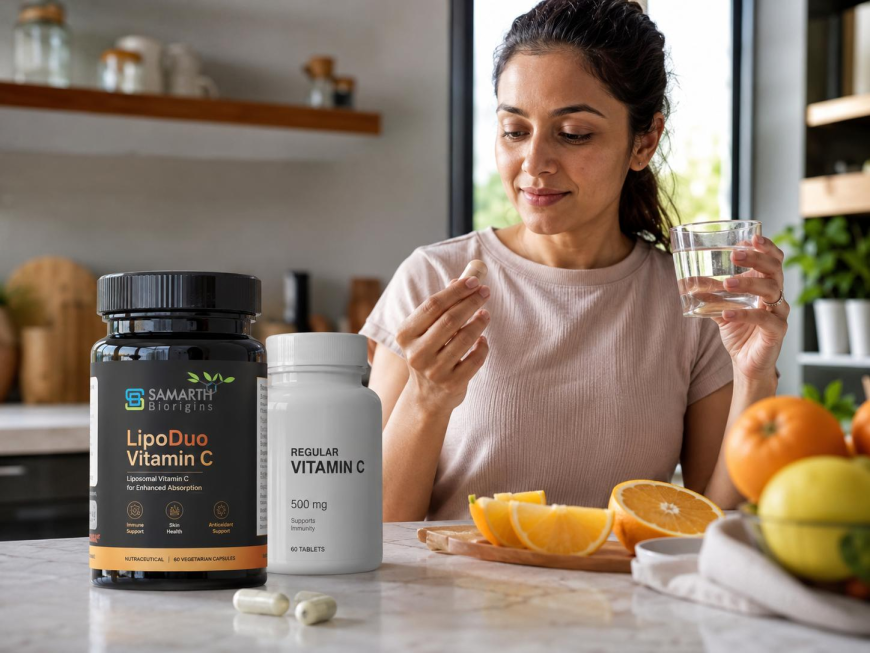
This is the supplement where honesty pays better than hype. At everyday doses, ordinary vitamin C is absorbed extremely well; your gut is good at it, up to a point. That point is the whole story. Absorption is near-complete around two hundred milligrams, then falls away as the intestinal transporters saturate, and by gram-plus doses the fraction you take in can drop below half. LipoDuo Vitamin C matters most exactly where regular vitamin C fails, at high doses, where a phospholipid route sidesteps those saturating transporters. At low doses the premium buys you very little, and I would rather say so plainly.
The dose–absorption curve nobody prints on the bottle
Vitamin C crosses the gut through sodium-dependent transporters, mainly SVCT1 and SVCT2. Think of them as a fixed number of turnstiles. At low intake there is plenty of capacity and almost everything gets through. Push the dose higher and the turnstiles jam, fractional absorption drops, and plasma levels plateau no matter how much more you swallow. This is why a two-thousand-milligram tablet does not put twice as much into your blood as a one-thousand one. The body simply will not let it in that fast by this route.
Where liposomal delivery changes the curve
Encapsulation shifts vitamin C onto a different path. Instead of queuing for the saturable transporters, a liposome delivers its cargo by fusing with cell membranes, which sidesteps the bottleneck. A double-blind randomised trial found liposomal delivery raised peak plasma vitamin C by around twenty-seven percent and leukocyte levels by about twenty percent versus a non-liposomal form over twenty-four hours. Those are meaningful gains, not miraculous ones. The value is concentrated at the high doses where the ordinary route has already given up.
Is it worth the premium? An honest cost look
Liposomal vitamin C typically costs several times more than plain ascorbic acid. For a person taking two hundred and fifty milligrams a day for general immune support, that spend is hard to defend; regular or buffered vitamin C does the job, and I would not upsell them. The premium starts to make sense in high-dose protocols, where ordinary absorption is leaking most of the extra away. My rule of thumb: below the saturation point, buy cheap; well above it, the encapsulation is finally doing something you paid for.
Stability, oxidation and staying compliant
The bowel-tolerance ceiling nobody mentions
There is a practical limit that high-dose vitamin C fans run into: take too much ordinary ascorbic acid at once and the unabsorbed remainder draws water into the gut, producing exactly the loose, urgent result you would expect. This bowel-tolerance ceiling is the body's blunt way of capping how much it will take by the standard route. Because a liposomal form moves vitamin C by a different path, it can raise the amount tolerated before that threshold hits, which is a real advantage for anyone deliberately running high doses. For a person taking a modest daily amount, it is a benefit they will never actually reach, which is worth being honest about.
I also want to correct a claim I see repeated with total confidence: that liposomal vitamin C matches an intravenous drip. It does not. Intravenous vitamin C bypasses the gut entirely and reaches plasma concentrations oral dosing simply cannot touch, which is why clinical high-dose protocols use a needle rather than a bottle. A LipoDuo Vitamin C product improves on ordinary oral absorption; it does not turn a capsule into an infusion. Selling it as an IV substitute is the kind of overreach that eventually costs a brand its credibility with the informed customers it most wants to keep.
What the label should and should not say
Because vitamin C is one of the few nutrients with genuinely permitted health wording in many markets, there is a legitimate story to tell without inventing one. Support for normal immune function and for collagen formation is defensible, specific, and backed by long-standing nutritional consensus rather than a single hopeful study. Curing or preventing infections is not, however popular the belief. Staying inside the honest, approved language is not timidity; it is what keeps a product on shelves when a regulator looks closely. A brand that disciplines its claims tends to outlast the ones making louder promises they cannot defend. The vitamin C category is crowded and price-sensitive, so credibility is one of the few advantages a serious brand can actually keep, and careless wording is the quickest way to throw it away.
Vitamin C oxidises readily, losing potency in the tub and turning tart or off-colour in a finished drink, and encapsulation helps guard both the molecule and the mouthfeel. On claims, restraint protects you. Vitamin C supports normal immune function within a balanced diet; it is not a cure for colds or anything more dramatic, and promising otherwise invites regulatory trouble in most markets. Verify the real vitamin C payload against the phospholipid weight with Samarth Biorigins, because a low-efficiency product can be mostly shell. Used where the dose justifies it, LipoDuo Vitamin C is a sensible upgrade rather than a magic one.