How to Avoid the Most Common Road Test Errors
 ultimatedrivers
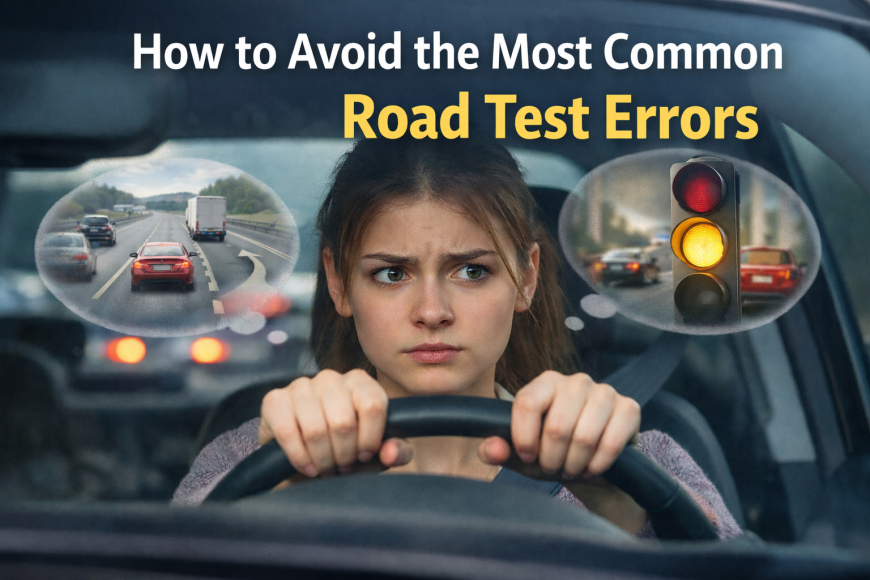
The road test is one of the most important milestones in becoming a licensed driver, yet many capable learners fail on their first attempt. In most cases, the issue isn’t a lack of driving ability—it’s small, preventable mistakes made under pressure.
Road test examiners are not looking for perfection. They are assessing whether a driver can operate a vehicle safely, predictably, and confidently in real-world conditions. Understanding where learners most often go wrong—and how to correct those habits—can make the difference between failing and passing.
Observation Errors: The #1 Reason Learners Fail
Poor observation is the most common reason examiners mark a test as unsuccessful. Many learners do check mirrors and blind spots, but they do so subtly, making it difficult for examiners to confirm that proper checks were performed.
Examiners must see clear head movement. Eye movement alone is not enough.
How to Avoid This Mistake
-
Follow a consistent mirror → signal → blind spot sequence
-
Make head movements deliberate and visible
-
Check mirrors every 5–8 seconds, not just before manoeuvres
-
Always shoulder-check before lane changes, turns, and pulling over
Clear observation demonstrates awareness, planning, and control—three qualities examiners prioritise heavily.
Speed Control: Too Fast or Too Slow
Speed-related errors cut both ways. Driving over the speed limit shows poor judgment, but driving well below the limit signals hesitation and lack of confidence. Many nervous test-takers unintentionally drive too slowly, disrupting traffic flow.
How to Avoid This Mistake
-
Know the speed limits for different road types
-
Adjust speed smoothly when entering new zones
-
Match traffic flow while staying within legal limits
-
Check the speedometer regularly, especially on unfamiliar roads
Proper speed control shows that you understand both road rules and real-world driving expectations.
Intersection Mistakes: Where Tests Are Often Lost
Intersections are high-risk areas during road tests. Rolling stops, poor lane positioning, hesitation, and unsafe gap selection frequently lead to immediate failure.
Common Intersection Errors
-
Not coming to a complete stop at stop signs
-
Stopping beyond the white line or crosswalk
-
Hesitating excessively or taking unsafe gaps
-
Accelerating through yellow lights unnecessarily
How to Avoid Them
-
Stop fully and pause briefly before proceeding
-
Count “one–two” after stopping to ensure full compliance
-
Commit confidently once a safe gap is identified
-
Approach yellow lights with caution, not urgency
Examiners look for calm, confident decision-making—not rushed or overly timid behavior.
Turning Errors and Lane Positioning
Improper turns are another frequent issue, particularly at multi-lane intersections. Turning too wide, cutting corners, or ending up in the wrong lane signals poor vehicle control.
How to Avoid This Mistake
-
Turn from the correct lane into the correct lane
-
Slow down before turning, not during
-
Keep wheels straight while waiting to turn left
-
Maintain lane discipline after completing the turn
Clean, controlled turns demonstrate coordination and spatial awareness.
Parking and Low-Speed Manoeuvres
Parallel parking, reverse parking, and three-point turns often cause anxiety, but these manoeuvres rarely fail due to minor positioning errors. Instead, failures occur due to lack of control, poor observation, or rushing.
How to Avoid Parking Errors
-
Take your time—speed is not graded
-
Check mirrors and blind spots continuously
-
Make adjustments calmly if needed
-
Avoid hitting the curb or other vehicles
Corrections are allowed. Awareness and control matter more than perfection.
Signalling and Communication Errors
Failure to signal—or signaling too late—is a surprisingly common mistake. Signals communicate intention to other drivers and are a key safety requirement.
How to Avoid This Mistake
-
Signal every turn, lane change, and pull-over
-
Signal early (at least several seconds in advance)
-
Cancel signals immediately after the maneuver
-
Never assume a signal is “optional”
Consistent signaling shows predictability, which examiners value highly.
Letting Nerves Take Over
Even well-prepared drivers can make mistakes when anxiety takes control. Nervous learners often rush decisions, forget basic checks, or fixate on one task while neglecting others.
How to Manage Test Anxiety
-
Practice in test-like conditions
-
Familiarize yourself with the test area
-
Take deep breaths before starting
-
Focus on one maneuver at a time
If a minor mistake happens, don’t dwell on it. Stay focused and continue driving safely.
Understanding What Examiners Actually Evaluate
Many learners fail because they misunderstand the purpose of the road test. It is not a test of speed, confidence, or flawless execution—it is an assessment of safety, awareness, and judgment.
Examiners want to see:
-
Clear observation habits
-
Calm, predictable driving
-
Safe decision-making
-
Control in everyday situations
Knowing this shifts preparation from memorisation to meaningful practice.
Conclusion
Most road test failures are caused by small, fixable habits rather than serious driving flaws. By understanding common errors and practising with intention, learners can dramatically improve their performance on test day.
The road test is not about proving perfection—it’s about demonstrating that you can drive safely, responsibly, and confidently in real-world conditions. The skills developed while preparing for the test form the foundation for a lifetime of safe driving, making the effort worthwhile far beyond the exam itself.
At Ultimate Drivers, instructors see firsthand how most road test failures are caused by small, correctable habits rather than a lack of ability. Through structured lessons and real-world practice, learners are guided to develop strong observation skills, proper speed control, and calm decision-making under pressure. By focusing on examiner expectations and safe driving principles, Ultimate Drivers helps students build the confidence and consistency needed not just to pass the road test, but to become responsible, capable drivers long after the test is over