GPU as a Service and Its Impact on Cloud-Based High-Performance Computing
GPU as a Service (GPUaaS) allows organizations to rent GPU resources through the cloud instead of purchasing and maintaining expensive on-premise systems.
 CyfutureCloud
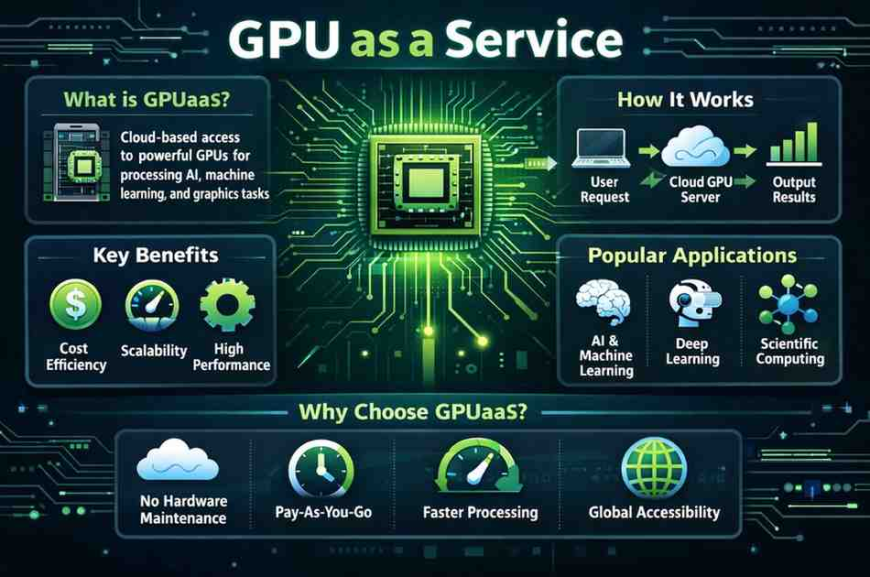
The demand for faster, more efficient computing has increased significantly as businesses adopt advanced technologies such as artificial intelligence, machine learning, and big data analytics. Traditional server infrastructure often struggles to keep up with these requirements, leading organizations to explore more powerful alternatives. One of the most effective solutions today is GPU as a Service, a cloud-based model that provides access to high-performance GPUs without the complexity of managing physical hardware.
Understanding GPU as a Service
GPU as a Service (GPUaaS) allows organizations to rent GPU resources through the cloud instead of purchasing and maintaining expensive on-premise systems. These GPUs are hosted on a GPU Cloud Server, offering scalable and on-demand access to computing power. This approach makes it easier for businesses to deploy resource-intensive applications while maintaining flexibility and cost control.
By leveraging GPU as a Service, companies can scale their GPU usage based on workload needs. Whether it is a short-term project or a long-term production environment, GPUaaS ensures reliable performance without unnecessary infrastructure investment.
Why GPUs Are Essential for Modern Workloads
GPUs are designed to handle parallel processing, enabling them to execute thousands of operations simultaneously. This makes them ideal for workloads that involve large datasets and complex calculations. Applications such as deep learning, video processing, scientific simulations, and financial modeling benefit significantly from GPU acceleration.
With GPU as a Service, organizations gain access to enterprise-grade GPU hardware that supports these demanding workloads while ensuring consistent performance and reliability.
Common GPUs Used in GPU as a Service Platforms
Modern GPU Cloud Server platforms offer a variety of GPU options to meet different performance requirements:
A100 GPU
The NVIDIA A100 GPU is widely used for artificial intelligence, machine learning, and high-performance computing. It provides strong performance for both training and inference tasks, making it suitable for a wide range of business applications.
H100 GPU
The NVIDIA H100 GPU is designed for advanced AI workloads and large-scale data processing. It delivers significantly higher performance and efficiency compared to previous generations, making it ideal for training large language models and complex neural networks.
H200 GPU
The NVIDIA H200 GPU offers enhanced memory capacity and faster bandwidth, making it particularly effective for data-intensive and generative AI workloads. It is well-suited for applications that require handling massive datasets with minimal latency.
Benefits of GPU as a Service
One of the most important benefits of GPU as a Service is cost efficiency. Purchasing high-end GPUs such as the H100 GPU or H200 GPU requires significant upfront capital. GPUaaS eliminates this expense by allowing organizations to pay only for the resources they use.
Scalability is another key advantage. GPU Cloud Server environments allow businesses to add or remove GPU resources quickly, ensuring optimal performance during peak workloads without overprovisioning.
Operational simplicity also adds value. Managing GPU hardware involves specialized expertise, power management, cooling, and regular maintenance. GPU as a Service shifts these responsibilities to the provider, allowing businesses to focus on innovation and application development.
Industry Use Cases
GPU as a Service is used across various industries. In artificial intelligence and machine learning, GPUs accelerate training and inference processes, reducing time to deployment. Research institutions use GPU Cloud Server platforms for simulations, climate modeling, and genomic analysis.
Media and entertainment companies rely on GPUs for video rendering, animation, and visual effects, significantly improving production efficiency. In the financial sector, GPUs support risk analysis, fraud detection, and real-time data processing.
Startups and small businesses also benefit from GPU as a Service. Access to powerful GPUs such as the A100 GPU allows them to develop advanced solutions without the financial burden of purchasing hardware.
Security and Reliability
Security is a critical consideration when adopting GPU as a Service. Reputable providers implement strong security measures, including encryption, access controls, and network isolation. GPU Cloud Server environments are typically hosted in secure data centers with redundant power and cooling systems to ensure high availability.
Many providers also offer dedicated GPU instances, which are ideal for organizations with strict compliance and data privacy requirements.
The Future of GPU as a Service
As AI models become more complex and data volumes continue to grow, the demand for GPU as a Service is expected to increase. Ongoing advancements in GPU technology, such as those seen with the H200 GPU, will further enhance performance and efficiency.
Cloud providers will continue to expand their GPU offerings, giving organizations access to the latest hardware without the need for constant upgrades. GPU as a Service will play a key role in making high-performance computing more accessible to businesses of all sizes.
Conclusion
GPU as a Service has become a foundational element of modern cloud infrastructure. By offering on-demand access to powerful GPUs through a GPU Cloud Server, it enables organizations to handle compute-intensive workloads efficiently and cost-effectively. With options such as the A100 GPU, H100 GPU, and H200 GPU, businesses can choose the right level of performance to support their specific needs.
As digital transformation accelerates, GPU as a Service will remain a critical solution for innovation, scalability, and long-term growth in a data-driven world.