Fast Point Cloud to Revit Services USA: A Complete Guide
Explore our complete guide to Fast Point Cloud to Revit services in USA. Learn how to streamline your projects with expert insights and tips.
 chudasama
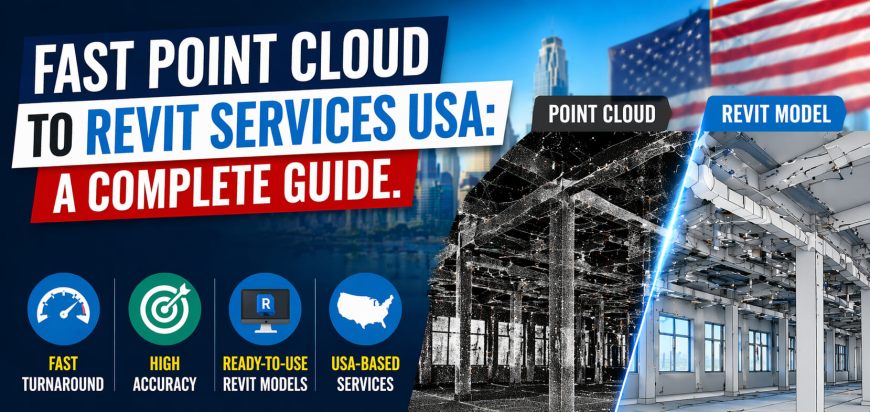
Modern construction and renovation projects demand absolute precision. When you start a building project with inaccurate site data, you risk cascading errors that cost time, money, and resources. Today, architecture, engineering, and construction (AEC) professionals rely on advanced digital tools to capture existing site conditions with pinpoint accuracy.
The transition from a physical space to a highly detailed digital model has revolutionized how teams plan and execute their designs. By utilizing laser scanning technology, professionals can map every inch of a building before a single design modification is made. This digital foundation ensures that all subsequent work relies on reliable, real-world dimensions.
If you want to streamline your modeling workflow and eliminate costly on-site surprises, converting your scanned data into a workable digital model is the answer. This guide explores everything you need to know about navigating these solutions and how fast model conversion can elevate your next project.
Introduction to Point Cloud to Revit Services
Understanding the foundational elements of digital modeling helps you appreciate the value of this technology.
What is Point Cloud?
A point cloud is a massive collection of data points plotted in 3D space. Laser scanners create these point clouds by measuring the distance between the scanner and physical objects in a room or exterior environment. The result is a highly accurate, digital 3D representation of an existing structure, capturing every detail from structural beams to exposed plumbing.
What is Revit?
Building Information Modeling (BIM) relies heavily on software like Autodesk Revit. Revit allows architects and engineers to design a building and its components in 3D, annotate the model with 2D drafting elements, and access building information from the building model's database. It is the industry standard for creating intelligent, data-rich architectural models.
Benefits of Converting Point Cloud to Revit
Transforming raw scan data into a Revit model turns millions of static data points into intelligent building components. Instead of just looking at a 3D picture of a wall, you get a recognizable Revit wall family that contains specific material and structural data. This conversion bridges the gap between existing site conditions and future design plans.
Why Choose Point Cloud to Revit Services in the USA?
Outsourcing your digital conversion to local experts brings distinct advantages to your workflow. Utilizing point cloud to Revit services USA ensures you partner with teams that understand the specific needs of domestic construction.
Expertise and Experience
Firms operating in the USA typically house highly trained BIM professionals. These experts have extensive experience handling complex architectural, structural, and MEP (Mechanical, Electrical, and Plumbing) models. They know exactly how to interpret messy scan data and translate it into clean, usable Revit geometry.
Adherence to Industry Standards
American construction projects must adhere to strict local building codes and standards like the AIA (American Institute of Architects) guidelines. USA-based service providers are deeply familiar with these requirements, ensuring your final Revit models comply with necessary domestic regulations.
Advanced Technology and Software
Top-tier service providers utilize the latest hardware and software to process heavy scan files quickly. They have the processing power and advanced plugins required to handle massive datasets without crashing, ensuring a smooth and rapid delivery of your final model.
Applications of Point Cloud to Revit Services
Accurate digital models serve various sectors within the AEC industry.
Architecture and Construction
Architects use accurate as-built models to plan renovations and extensions. Knowing the exact dimensions of an existing space allows them to design new additions that fit perfectly without clashing with the existing structure.
Facility Management
Facility managers rely on updated BIM models to maintain and operate large buildings. An accurate Revit model helps them locate hidden MEP systems, plan maintenance schedules, and manage space utilization efficiently.
Historic Preservation
When dealing with heritage buildings, traditional measuring tape simply does not work. Laser scanning captures the intricate details of historic facades and uneven structures without causing physical damage, allowing preservationists to create accurate records for future restoration.
The Process of Point Cloud to Revit Conversion
Turning millions of laser points into a functional building model happens in three distinct stages.
Data Acquisition (Scanning)
The process begins on-site. Technicians set up terrestrial laser scanners at multiple locations around and inside the building. These scanners capture the geometry of the space, generating thousands of individual scans that cover every angle of the property.
Pre-processing of Point Cloud Data
Once the scanning is complete, the raw data moves to the processing software. Technicians register the individual scans, stitching them together like a massive 3D puzzle to create one unified point cloud. They also clean the data by removing digital noise, such as reflections from windows or people walking through the scan area.
Revit Modeling from Point Cloud
BIM modelers import the cleaned point cloud into Revit. Using the points as a highly accurate tracing template, they build out the walls, floors, roofs, and MEP systems. The modelers carefully select the correct Revit families to match the real-world elements captured in the scan.
Benefits of Fast Model Conversion
Speed is a critical factor in modern construction. Partnering with a reliable firm like Chudasama Outsourcing for your conversion needs provides a serious competitive edge.
Time and Cost Efficiency
Fast model conversion keeps your project on schedule. When your design team receives the as-built model quickly, they can start their work sooner. This prevents project delays and significantly reduces the labor costs associated with manual site measurements and drafting.
Accuracy and Precision
Rapid conversion does not mean cutting corners. Advanced workflows ensure that the resulting Revit model maintains the millimeter-level precision of the original laser scan. This high level of accuracy prevents costly rework and material waste during the actual construction phase.
Improved Collaboration
A centralized, highly accurate Revit model serves as a single source of truth for all project stakeholders. Architects, engineers, and contractors can all work from the same updated model, reducing miscommunication and preventing clash errors before ground is even broken.
Case Studies and Examples
Consider a recent commercial renovation in downtown Chicago. The general contractor needed to update the HVAC systems in a 100-year-old office building. By utilizing scan-to-BIM services, the team discovered that the existing ceiling plenums were significantly shallower than the original 1920s blueprints indicated. Because the team had access to a fast, accurate Revit model, they adjusted their mechanical designs prior to manufacturing the new ductwork, saving tens of thousands of dollars in potential rework.
Securing the Future of Your Construction Projects
Accurate site data is the bedrock of any successful renovation or retrofitting project. By converting complex point cloud data into intelligent Revit models, AEC professionals eliminate guesswork, reduce costly errors, and dramatically improve team collaboration. The ability to visualize existing conditions with absolute clarity gives project managers the confidence they need to execute complex designs on time and under budget.
As laser scanning technology becomes more accessible and processing software grows more powerful, the demand for high-quality scan-to-BIM workflows will only increase. Embracing these advanced services now positions your firm at the forefront of construction innovation.
Ready to streamline your next building project? Contact a trusted BIM service provider today to turn your raw scan data into an intelligent, project-ready Revit model.