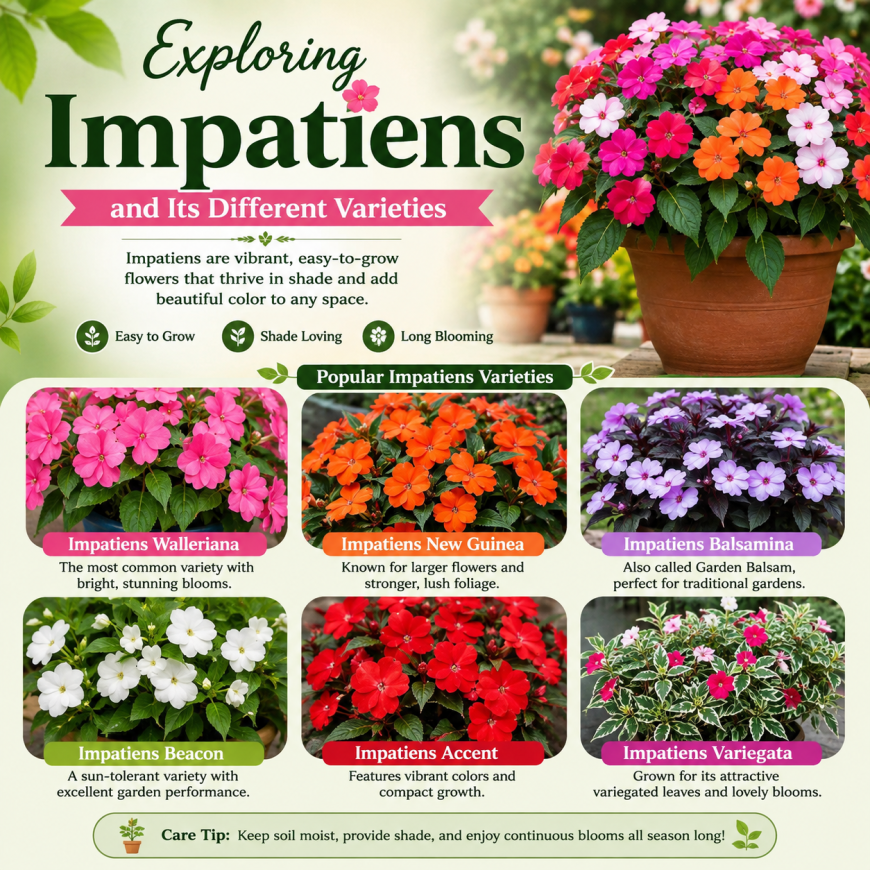
Exploring Impatiens and Its Different Varieties
 david
david
Impatiens is a kind of a big genus of flowering plants that mostly comes from tropical Africa and Asia. The word “Impatiens” comes from Latin, like “impatient”, and that fits the plant because when the seed pods get ripe, they basically explode, sort of burst outward, fast.
You can usually spot them by the fleshy stems, soft leaves, and those five-petaled flowers that show up in a wide parade of colors. In hot climates, a lot of species act like real perennial blooms, and they return again next season. But in temperate areas, Impatiens flowers are usually handled as an annual since frost really stops it.
Before growing the Impatiens flower, you need to know about the different varieties of this plant, so that you can easily choose the best one for your space.
Exploring the different varieties of the Impatiens flower
You will find different types of impatiens flowers in nature, and depending on the space you have, you can choose any variety.
-
Impatiens walleriana
This is the one most people grow, pretty much always. It makes a dense, mounded shape, and it flowers in a steady, almost nonstop way. Walleriana likes partial shade and even full shade, surprisingly well. You’ll find it in solid colors or bicolor mixes, red, pink, white, purple, orange, and salmon tones. In most places it’s treated as an annual, because colder weather can be a problem.
-
New Guinea Impatiens (Impatiens hawkeri)
New Guinea Impatiens tend to handle more sun than Walleriana, and the blooms are often bigger, more showy too. The leaves can look rich green or sometimes bronze-ish, which makes it a little extra decorative. Folks often wonder, do New Guinea Impatiens come back every year? In places with no frost, yes, they act like perennial flowers. In temperate climates, they’re typically annuals, unless you overwinter them indoors, sort of keep them going till spring.
-
Impatiens balsamina
You might also hear this one called garden balsam or rose balsam. It grows upright and forms rose-like double flowers. This variety is fast; it moves quickly, and it becomes a good summer annual. It also prefers spots that are a bit sunnier than what Walleriana would usually take.
-
Impatiens capensis
This one is commonly called jewelweed, and it’s native to North America. It has orange, trumpet-shaped flowers, and it seems happiest in damp woodland areas. People use it for naturalized plantings, and it also has ethnobotanical importance, the kind of history where it’s been used by communities for different reasons.
Source: Abodelook