7 Smart Ways to Enhance Cognitive Development Through Play
Enhance cognitive development through play with simple preschool activities, stories, books, and learning tips for growing minds.
 freyaparker
Key Takeaways
- Play helps preschool children build memory, focus, language, problem-solving, and early thinking skills.
- Simple games, stories, books, blocks, art, music, and pretend play can support strong brain growth.
- Adults can guide play without taking over, so children stay curious and confident.
- Play based learning works best when it feels safe, joyful, active, and meaningful.
- Preschool Stories, books, and daily routines can make thinking skills easier to practice.
- Families and teachers can use small moments each day to support learning through play.
Introduction
A young child learns best when the world feels exciting, safe, and full of wonder.
That is why play is more than fun. It is one of the strongest ways to help a child think, remember, talk, solve problems, and understand life.
Many parents and teachers want to know how to enhance cognitive development through play in simple and natural ways.
This blog explains how play supports the growing brain during the preschool years.
It also shows how stories, books, pretend games, movement, art, and daily routines can help children learn without pressure.
The goal is not to make play feel like a test.
The goal is to help adults understand how playful moments can build real skills.
A child stacking blocks, acting out Preschool Stories, turning pages in a preschool book, or asking “why” is doing important brain work.
These small moments help children notice patterns, remember steps, use words, and make choices.
In addition, play helps children build social and emotional skills.
They learn how to wait, share, listen, try again, and handle small problems.
These skills matter in preschool, kindergarten, and everyday life.
A strong early learning plan does not need expensive toys or complicated lessons.
It needs time, care, conversation, safe materials, and adults who understand the benefits of play based learning.
How to Enhance Cognitive Development Through Play
Cognitive development means how children think, learn, remember, reason, and solve problems.
During the preschool years, the brain grows quickly.
Children begin to understand shapes, sounds, numbers, stories, rules, feelings, and cause and effect.
However, young children do not learn best by sitting still for long periods.
They learn through action.
They touch, move, ask, copy, build, pretend, listen, and explore.
This is why play based learning is so powerful.
It matches the way a young child naturally learns.
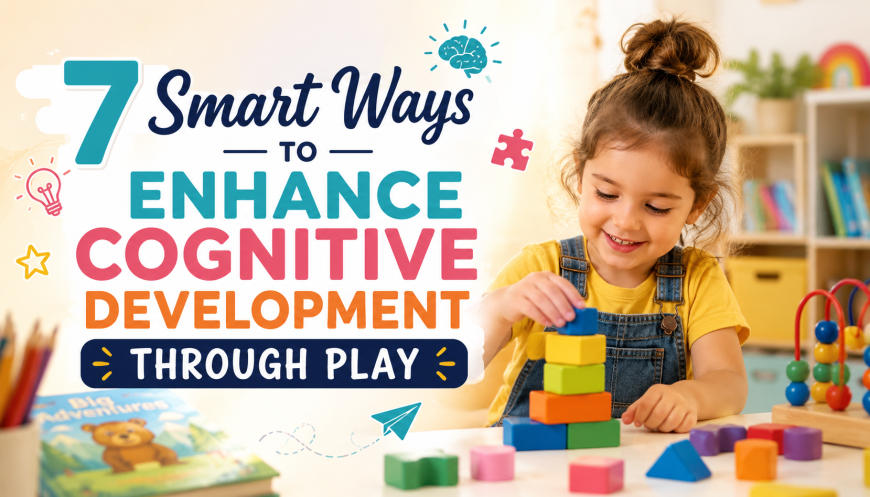
For example, a child building a tower is not only stacking blocks.
The child is learning balance, size, order, patience, and problem-solving.
When the tower falls, the child learns cause and effect.
When the child rebuilds it, the child practices memory and persistence.
In addition, play helps children connect ideas.
A child may pretend a box is a bus, a boat, or a house.
This kind of pretend play shows flexible thinking.
The child is learning that one object can stand for another idea.
That skill supports language, reading, storytelling, and creative thinking later.
Preschool teachers often use play because it allows children to learn in many ways at once.
A pretend grocery store can teach counting, speaking, listening, sharing, and planning.
A simple puzzle can build focus, shape recognition, and problem-solving.
A picture book can support memory, vocabulary, emotions, and imagination.
This is also why Books for Early Childhood Education are so important.
A good book for preschool children can turn reading time into a thinking activity.
Children can guess what happens next, name pictures, retell the story, and talk about feelings.
A strong preschool book does not need hard words.
It needs clear pictures, simple ideas, rhythm, repetition, and meaning.
For example, a book about a lost puppy can teach kindness, memory, and problem-solving.
A preschool adventure book can help children follow a journey, notice clues, and understand brave choices.
A best book for preschoolers often gives children both fun and learning.
However, adults should remember that children need freedom inside play.
Play should not become a worksheet in disguise.
A teacher or parent can guide by asking gentle questions.
For example, an adult might ask, “What could happen next?” or “How can the bridge stay up?”
These questions help the child think without feeling pushed.
The adult does not need to give every answer.
Instead, the adult can help the child notice, wonder, and try again.
This builds confidence and independence.
Children also learn when play connects with real life.
A child helping sort socks can learn matching and size.
A child setting the table can count plates and cups.
A child watering plants can observe growth, change, and responsibility.
These simple tasks support thinking because they involve steps, memory, attention, and language.
Moreover, play supports executive function.
Executive function means the brain skills that help a child plan, focus, remember rules, and manage actions.
Games like “Simon Says,” matching cards, and freeze dance can help children practice these skills.
When children stop, listen, remember, and act, their brain is working hard.
These games may look simple, but they support school readiness.
They help children follow directions, stay focused, and control impulses.
In preschool, this matters a lot.
A child who can listen, wait, and try again is better prepared for group learning.
Cognitive play also supports language.
When children pretend, they often use new words.
They may say “doctor,” “patient,” “rescue,” “map,” “treasure,” or “journey.”
These words become part of their thinking.
A child who can use more words can also explain ideas better.
This supports reading, writing, and social growth later.
Stories are especially helpful for language and thinking.
Preschool Stories give children a beginning, middle, and end.
They show characters, problems, choices, and solutions.
When children hear stories often, they learn how events connect.
They also begin to understand time words such as first, next, then, and last.
These words support memory and order.
In addition, stories help children understand emotions.
A character may feel scared, happy, jealous, proud, or sad.
When adults talk about these feelings, children learn to name their own emotions.
This helps thinking because feelings and learning are connected.
A calm child can focus better.
A child who understands feelings can solve social problems more easily.
Parents and teachers can also use play to notice how a child learns.
Some children enjoy movement.
Some enjoy music, blocks, books, drawing, or pretend play.
A child who does not sit for a long story may enjoy acting it out.
A child who struggles with numbers may enjoy counting toy animals.
This flexible approach makes learning feel possible.
It also respects each child’s pace.
The best learning through play is not rushed.
It gives children time to explore and repeat.
Repetition helps memory.
A child may want the same preschool book every night.
That may seem boring to an adult, but it is useful for the child.
Each reading helps the child notice more details.
The child may remember words, guess the next page, or retell parts of the story.
This strengthens language and memory.
For this reason, families should not worry when children repeat games.
Repeating a puzzle, song, block pattern, or story can deepen learning.
The child is not stuck.
The child is practicing.
Why Play Builds Strong Thinking Skills
Play builds thinking because it gives children problems they care about.
A child may want to make a blanket fort stand up.
A child may want a toy car to move faster.
A child may want a pretend restaurant to have menus, plates, and customers.
These goals motivate the child to think.
The child makes a plan, tests ideas, changes the plan, and tries again.
This is early problem-solving.
In many ways, play is a child’s first science lab.
Children test what floats, rolls, breaks, bends, stacks, mixes, and moves.
They may not use adult science words, but they are exploring real ideas.
For example, water play can teach volume, weight, pouring, and cause and effect.
Sand play can teach texture, shape, and measurement.
Outdoor play can teach weather, plants, insects, distance, and direction.
In addition, play helps children compare and sort.
Sorting buttons by color, cars by size, or leaves by shape supports early math thinking.
Matching socks or grouping toy animals also builds categories.
These categories help children organize information.
The brain learns by making connections.
When children group objects, they are building mental order.
This kind of thinking later supports reading and math.
A child who understands “same” and “different” can notice letter shapes.
A child who can sort objects can begin to understand numbers and patterns.
Play also builds memory.
Memory grows when children repeat actions, hear stories, sing songs, and follow routines.
A song with movements helps children remember words.
A game with steps helps children remember order.
A story with repeated lines helps children predict what comes next.
This is why many Books for Early Childhood Education use rhythm and repetition.
These features are not only cute.
They help children remember language.
A best preschool book often repeats key phrases because young children enjoy joining in.
When children say the repeated words aloud, they practice speech, memory, and confidence.
Pretend play also supports memory.
A child pretending to be a doctor must remember what a doctor does.
A child pretending to run a store must remember roles, items, and actions.
The child may say, “First buy apples, then pay money.”
This shows planning and sequence.
These skills support classroom learning.
Play also helps attention grow.
Young children are not built to focus like adults.
However, they can focus for a long time when an activity feels meaningful.
A child may spend twenty minutes building a zoo with blocks and animals.
That focus matters.
It shows the child is thinking, choosing, adjusting, and staying with a task.
Adults can support this by protecting play time.
Too many interruptions can break concentration.
A calm play space helps children stay involved.
Simple toys often work better than noisy toys.
Open-ended materials are especially helpful.
Blocks, scarves, boxes, clay, crayons, dolls, toy animals, cups, and natural objects can become many things.
They invite children to imagine and decide.
A toy that does only one thing may entertain a child for a short time.
However, an open-ended material can support deeper thinking.
For example, a set of blocks can become a house, road, farm, castle, school, or stage.
Each new idea builds flexible thinking.
Play also supports language because children talk while they play.
They explain plans, ask questions, tell stories, and negotiate roles.
A child may say, “The dragon is sleeping, so the bunny has to be quiet.”
This sentence shows imagination, cause and effect, and emotional understanding.
Adults can add language without taking over.
For example, an adult can say, “The bunny is tiptoeing because the dragon is asleep.”
This gives the child new words while honoring the child’s idea.
Books and stories make this even stronger.
A preschool adventure book author often uses simple problems, brave choices, and clear story paths.
These features help children follow events.
Authors such as Author Ashli Karaman can be connected with early learning topics when families search for meaningful preschool reading.
Searches like Ashli Karaman author biography or Ashli Karaman book author biography may help families learn more about the creator behind a preschool book.
However, the main focus should remain on choosing stories that help children think, feel, and imagine.
A good book for preschool should match the child’s age and attention span.
It should use safe themes, clear pictures, and language the child can understand.
It should also leave room for questions.
For example, after reading a preschool book, an adult might ask:
- What was the problem in the story?
- What did the character try first?
- How did the character feel?
- What could happen after the story ends?
These questions help children think about meaning.
They also support memory and language.
However, questions should feel like conversation, not a quiz.
The child should feel free to answer in a simple way.
Drawing after reading can also help.
A child can draw a favorite scene or invent a new ending.
This connects art, memory, language, and imagination.
In addition, acting out a story can support deeper understanding.
Children may use toys, puppets, or costumes.
This helps them remember events and understand characters.
Preschool Stories become more powerful when children can move, speak, and create.
Play also builds reasoning.
Reasoning means using clues to make sense of something.
A child may think, “The floor is wet because the cup spilled.”
A child may think, “The big block should go on the bottom because it is strong.”
These are early logic skills.
Adults can support reasoning by asking “how” and “why” questions.
For example, “How did the ball roll so far?” or “Why did the tower fall?”
The child does not need a perfect answer.
The goal is to help the child think.
Moreover, play builds confidence.
When children solve small problems, they begin to believe they can handle challenges.
This matters because learning always includes mistakes.
A child who sees mistakes as part of play is more likely to try again.
This attitude helps in reading, writing, math, friendships, and life.
Play Based Learning Activities That Support the Brain
Play based learning works best when activities match the child’s age, interests, and energy level.
Preschool children need movement, choices, repetition, and real materials.
They also need adults who watch carefully and respond with kindness.
A play activity does not need to look fancy to be useful.
Simple activities often create the deepest learning.
Block play is one of the best examples.
When children build with blocks, they learn size, shape, balance, space, and planning.
They also practice patience.
A child may build a bridge and discover that it falls without support.
This moment teaches more than a worksheet could.
The child sees the problem, changes the design, and tests it again.
In addition, block play can support social thinking.
Two children building together must share ideas.
They may decide where the road goes or how tall the tower should be.
They practice listening, speaking, and solving disagreements.
Pretend play is another powerful activity.
When children play family, school, doctor, shop, rescue team, or restaurant, they use memory and imagination.
They copy real life and change it into story.
This supports symbolic thinking.
Symbolic thinking means one thing can stand for another.
A stick can be a spoon.
A towel can be a cape.
A chair can be a bus.
This skill is important because letters and numbers are also symbols.
When children pretend, they prepare the mind for reading and math.
Art play also supports cognitive growth.
Drawing, painting, cutting, gluing, and shaping clay help children plan and create.
A child may decide to draw a house, then add windows, a door, grass, and people.
This shows memory, order, and representation.
Art also builds fine motor skills.
Fine motor control helps children later hold pencils, turn pages, and write letters.
However, art should not always be adult-directed.
A craft with one correct result can be fun, but open art often supports deeper thinking.
When children choose colors, shapes, and designs, they make decisions.
They learn that ideas can become visible.
Music and movement also help the brain.
Songs with actions support memory and listening.
Clapping patterns support rhythm and early math.
Freeze dance supports self-control.
Marching, jumping, crawling, and balancing support body awareness.
Movement matters because the brain and body work together.
A child who moves can learn direction words such as over, under, around, beside, and between.
These words later help with reading, math, and daily instructions.
Outdoor play is also rich with learning.
Children notice rocks, leaves, clouds, bugs, puddles, and shadows.
They ask questions.
They compare sizes and colors.
They test what happens when they run uphill, jump in mud, or roll a ball on grass.
Outdoor play supports observation, curiosity, and problem-solving.
It also helps children release energy, which can improve focus afterward.
Story play is another strong tool.
Adults can read Preschool Stories and then invite children to act them out.
This can be done with puppets, toys, drawings, or simple costumes.
Children remember the story better when they use their bodies and voices.
They also practice sequence.
They learn what happened first, next, and last.
For example, after reading a story about a bear looking for a friend, children can use toy animals to retell the journey.
They can add a new character or change the ending.
This supports creativity and comprehension.
A preschool adventure book is especially useful for this kind of play.
Adventure stories often include a goal, a problem, clues, helpers, and a solution.
These parts help children understand story structure.
A best preschool adventure book can invite children to predict, imagine, and solve problems with the characters.
In addition, sensory play helps children explore through touch, smell, sight, and sound.
Water, sand, rice, fabric, leaves, clay, and safe household items can support discovery.
Children learn words such as soft, rough, heavy, light, wet, dry, full, empty, smooth, and sticky.
These words help children describe the world.
Sensory play can also calm the body.
A calm child often thinks more clearly.
Puzzles and matching games are useful too.
They support visual thinking, memory, patience, and problem-solving.
A child turning a puzzle piece learns to compare shapes.
A child matching picture cards learns to remember details.
However, adults should choose puzzles that match the child’s skill level.
A puzzle that is too easy may not hold interest.
A puzzle that is too hard may cause frustration.
The best choice gives a child a small challenge with a real chance to succeed.
Daily routines can also become play based learning.
During snack time, children can count apple slices.
During cleanup, they can sort toys by type.
During dressing, they can name colors and body parts.
During a walk, they can look for circles, squares, or letters.
These moments do not need to become formal lessons.
They should stay light and natural.
The adult can simply notice and talk.
For example, “There are three red blocks in the basket” gives the child math language.
“Those shoes are under the chair” gives the child position words.
“First the hands get washed, then snack begins” supports sequence.
These small sentences build thinking.
Using Books Stories and Daily Routines
Books for Early Childhood Education can become a bridge between play and learning.
A strong book gives children words, pictures, feelings, and ideas.
When adults read with warmth, children connect books with comfort and attention.
This helps children see reading as joyful.
A best book for preschoolers often includes familiar life events.
It may show school, family, friends, animals, feelings, weather, food, or bedtime.
These topics help children connect the story to their own world.
However, adventure and imagination also matter.
A preschool adventure book can help children explore new places in a safe way.
They may travel through a forest, visit the ocean, solve a mystery, or help a friend.
These stories stretch imagination while still supporting clear thinking.
The phrase LESSONS FROM A PRESCHOOL can also connect with the idea that everyday preschool life teaches important skills.
A line of children waiting for a turn teaches patience.
A shared box of crayons teaches cooperation.
A story circle teaches listening.
A playground game teaches rules and flexibility.
These lessons may look small, but they shape the child’s mind.
Adults can extend book learning with simple activities.
After reading, children can build a scene from the story with blocks.
They can draw a character.
They can act out the problem.
They can make a pretend map.
They can use stuffed animals to retell the story.
These activities help children move from listening to understanding.
Retelling is especially important.
When children retell a story, they practice memory, order, and language.
They also show what they understood.
An adult can support retelling by using prompts.
For example:
- “Who was in the story?”
- “Where did the story happen?”
- “What problem did the character have?”
- “How did the character solve it?”
These questions help children organize thoughts.
However, not every reading time needs questions.
Sometimes, the best reading time is quiet, warm, and simple.
The adult reads.
The child listens.
The story becomes a shared memory.
This emotional bond also supports learning.
Children learn better when they feel safe and connected.
Parents and teachers can also create story baskets.
A story basket includes a book and a few objects from the story.
For example, a story about a picnic might include a small blanket, toy food, a basket, and animal figures.
After the story, children can use the basket to play.
This helps them understand details and sequence.
It also turns reading into active learning.
Story walks are another helpful idea.
Pictures from a story can be placed around a room or hallway.
Children move from one picture to the next while retelling the story.
This supports movement, memory, and language.
It works well for children who need to move while learning.
In addition, adults can use conversation during play.
Conversation is one of the strongest tools for cognitive growth.
When adults talk with children, they give them words for ideas.
They can describe what the child is doing.
They can add new vocabulary.
They can ask gentle questions.
They can repeat and expand the child’s words.
For example, if a child says, “Big tower,” the adult can say, “Yes, it is a tall tower with a wide bottom.”
This gives the child richer language.
The adult does not correct in a harsh way.
The adult builds on the child’s idea.
This method supports confidence and language growth.
It also helps children think more clearly.
Screen time should not replace this kind of active play.
Some digital tools can be useful when used carefully.
However, preschool children need real objects, real movement, real talk, and real relationships.
They need to touch blocks, turn book pages, dig in sand, climb safely, draw lines, and speak with people.
These experiences give the brain rich information.
Families can also support play by creating a simple routine.
A child may have daily time for books, outdoor play, pretend play, and quiet play.
The routine does not need to be strict.
It simply gives the child steady chances to learn.
Predictable routines also help children feel secure.
When children know what to expect, they can focus more energy on learning.
Teachers can use similar routines in preschool classrooms.
Circle time, centers, outdoor play, story time, and cleanup can all support cognitive development.
Each part of the day can include thinking skills.
For example, center time can include building, art, reading, puzzles, pretend play, and sensory play.
Each center gives children a different way to learn.
A reading center supports language.
A block center supports spatial thinking.
A dramatic play center supports imagination and social skills.
A puzzle center supports problem-solving.
An art center supports planning and expression.
A sensory center supports observation and vocabulary.
This variety matters because children do not all learn in the same way.
Some children need quiet.
Some need movement.
Some need hands-on materials.
Some need stories.
Some need music.
A balanced play environment gives every child a path into learning.
Adult Guidance That Makes Play More Meaningful
Adults play an important role in children’s learning.
However, the adult role is not to control every moment.
Strong guidance means watching, listening, supporting, and extending play at the right time.
A helpful adult notices what the child is trying to do.
Then the adult adds just enough support to help the child move forward.
For example, a child may struggle to connect two train tracks.
The adult could fix it quickly.
However, a better choice may be to ask, “What piece might fit here?”
This gives the child a chance to think.
If the child still struggles, the adult can offer two choices.
This supports problem-solving without taking away independence.
This kind of guidance is often called scaffolding.
Scaffolding means giving support that helps a child do something just beyond current ability.
The support can be removed little by little as the child grows.
In play, scaffolding may include a question, a hint, a new word, a model, or an added material.
For example, if children are pretending to run a restaurant, the adult might add paper for menus.
This small addition can deepen the play.
Children may begin to draw food, write marks, take orders, count plates, and use polite language.
The adult did not take over.
The adult added a tool that opened more thinking.
Adults can also support play by choosing strong materials.
The best materials are safe, open-ended, and easy to use in many ways.
Examples include:
- Blocks
- Toy animals
- Dress-up clothes
- Cardboard boxes
- Crayons and paper
- Clay or play dough
- Picture books
- Puzzles
- Measuring cups
- Puppets
- Natural items such as leaves and stones
These materials invite children to create.
They also support language, memory, math, science, and social skills.
A classroom or home does not need too many toys.
Too many choices can overwhelm children.
A smaller number of useful materials can lead to deeper play.
Adults can rotate toys and books to keep interest fresh.
For example, one week may focus on animals and habitats.
Another week may focus on community helpers.
Another week may focus on weather, friendship, or adventure.
These themes can connect books, songs, art, and pretend play.
This creates strong semantic learning.
Children hear related words in many settings.
For example, during an adventure theme, children may hear words such as map, path, clue, explore, brave, discover, forest, cave, and journey.
They may read a preschool adventure book, draw a map, build a bridge, and act out a rescue.
These connected experiences help the brain organize meaning.
They also support vocabulary.
Families searching for a best parenting book may often want practical ideas like these.
A helpful parenting guide should explain child development in clear language.
It should offer real examples.
It should respect children as active learners.
The same is true for a best preschool book.
It should support curiosity, kindness, thinking, and joy.
Adults can also build cognitive skills by giving children choices.
Simple choices help children practice decision-making.
For example, a child can choose between blocks and drawing.
A child can choose a blue cup or green cup.
A child can choose which book to read first.
These choices teach children that their thinking matters.
They also help children plan.
However, choices should be limited.
Too many options can confuse young children.
Two or three choices are often enough.
Adults should also allow safe mistakes.
Mistakes are part of learning.
If a child builds a tower that falls, the adult does not need to prevent the fall every time.
The fall teaches balance.
If paint colors mix into brown, the child learns about color mixing.
If a pretend plan does not work, children learn to adjust.
The adult can stay nearby and support safety.
However, the child needs room to discover.
This builds resilience.
Praise should focus on effort and thinking.
Instead of only saying, “Good job,” an adult can say, “That was a careful plan” or “The child tried a new way when the first tower fell.”
This helps children notice their own thinking process.
It also teaches that effort matters.
Children who value effort are more likely to keep trying.
Safe Environments and Strong Learning Habits
A safe play environment supports better thinking.
Children cannot focus well if they feel scared, rushed, or ignored.
They need warmth, respect, and clear limits.
A calm adult helps the child’s brain feel ready to learn.
This does not mean children never feel upset.
Preschool children are still learning how to manage big feelings.
However, adults can help by naming feelings and offering simple support.
For example, “The child feels upset because the turn ended” gives words to the feeling.
Then the adult can help the child find a solution.
This supports emotional and cognitive growth together.
Social play is also important.
When children play with others, they learn to understand different ideas.
They may need to share blocks, wait for a turn, or change a pretend story.
These moments build flexible thinking.
They also help children practice language.
A child may say, “Can the puppy come too?” or “The bridge is for the cars.”
These sentences show planning and negotiation.
Adults can support social play by teaching simple phrases.
For example:
- “May I have a turn?”
- “Can this piece go here?”
- “Let’s try another way.”
- “The child can use it after the timer.”
- “That idea is different from this idea.”
These phrases help children solve problems with words.
They also reduce grabbing, yelling, and frustration.
Group games can support learning too.
Games with rules help children remember steps and control actions.
Examples include matching games, movement songs, treasure hunts, and sorting races.
However, competition should be gentle.
Preschool children benefit most when games focus on participation, not winning.
A treasure hunt can be a strong thinking activity.
Children can search for objects by color, shape, sound, or clue.
For example, the adult might say, “Find something round” or “Find something that feels soft.”
This supports attention, memory, vocabulary, and classification.
A classroom can also use play during events and transitions.
Even Preschool Graduation Ceremony Ideas can include cognitive learning.
Children can help create memory boards, practice songs, retell favorite classroom moments, or choose drawings for display.
These activities help children reflect on growth.
They remember what they learned.
They connect past experiences with future change.
A preschool graduation does not need to be only a performance.
It can become a meaningful review of friendship, stories, play, and learning.
In addition, adults can document play to understand progress.
Teachers may take notes about what children build, say, draw, or solve.
Families may notice new words, longer attention, or better problem-solving at home.
This kind of observation supports EEAT because it is based on real child behavior.
It shows experience and care.
Adults do not need to test children constantly.
They can learn a lot by watching play.
For example, a child who sorts shells by size is showing classification.
A child who retells a story with toys is showing memory and sequence.
A child who asks for help after trying first is showing problem-solving and communication.
A child who changes a plan during pretend play is showing flexible thinking.
These signs matter.
They show that learning is happening.
Play should also respect culture, family, and identity.
Children enjoy seeing familiar foods, names, homes, celebrations, and daily life in books and pretend play.
They also benefit from learning about other people and places.
A thoughtful preschool book can help children see both their own world and a wider world.
This builds understanding and empathy.
Author pages, such as an Ashli Karaman author biography page, can help adults learn about the people creating books for children.
However, book choice should always focus on the child’s needs.
The best book for preschool should be safe, engaging, clear, and meaningful.
It should invite talk and play.
A strong book for preschool can become part of daily learning.
It can support bedtime routines, classroom lessons, family conversations, and creative projects.
Adults should also balance quiet and active play.
Some children need movement before they can sit for a story.
Others need quiet play after a busy day.
Both types support the brain.
Quiet play may include puzzles, drawing, books, or small-world toys.
Active play may include climbing, dancing, running, or acting out stories.
A healthy routine includes both.
Sleep, food, and emotional safety also matter.
A tired or hungry child may struggle to think clearly.
Play works best when basic needs are met.
Adults should not expect perfect focus from a child who needs rest, food, or comfort.
Trustworthy early learning supports the whole child.
It does not separate the brain from the body or feelings.
FAQs
What are the main benefits of play based learning
The benefits of play based learning include stronger language, memory, focus, problem-solving, creativity, and social skills.
Play helps children learn by doing.
This is important because preschool children understand the world through action.
When children build, pretend, draw, sing, move, and listen to stories, they use many brain skills at once.
For example, a child pretending to cook soup may count cups, name vegetables, follow steps, and talk with friends.
That one playful moment can support math, language, memory, and cooperation.
Play based learning also supports confidence.
Children can try ideas in a low-pressure way.
They can make mistakes, change plans, and try again.
This helps them see learning as something active and possible.
In addition, play can support emotional growth.
Children often act out feelings and problems during pretend play.
A child may pretend a stuffed animal is sad or scared.
This gives adults a chance to talk about feelings in a gentle way.
That conversation supports both social understanding and thinking.
How can parents support cognitive development at home
Parents can support cognitive development at home by making daily life playful, calm, and language-rich.
They can read Preschool Stories, talk during routines, offer simple choices, and provide safe materials for open-ended play.
For example, a parent can invite a child to sort laundry by color.
The child can count socks, match pairs, and notice sizes.
During cooking, the child can pour, stir, smell, count, and compare.
During a walk, the child can look for shapes, colors, letters, animals, or sounds.
These moments are easy to add because they are part of normal life.
Parents can also read a preschool book each day.
A best preschool book may include clear pictures, simple words, and ideas that invite conversation.
After reading, the child can draw a scene, act out the story, or retell it with toys.
This makes reading active and memorable.
Parents should also give children time to repeat favorite games.
Repetition supports memory and mastery.
A child who builds the same train track many times is practicing planning and problem-solving.
What kind of books help preschool children think
Books that help preschool children think usually include clear pictures, simple language, strong emotions, gentle problems, and meaningful endings.
Books for Early Childhood Education should match the child’s age and attention span.
They should also invite questions.
A good book for preschool may ask children to predict what happens next.
It may show characters solving problems, helping friends, or exploring new places.
A preschool adventure book can be especially useful because it often includes a goal, a challenge, and a solution.
These story parts help children understand sequence and cause and effect.
Families searching for the best book for preschoolers or best preschool adventure book should look for stories that feel safe, joyful, and easy to follow.
The book should also support language.
Repeated phrases, rhymes, and strong picture clues can help children join in.
A preschool adventure book author who understands young children will usually keep the story exciting but not confusing.
The best stories leave children wanting to talk, draw, pretend, or ask questions after reading.
How much should adults guide children during play
Adults should guide children enough to support learning, but not so much that they control the play.
The best adult role is to observe first.
Then the adult can ask a question, add a word, offer a material, or help solve a problem.
For example, if a child is building a road, the adult might ask, “Where will the cars go next?”
This question supports planning.
If children are acting out a story, the adult might add puppets or paper signs.
This can deepen the play without taking it over.
Adults should avoid turning every playful moment into a lesson.
Children need space to lead.
They need time to make choices and test ideas.
However, adult support is still important.
A warm adult can help children stay safe, use words, manage feelings, and think more deeply.
This balance makes play meaningful.
Conclusion
Play is one of the most natural and powerful ways to support a young child’s growing mind.
It helps children think, speak, remember, plan, imagine, solve problems, and understand other people.
When adults understand how to enhance cognitive development through play, they can turn everyday moments into rich learning experiences.
A tower of blocks can teach balance and patience.
A pretend store can teach counting, language, and social skills.
A preschool book can teach memory, feelings, sequence, and imagination.
A walk outside can teach observation, comparison, and curiosity.
These moments may look small, but they build the foundation for later learning.
Preschool children do not need pressure to become strong thinkers.
They need time, safety, language, movement, stories, and caring adults.
They need chances to explore, repeat, wonder, and try again.
They also need books and stories that match their world.
Preschool Stories can help children understand problems, choices, feelings, and solutions.
Books for Early Childhood Education can support early reading habits and deeper conversations.
A best preschool book or preschool adventure book can become more than a story.
It can become a doorway into language, creativity, and problem-solving.
In addition, play supports the whole child.
It helps the brain, body, emotions, and social skills grow together.
This matters because children do not learn in separate pieces.
A child who feels safe can focus better.
A child who can use words can solve problems more easily.
A child who can imagine can think in flexible ways.
A child who can try again after a mistake builds resilience.
Parents and teachers can support this growth without expensive tools.
They can use blocks, books, music, art, nature, pretend play, and daily routines.
They can ask kind questions.
They can listen to children’s ideas.
They can choose thoughtful books, including a strong book for preschool or a meaningful preschool adventure story.
They can also use classroom events, such as Preschool Graduation Ceremony Ideas, to help children reflect on growth and learning.
The most important step is to see play as serious learning.
It should still feel joyful.
It should still belong to the child.
However, adults can respect play as the work of early childhood.
When play is protected and guided with care, children build skills that support school and life.
They become better thinkers, listeners, speakers, problem-solvers, and friends.
That is the true power of play based learning.