Custom Lab Grown Diamond Rings for Different Hand Shapes
 antiquecut28
Find custom lab grown diamond rings suited to different hand shapes, finger lengths, diamond cuts, settings, bands, and personal ring preferences.
Choosing an engagement ring often starts with diamond shape, carat size, or metal color. However, the shape of the hand and fingers can also change how a ring looks when worn. Custom lab grown diamond rings give couples more control over proportions, stone placement, band width, and setting details, making it easier to create a design that feels balanced on a specific hand.
There is no strict rule saying a certain hand shape must wear one type of diamond. Personal taste should always come first. Still, knowing how visual proportions work can make the customization process much easier.
A long oval diamond may create a different effect on short fingers than a wide cushion cut. A thick band may feel strong on a broad hand but appear heavy on narrow fingers. These small design decisions can change the full appearance of a ring.
This is where custom ring planning becomes useful.
You can explore custom lab grown diamond engagement rings while comparing wedding band placement, setting height, and finger coverage before choosing the final design.
Why Hand Shape Matters When Choosing a Ring
Every hand has different proportions. Some people have long fingers with narrow knuckles, while others have short fingers, wider palms, or pronounced joints.
A ring sits in a very small visual area, so details such as center stone width and band thickness can feel more noticeable than expected.
The main factors to look at include:
- Finger length
- Finger width
- Palm width
- Knuckle size
- Ring size
- Nail shape
- Preferred carat appearance
- Daily wear habits
For example, two people with the same ring size may have completely different hand proportions. One may have short, wide fingers, while another has longer fingers with a large knuckle.
This is one reason custom lab grown diamond engagement rings can be useful. Instead of choosing every detail from a standard ring design, the proportions can be adjusted around the wearer's preferences.
Custom Rings for Short Fingers
Short fingers often benefit from designs that create a vertical line along the finger.
Elongated diamond cuts can work well because their length draws the eye from the base of the finger toward the fingertip.
Popular options include:
- Oval cut diamonds
- Marquise cut diamonds
- Pear cut diamonds
- Elongated cushion cuts
- Elongated radiant cuts
An oval center stone with a narrow band can create a longer visual line. A north-south marquise setting can produce an even stronger lengthening effect.
Band width can also matter.
A very wide band may cover more of the finger and make the ring feel visually crowded. A narrower shank often leaves more visible space around the ring.
This does not mean short fingers cannot wear large diamonds or thick bands. The purpose of customization is not to restrict choices. It simply allows the proportions to be adjusted until the design looks right to the wearer.
When planning a custom lab grown diamond ring, try comparing stone measurements rather than focusing only on carat weight. Two diamonds with the same carat weight may have different face-up dimensions.
A diamond that carries more of its weight below the setting may look smaller from the top than a stone with a broader visible surface.
Ring Designs for Long Fingers
Long fingers can carry many diamond shapes and ring structures.
Round, cushion, Asscher, emerald, oval, and radiant cuts can all look well-proportioned depending on the setting.
People with long fingers may also prefer:
- Wider bands
- Split shank designs
- Three-stone settings
- Double bands
- Detailed side stones
- East-west settings
A wider cushion or radiant cut can add horizontal balance to a long finger. An east-west oval or emerald cut also changes the traditional vertical direction of the center stone.
For buyers who prefer more detail, a three-stone arrangement can fill additional space across the finger.
The size relationship between the center and side stones should still be considered carefully. Large side stones can compete visually with the center diamond, while very small side stones may feel disconnected.
Customization allows the side stone dimensions to be selected around the exact center diamond.
Rings for Wide Fingers
People with wider fingers sometimes worry that a center diamond will look too small. Carat weight is not the only solution.
The visible width of a ring can be increased through setting design.
A halo, three-stone setting, side diamond arrangement, or wide center cut may create more finger coverage without requiring an extremely high center carat weight.
Diamond shapes worth considering include:
- Cushion
- Radiant
- Round
- Emerald
- Asscher
- Wide oval cuts
A radiant cut with a fuller length-to-width ratio can create strong surface coverage. Cushion diamonds can also have square or rectangular proportions depending on the chosen stone.
People planning to customize lab grown diamond ring details may want to review exact millimeter measurements before approving the center stone.
The band is another important detail.
A very thin band beside a broad hand may create a strong contrast. Some buyers like this appearance because the center stone becomes more noticeable. Others prefer a medium-width band for greater visual balance.
There is no single correct answer. Seeing the complete ring proportions together is more useful than selecting the band and center stone separately.
Custom Rings for Narrow Fingers
Narrow fingers often suit rings with refined proportions and carefully selected stone widths.
Round diamonds are a popular choice because their balanced outline can sit neatly within the finger width. Oval and pear cuts may also work well when the stone is not excessively broad.
A slim solitaire setting keeps the focus on the center diamond.
Other suitable design ideas include:
- Four-prong solitaire settings
- Six-prong round settings
- Hidden halo designs
- Fine pavé bands
- Low-profile baskets
- Petite side diamonds
When designing custom lab diamond rings, band width should also be discussed in actual millimeters.
The visual difference between a 1.5 mm and a 2.2 mm band can be significant on a narrow finger.
Extremely thin bands may require additional consideration based on metal, ring size, and center stone weight. The goal should be a ring that meets the desired appearance while also supporting the setting appropriately.
Rings for Large Knuckles
Some people have fingers that are narrow near the base but wider around the knuckle. This can create a sizing challenge.
The ring needs enough room to pass over the knuckle while still sitting securely near the base of the finger.
Ring design can affect how the piece feels after it is put on.
A top-heavy center stone may rotate more easily if the base of the finger is significantly narrower than the knuckle.
Possible design considerations include:
- A balanced setting
- A slightly wider band
- Lower center stone placement
- Sizing beads
- Interior ring adjustments
- Shank proportion changes
A custom ring gives buyers the chance to discuss these details before production.
This is particularly useful with larger center diamonds because stone height and basket structure may affect how much the ring moves during daily activities.
Accurate ring sizing is important. In some cases, a jeweler may suggest checking more than one finger measurement before deciding on the final size.
Small Hands and Diamond Proportions
Smaller hands can wear any diamond size, but center stone proportions can strongly influence the overall appearance.
A one-carat elongated diamond may appear larger because of its visible surface dimensions. A two-carat round may create greater width across the finger.
For buyers who want a larger visual presence, halo settings and side diamonds may add coverage.
For a simpler appearance, solitaire rings can place all attention on one center stone.
The height of the diamond should also be considered.
A high-profile setting can make a center stone feel more prominent from the side. A lower basket may sit closer to the finger and feel less exposed during everyday wear.
Couples planning custom made diamond engagement rings should consider both top-view and side-view proportions.
A ring may look balanced from above but feel taller than expected from the side. Reviewing the basket, prongs, gallery, and wedding band clearance can help avoid this issue.
Broad Hands and Strong Ring Designs
Broad hands can provide enough visual space for bold diamond arrangements.
Three-stone rings, bezel settings, wider bands, and larger center diamonds can work particularly well.
Emerald cuts with side baguettes are one option. A cushion center with tapered baguettes can also create a broad horizontal spread.
Another idea is a wide east-west setting.
Turning an oval, radiant, or emerald cut horizontally changes how the diamond covers the finger. This can create a distinctive appearance without adding more stones.
People who prefer multi-stone designs may also consider five-stone rings or graduated diamond bands.
The most important detail is the transition from the center setting into the band. A very broad top section paired with an extremely narrow band may create a sharp visual change.
Custom CAD planning allows these proportions to be reviewed before the ring reaches production.
How Diamond Shape Changes the Look of the Hand
Diamond shape is one of the strongest visual factors in an engagement ring.
Oval Cut
Oval diamonds create a long center line and can work across many finger shapes. The length-to-width ratio determines whether the stone looks rounded or more elongated.
Marquise Cut
The pointed ends and long outline create strong vertical direction. Marquise cuts can appear large from the top because of their face-up spread.
Pear Cut
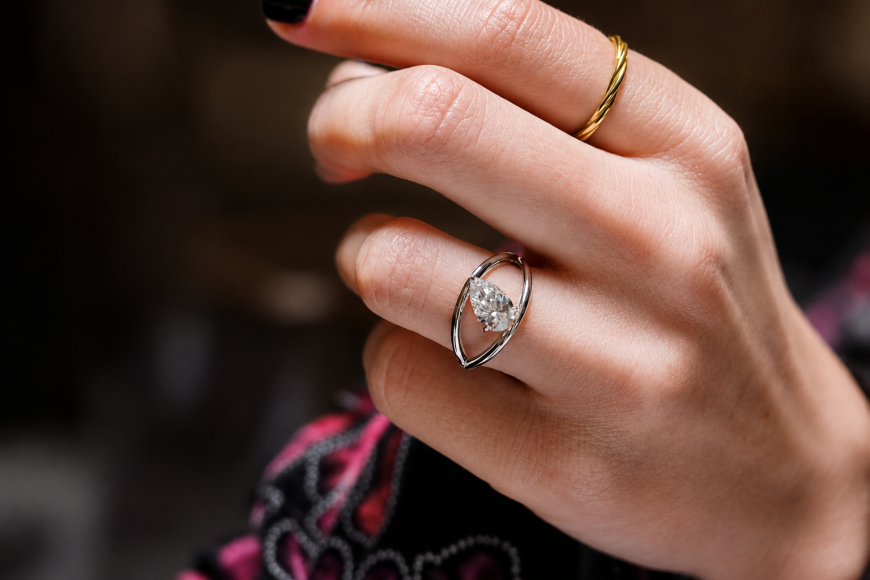
Pear diamonds combine a rounded end with a pointed tip. The point is usually worn toward the fingertip, though orientation is a personal choice.
Round Cut
Round diamonds create a balanced center point. Their symmetrical shape works with solitaire, halo, three-stone, and pavé settings.
Cushion Cut
Cushion diamonds may be square, soft square, or elongated. Their width can help create additional finger coverage.
Emerald Cut
Emerald cuts have a long rectangular outline with stepped facets. Elongated stones create vertical direction, while wider ratios can produce a stronger horizontal presence.
Radiant Cut
Radiant diamonds combine a rectangular or square outline with trimmed corners. Their varied ratios make them useful for custom proportion planning.
Choosing Band Width for Your Hand
Band width should not be treated as an afterthought.
The shank connects the entire ring design and can influence how large or small the center diamond appears.
Narrow bands often make the center stone feel visually larger. Medium-width bands may provide more balance with heavy center settings. Wide bands create greater hand coverage.
Common considerations include:
- Center stone dimensions
- Ring size
- Setting weight
- Metal choice
- Pavé diamonds
- Wedding band pairing
- Daily use
Someone choosing to build your own engagement ring lab diamond design should review the band in relation to the entire ring rather than selecting a width based only on a product photo.
Product photos are often enlarged, and small millimeter differences may look less noticeable on a screen.
Think About the Wedding Band Early
An engagement ring is often selected first, with the wedding band considered later.
For custom designs, it can be helpful to think about both rings at the same time.
A low basket or wide center setting may leave a gap between the engagement ring and wedding band. Some people like this space. Others prefer the two rings to sit closely together.
Straight wedding bands work easily with many raised settings.
Curved or contoured bands may be required when the center basket extends outward near the finger.
Matching band widths can create a coordinated appearance, while mixed widths add contrast.
Personal Taste Should Come Before Hand Shape Rules
Hand shape suggestions can be helpful, but they should never become strict rules.
A person with short fingers may love a wide Asscher cut. Someone with broad hands may prefer a tiny round solitaire. A buyer with long fingers may choose an elongated marquise because it matches their personal taste.
The ring will be worn by one person, so their preferences matter more than a general proportion formula.
Hand shape should be treated as one design factor alongside lifestyle, budget, diamond preference, metal color, and ring comfort.
The benefit of customization is the freedom to test different combinations.
Changing a diamond ratio, reducing the band width, lowering the basket, or adjusting side stone dimensions may be enough to make a ring feel much better suited to the wearer.
Final Thoughts
Choosing an engagement ring for a specific hand shape is not about finding one required diamond cut. It is about understanding how stone length, width, band thickness, setting height, and finger coverage work together.
Custom lab grown diamond rings allow these details to be planned around individual proportions rather than relying only on a standard design.
Short fingers may benefit from elongated cuts, while long fingers can carry wider bands and detailed settings. Narrow fingers may suit precise proportions, and broad hands can provide space for wider diamond arrangements. Large knuckles may require additional attention to sizing and ring balance.
The best results come from viewing the ring as o
ne complete design.
At Antiquecut, custom ring choices can begin with diamond shape and setting preference, followed by proportion changes that reflect the wearer's personal style and hand characteristics.
A well-planned ring does not need to follow every traditional rule. It only needs to feel right on the hand that will wear it.