Automotive Aftermarket Growth Forecast: Rising Demand for Replacement Parts Supports Market Expansion Through 2034
 Dhirajv
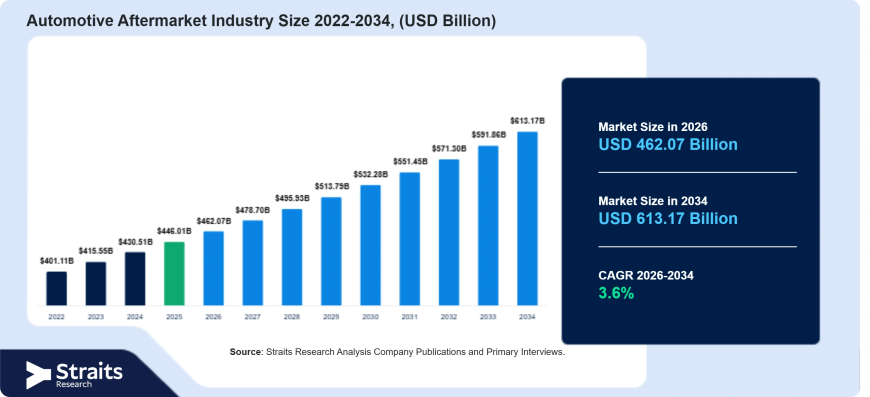
The global automotive aftermarket industry is witnessing steady growth due to the increasing average age of vehicles, rising vehicle ownership in emerging markets, growing demand for replacement parts, and the rapid digitalization of automotive parts distribution. The global automotive aftermarket industry size was valued at USD 446.01 billion in 2025 and is projected to grow from USD 462.07 billion in 2026 to USD 613.17 billion by 2034, registering a CAGR of 3.6% during the forecast period (2026–2034). Asia-Pacific dominated the automotive aftermarket industry with a 36.8% market share in 2025.
The automotive aftermarket supports vehicle maintenance, customization, repair, and replacement after the original vehicle sale. As vehicles remain in use for longer periods, demand for replacement tires, batteries, filters, brake components, lighting systems, electronic components, and other aftermarket products continues to increase. The growing adoption of electric vehicles is also creating demand for new aftermarket categories, including high-voltage batteries, inverters, electric drivetrain components, and specialized diagnostic solutions. At the same time, e-commerce and digital platforms are making automotive parts more accessible to consumers and repair businesses.
Market Drivers
One of the primary drivers of the automotive aftermarket industry is the increasing average age of vehicles. Older vehicles generally require more frequent maintenance, repairs, and replacement components. Rising new-vehicle prices and economic uncertainty are also encouraging consumers to keep their existing vehicles for longer periods. Once vehicles move beyond their original warranty periods, owners are more likely to use independent repair workshops and aftermarket components to control maintenance costs.
Another important growth driver is expanding vehicle ownership in emerging markets. Rising household incomes, urbanization, improving road infrastructure, and greater access to vehicle financing are increasing the number of passenger cars, commercial vehicles, and two-wheelers across Asia-Pacific, Latin America, Africa, and the Middle East. A larger vehicle population creates recurring demand for maintenance services and replacement parts.
The growing adoption of electric and connected vehicles is also transforming the aftermarket. Electric vehicles require specialized components and services, including battery diagnostics, battery maintenance, insulation testing, thermal-system servicing, electric motor repair, software updates, and sensor calibration. As more EVs move beyond warranty coverage, independent service providers are expected to develop specialized aftermarket capabilities.
The expansion of e-commerce is creating additional opportunities. Online platforms allow consumers and workshops to compare products, check vehicle compatibility, and purchase replacement components conveniently. VIN-based searches, automated fitment tools, and AI-supported product cataloging are improving product selection and helping reduce incorrect purchases and returns.
Market Challenges
Despite positive growth prospects, the automotive aftermarket industry faces several challenges.
One of the major restraints is the increasing complexity of modern vehicles. Advanced driver-assistance systems, connected electronics, hybrid powertrains, electric drivetrains, smart sensors, and software-controlled functions require specialized diagnostic equipment and trained technicians. Independent workshops without access to advanced tools or manufacturer-specific information may find it difficult to service newer vehicles effectively.
Another challenge is the increasing regulatory and compliance burden. Aftermarket component manufacturers must meet changing safety, emissions, cybersecurity, and environmental requirements. Products such as tires, batteries, electronic sensors, brake components, and other vehicle systems may require extensive testing and documentation before entering regulated markets. Different requirements across regions can increase certification costs and complicate international distribution.
Limited access to vehicle data and repair information is another important challenge. Independent workshops need reliable diagnostic data, repair software, calibration information, and manufacturer-specific tools to safely service connected and software-defined vehicles. Balancing repair access with vehicle cybersecurity and data protection can create additional complexity for industry participants.
Market Segmentation
By Replacement Part
- Tire
- Battery
- Brake Parts
- Filters
- Body Parts
- Lighting and Electronic Components
- Wheels
- Exhaust Components
- Turbochargers
- Others
The tire segment dominated the global automotive aftermarket with a 26.4% share in 2025, valued at USD 117.75 billion, and is projected to grow at a CAGR of 4.18% during 2026–2034. Regular tread wear, road conditions, seasonal replacement requirements, and increasing vehicle usage continue to support demand for replacement tires. The battery segment is projected to register the fastest CAGR of 5.24%, supported by battery degradation, vehicle electrification, and increasing use of auxiliary batteries.
By Vehicle Type
- Two Wheelers
- Passenger Cars
- Commercial Vehicles
The passenger cars segment dominated the market with a 58.9% share in 2025, valued at USD 262.70 billion, and is projected to grow at a CAGR of 4.08% during 2026–2034. Its leading position is supported by the large global passenger vehicle fleet, rising car ownership, longer vehicle service life, and increasing consumer spending on maintenance, personalization, infotainment, and safety upgrades. The two-wheelers segment is expected to register the fastest CAGR of 4.46%.
Regional Insights
Asia-Pacific
Asia-Pacific dominated the global automotive aftermarket industry with a 36.8% market share, reaching USD 164.13 billion in 2025. The region is projected to grow at a CAGR of 4.35% during the forecast period. Its growth is supported by a large vehicle population, rising ownership of passenger cars and two-wheelers, increasing vehicle age, and strong demand for affordable replacement parts. Expanding e-commerce channels, independent repair networks, and local component manufacturing are further supporting regional growth.
Europe
Europe accounted for 24.6% of the global automotive aftermarket industry, reaching USD 109.72 billion in 2025, and is projected to register the fastest regional CAGR of 4.86%. Growth is supported by strict vehicle inspection standards, strong demand for certified replacement parts, increasing vehicle electrification, and a large installed base of passenger and commercial vehicles. Sustainability regulations are also encouraging remanufacturing, recycling, and longer vehicle lifecycles.
North America
North America accounted for 27.4% of the global automotive aftermarket industry, reaching USD 122.21 billion in 2025, and is expected to grow at a CAGR of 3.78%. An aging vehicle fleet, high vehicle ownership, increasing repair and maintenance spending, and strong demand for premium replacement parts are supporting market growth. Independent garages, dealerships, distributors, and online retailers also contribute to the region's strong aftermarket ecosystem.
Latin America
Latin America accounted for 6.3% of the global market, reaching USD 28.10 billion in 2025, and is projected to grow at a CAGR of 4.08%. Rising vehicle ownership, extended vehicle usage, limited access to new vehicles, and strong demand for affordable replacement components are supporting regional development.
Middle East and Africa
The Middle East and Africa accounted for 4.9% of the global automotive aftermarket industry, totaling USD 21.85 billion in 2025, and are projected to grow at a CAGR of 3.95%. Increasing vehicle ownership, harsh climatic conditions, rising maintenance requirements, and expanding automotive retail and repair networks are supporting regional growth.
Key Players Analysis
The automotive aftermarket industry is moderately fragmented, with global parts manufacturers, distributors, retail chains, and service providers competing across replacement parts, maintenance services, tires, batteries, lubricants, and vehicle accessories. Companies are strengthening their product portfolios, expanding e-commerce platforms, improving digital diagnostics, and investing in electric vehicle service capabilities.
Major Companies Operating in the Market
- Continental AG
- Aisin Seiki Co. Ltd
- Robert Bosch GmbH
- 3M
- Valeo
- Denso Corporation
- Magneti Marelli S.p.A
- Cooper Tire & Rubber Company
- Sumitomo Electric Industries Ltd
- Federal-Mogul Corporation
- Aptiv PLC
- Lippert Components Inc
- MotoRad LTD
These companies are expanding their aftermarket offerings through product development, digital services, e-commerce platforms, supply chain improvements, and solutions designed for electric and connected vehicles.
For Detailed Insights, Visit:
https://straitsresearch.com/report/automotive-after-market
About Us
Straits Research is a leading market research and intelligence organization specializing in research, analytics, and advisory services. The company provides comprehensive market reports, industry insights, and strategic business intelligence across multiple industries, helping organizations identify growth opportunities and make informed business decisions.
Contact Us
Email: [email protected]
U.S.: +1 646 905 0080
U.K.: +44 203 695 0070