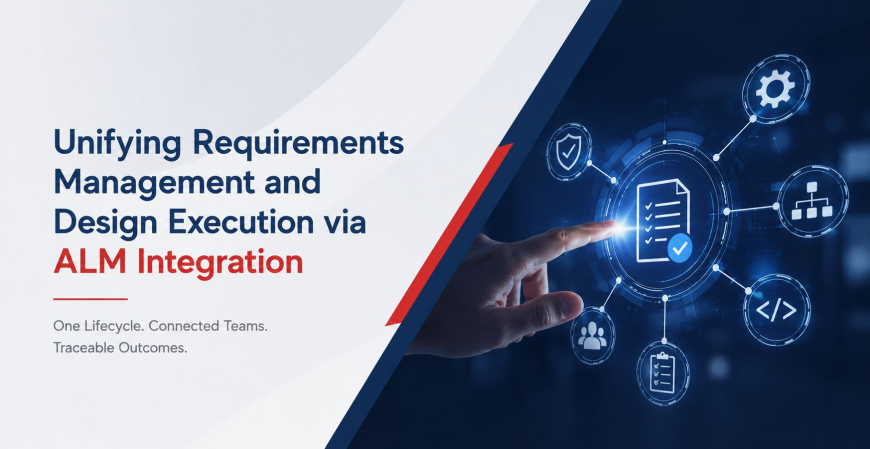
Unifying Requirements Management and Design Execution Through ALM Integration
Learn how ALM integration connects requirements, PLM, design, testing, and release workflows to improve traceability across complex engineering programs.
 3HTi
3HTi
Modern products rarely belong to a single engineering discipline. A connected vehicle, medical device, aircraft system, or industrial machine may combine mechanical components, electronics, embedded software, cloud services, and regulated processes.
The challenge is keeping these disciplines aligned as requirements change.
ALM integration connects application lifecycle management with adjacent engineering systems so requirements, design information, development work, testing, and changes remain traceable across the product lifecycle. The objective is not simply to move data between tools. It is to create controlled relationships between engineering artifacts so teams can understand what changed, why it changed, and what else may be affected.
For organizations managing complex products, this distinction is critical.

What Is ALM Integration?
-
What it is: The connection of an Application Lifecycle Management (ALM) platform with systems such as Product Lifecycle Management (PLM), systems engineering, development, testing, and DevOps tools.
-
Category: Enterprise engineering systems integration.
-
Primary purpose: Connect requirements and software lifecycle activities with broader product-development processes.
-
Why it matters: It creates traceability across otherwise disconnected engineering workflows.
-
Business value: Better change visibility, reduced manual reconciliation, stronger governance, and more predictable product development.
-
Common use cases: Hardware-software development, requirements traceability, change impact analysis, regulated product development, systems engineering, and product variant management.
Modern ALM platforms can connect requirements, risks, tests, development artifacts, and releases, while integrations with PLM systems can extend traceability into product data and engineering processes.
Why ALM Integration Matters in Engineering Organizations
The fundamental problem is lifecycle fragmentation.
Requirements may originate in one system, product structures in another, CAD models elsewhere, and software development in an ALM environment. When those systems operate independently, engineers often rely on spreadsheets, exported documents, email, or manual status checks to establish relationships.
That creates three significant risks:
-
Traceability gaps — teams cannot easily establish which requirement relates to which design, software component, test, or release.
-
Change propagation failures — a modification in one domain may not be visible to another team.
-
Configuration inconsistencies — hardware and software teams may work against different product versions or baselines.
Integration addresses these problems by maintaining relationships between artifacts rather than forcing every team to abandon its specialized tools.
How ALM Integration Connects Requirements With Design Execution
Effective integration establishes a chain of relationships:
Requirement → System Function → Architecture → Design → Implementation → Test → Release
The exact workflow varies by organization, but the principle remains consistent: each important engineering artifact should have a meaningful relationship with the artifacts that depend on it.
For example, a requirement for a vehicle's braking-control function could be connected to a system-level requirement, software requirement, implementation task, test case, test result, and relevant product configuration.
If the requirement changes, engineers can determine which downstream artifacts require review.
This is particularly valuable in regulated environments where organizations need evidence that requirements have been addressed and verified. Requirements management practices emphasize traceability from high-level objectives through detailed definition and implementation.
Codebeamer ALM and PLM Integration
Codebeamer ALM is one example of an ALM platform designed to connect requirements, risks, tests, development activities, and broader engineering processes.
Its integration capabilities include connections with PLM, modeling, source-control, testing, and CI/CD environments. PTC documents integration between Codebeamer and Windchill using OSLC, enabling links between ALM artifacts and PLM information.
The important architectural principle is that integration does not necessarily require every system to become a single repository.
Instead, specialized systems can retain ownership of their data while relationships between systems provide cross-domain visibility.
That approach is often more practical for established enterprises with years of legacy data, validated processes, and specialized engineering applications.
A Practical ALM Integration Workflow
A disciplined implementation typically follows five stages.
1. Map the Current Engineering Process
Document how requirements, design changes, software, tests, approvals, and releases currently move through the organization.
Do not begin with tool configuration. Begin with process discovery.
2. Define System Ownership
Establish which platform owns each artifact.
For example:
-
ALM: requirements, risks, software work items, tests
-
PLM: parts, product structures, configurations, engineering changes
-
CAD: detailed design models
-
Source control: code and repository history
-
Testing platforms: execution evidence and results
Clear ownership prevents duplicate records and conflicting versions.
3. Define Traceability Relationships
Determine which relationships actually provide business value.
Not every field needs synchronization. In many implementations, synchronizing too much data creates complexity without improving decision-making.
4. Select the Integration Architecture
Organizations may use:
-
Standard connectors
-
OSLC-based integrations
-
APIs
-
Middleware or integration hubs
-
Custom event-driven integrations
Codebeamer supports standards-based and custom integration approaches, including OSLC and REST/Swagger APIs.
5. Validate With a Representative Product
Start with a realistic product or subsystem rather than attempting an enterprise-wide rollout immediately.
A useful pilot should contain meaningful requirements, engineering changes, software, testing, and configuration relationships.
Common Implementation Mistakes
The most expensive ALM integration mistakes are usually architectural rather than technical.
Common failures include:
-
Integrating tools before defining process ownership
-
Synchronizing unnecessary data
-
Ignoring configuration management
-
Treating integration as a one-time IT project
-
Failing to involve engineering and quality teams
-
Creating duplicate master records
-
Underestimating legacy-data complexity
-
Measuring technical connectivity instead of business outcomes
One particularly common misconception is that an integration is successful once two systems can exchange data.
That is only the beginning.
A successful integration allows engineers to answer operational questions such as “What changed?”, “What does this requirement affect?”, “Which tests validate it?”, and “Which product configurations contain it?”
When Should Organizations Consider ALM Integration?
ALM integration becomes especially valuable when:
-
Products combine hardware and software.
-
Engineering teams use separate lifecycle platforms.
-
Requirements change frequently.
-
Regulatory traceability is important.
-
Product variants create configuration complexity.
-
Software releases must remain aligned with physical products.
-
Manual reconciliation consumes significant engineering time.
For organizations planning or modernizing ALM environments, specialized ALM services can help assess existing workflows, define integration architecture, configure lifecycle processes, and establish governance before deployment. A structured ALM services approach can be particularly useful when integration must fit an established PLM and engineering environment.
The Strategic Role of ALM Integration
The strongest ALM integration programs are not primarily about connecting software platforms. They are about connecting engineering decisions.
When requirements, product structures, designs, software, tests, and changes remain linked, engineering leaders gain a clearer view of product dependencies. Teams can investigate change impact earlier, quality organizations can follow evidence through the lifecycle, and program leaders can make decisions using relationships rather than disconnected status reports.
That is why ALM integration should be treated as part of a broader engineering transformation strategy not simply as middleware between applications.
For enterprises already pursuing digital transformation consulting services or PLM implementation services, integrating ALM into the wider engineering digital thread can provide a practical path toward unified product development without forcing every discipline onto the same tool.
Conclusion
ALM integration is most valuable when it creates meaningful traceability between requirements and the engineering work required to fulfill them.
The strongest implementations establish clear data ownership, purposeful artifact relationships, controlled synchronization, configuration management, and measurable operational outcomes.
For engineering-driven organizations, the objective should not be a single giant system. The objective should be a connected lifecycle in which teams can confidently trace requirements to design, design to implementation, implementation to verification, and verification to release.
That is the foundation for more controlled product development as hardware and software become increasingly interdependent.
FAQ
What is ALM integration?
ALM integration connects an Application Lifecycle Management platform with other engineering and development systems, such as PLM, CAD, testing, source control, and systems engineering tools. Its primary purpose is to establish traceability between lifecycle artifacts while allowing specialized systems to retain responsibility for their own data and processes.
How does ALM integration improve requirements traceability?
ALM integration connects requirements with related engineering artifacts such as architecture elements, development work, tests, defects, and releases. When relationships are maintained across systems, teams can determine which downstream artifacts are affected by a requirement change and identify whether the modified requirement has been implemented and verified.
What is the difference between ALM and PLM integration?
ALM generally manages software and application lifecycle activities, including requirements, development, testing, and releases. PLM manages product information, configurations, parts, documents, and engineering processes. Integration connects these domains so software development can remain aligned with physical product structures and engineering changes.
Is Codebeamer suitable for ALM-PLM integration?
Codebeamer is designed for complex product and software development and supports integration with PLM and other engineering systems. Its documented integration capabilities include OSLC connections with Windchill, allowing relationships between ALM artifacts and PLM information. The appropriate architecture still depends on organizational processes, data ownership, and integration requirements.
Should an organization synchronize all data between ALM and PLM?
No. Synchronizing every field or artifact can increase complexity, maintenance requirements, and the risk of conflicting information. Organizations should first establish which system owns each data type and synchronize only information that supports meaningful workflows, traceability, change management, or compliance objectives.
What are the biggest risks in an ALM integration project?
The primary risks include unclear data ownership, poor process definition, excessive synchronization, legacy-data complexity, weak configuration management, and insufficient stakeholder involvement. Technical connectivity alone does not guarantee success. Integration should be validated against real engineering workflows and measurable operational requirements.
Can ALM integration support regulated industries?
Yes. ALM integration can support regulated product development by connecting requirements, verification activities, changes, configurations, and related evidence. However, integration itself does not guarantee regulatory compliance. Organizations must configure appropriate processes, controls, documentation, validation, access management, and evidence practices for the applicable regulatory environment.