Advanced Micellar Technology Solving the Solubilization Problem for Fat-Soluble Actives
Understand how advanced micellar technology solubilizes fat-soluble nutrients in water-based formulas — covering nano-micelle assembly, stability metrics, and when to choose micelles over liposomes.
 mananiyerr
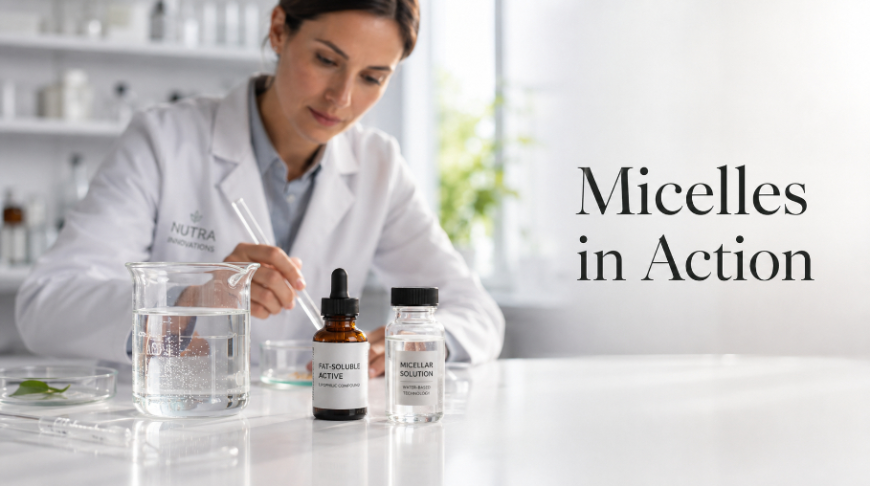
The solubilization problem in oral supplement delivery is deceptively simple to state: fat-soluble nutrients do not dissolve in water, and the human gut is an aqueous environment. Vitamin D3, vitamin K2, CoQ10, curcumin, astaxanthin — the list of high-value, poorly water-soluble actives that this constraint affects includes most of the premium supplement category's most compelling ingredients. The body has its own partial solution, using bile salts to form mixed micelles in the small intestine that carry hydrophobic molecules across the unstirred water layer to the mucosal surface. Advanced micellar technology builds on that physiological mechanism and executes it before the supplement even reaches the gut.
Understanding how this works at the physical chemistry level — and where the technology genuinely performs versus where its claims outrun its evidence — is essential for any formulator developing a product whose efficacy premise depends on fat-soluble bioavailability.
How amphiphilic assembly creates a solubilization vehicle
A micelle forms when amphiphilic molecules — surfactants or specific phospholipids with both water-attracting and water-repelling regions — reach a concentration above the critical micelle concentration (CMC) in an aqueous medium. Above the CMC, the molecules spontaneously orient themselves into spherical structures: hydrophobic tails pointing inward, hydrophilic heads pointing outward into the water. This creates a nonpolar interior cavity that can accommodate hydrophobic molecules like vitamin D3 or curcumin.
The geometry is important. A well-formed nano-micelle in the 10 to 50 nanometer size range presents a hydrophilic exterior that is fully miscible with water — which is why a micellar vitamin D3 ingredient can be dispersed in a water-based liquid without oil separation or turbidity. The interior is a microenvironment of controlled nonpolarity, and the size of that interior, and therefore the loading capacity for hydrophobic actives, is a function of the surfactant molecular architecture and the assembly conditions.
The distinction between advanced nano-micelles and a conventional oil-in-water emulsion is structural, not cosmetic. An emulsion disperses oil droplets in water with a surfactant stabilizer; the droplets are typically hundreds of nanometers to micrometers in size, thermodynamically unstable, and prone to coalescence over time. A true micellar system forms spontaneously at the molecular level and is thermodynamically more stable. The practical consequence is that a micellar vitamin D3 liquid does not separate on the shelf the way an improperly formulated oil-in-water suspension does — and the particle size in the nano range is consistent with the size scale at which intestinal absorption mechanisms operate.
The absorption pathway that makes micellar delivery mechanistically distinct
The physiological basis for expecting enhanced bioavailability from micellar delivery is the unstirred water layer (UWL) adjacent to the intestinal epithelium. Lipophilic molecules absorbed through standard emulsion delivery need to traverse this aqueous layer by diffusion — a process that is slow for large oil droplets and rate-limiting for many fat-soluble nutrients. Nano-sized micellar particles navigate this layer more efficiently by virtue of their size, and their hydrophilic surface allows them to remain in the aqueous phase rather than being retained at the oil-water interface.
Curcumin is the most-studied example of this phenomenon in the nutraceutical space. Standard curcumin extract has been documented in multiple pharmacokinetic studies to have extremely low oral bioavailability — primarily because of poor aqueous solubility and rapid metabolic conjugation in the intestinal mucosa. Micellar curcumin formulations, including commercially available products like MicelVita (produced by Aquanova AG), have shown meaningfully higher plasma curcumin concentrations in human crossover studies compared to standard extracts. The mechanism is exactly the solubilization effect described above: getting curcumin into solution at the mucosal surface changes its absorption profile.
We should be careful here about overgeneralizing. The clinical evidence for micellar enhancement is strongest for Micellar Curcumin and vitamin D. For some other fat-soluble actives, the absorption-limiting step may not be solubilization — it may be transporter saturation, metabolic conjugation, or efflux pump activity — in which case micellar delivery addresses the wrong bottleneck. The answer varies by active, and a technically honest supplier will acknowledge this rather than positioning micellar technology as a universal solution to fat-soluble bioavailability.
Clean liquid drop applications: where the format and the technology intersect
One of the most commercially appealing applications for advanced micellar technology is the clean, water-clear or lightly translucent liquid drop format. A micellar vitamin D3 at 400 IU per drop can be formulated in a water base with no oil separation, no visible turbidity, and no fatty mouthfeel — properties that are genuinely difficult to achieve with conventional lipid-based delivery approaches. For pediatric nutrition products, for sublingual delivery formats, and for functional beverages where aesthetic clarity matters, this is a real technical advantage, not just a marketing angle.
The stability of these clear liquid formats is where the technical depth of the supplier shows. A micellar system that remains clear at room temperature for 24 months is a different engineering achievement from one that was clear at manufacture and shows turbidity at the six-month stability check. Turbidity in a previously clear micellar liquid indicates particle growth — micelles aggregating into larger structures, which reverses the solubilization advantage and may indicate surfactant degradation or pH drift in the formula.
Stability metrics for micellar nutrient delivery should include particle size by dynamic light scattering at the intended storage condition (not just at 25°C, but at the maximum label storage temperature), zeta potential to monitor colloidal stability, and active ingredient assay to confirm no chemical degradation. A supplier offering micellar liquid ingredient concentrates for B2B applications should provide all three data points across at least 12 months of real-time data, not just an accelerated stability projection.
The CMC question that B2B buyers rarely ask
The critical micelle concentration is the minimum surfactant concentration required to maintain the micellar structure. Below the CMC, micelles dissociate into individual amphiphilic molecules and the solubilization function is lost. This becomes a practical issue in formulation when a micellar ingredient concentrate is diluted significantly during finished product manufacturing — either to hit a specific active dose per serving or to achieve the desired sensory profile in a beverage.
In our experience advising product development teams, the CMC question surfaces most acutely during the transition from a bench formulation to a production batch. A 5% micellar concentrate that maintains structural integrity in the bulk ingredient may fall below the effective CMC when diluted to 0.5% in a 500ml beverage format. The active is still present. The micellar structure that justifies the bioavailability claim is not. This is a formulation variable that the ingredient supplier should model for you at your intended use concentration — and if they cannot, that is a process knowledge gap worth noting.
Samarth Biorigins, whose lipid delivery platform spans both liposomal and micellar systems, approaches formulation design from the perspective of the finished product environment, not just the bulk concentrate. That orientation — asking what happens to the structure at your use concentration, in your matrix, at your storage condition — is what distinguishes a formulation partner from a bulk ingredient vendor. The distinction matters more as the technical claims around the product become more specific.
Comparing micellar and liposomal delivery: when one is the better engineering choice
The question we get most often from brand teams building a fat-soluble supplement line is whether to use micellar or liposomal delivery. The honest answer is that for most fat-soluble actives — vitamin D3, vitamin K2-MK7, CoQ10 — micellar delivery is the simpler, more cost-effective, and well-validated approach. The manufacturing process for micellar concentrates is less complex than liposomal production: no high-pressure homogenizer, no bilayer formation validation, lower phospholipid cost per unit dose.
Liposomal delivery earns its additional complexity and cost when the active is: hydrophilic (water-soluble) rather than lipophilic; sensitive to enzymatic degradation in the GI tract (lactoferrin, certain peptides); or when the target delivery site requires a structure capable of membrane fusion with cells rather than simple surface absorption. For liposomal vitamin C, the water-soluble ascorbic acid is encapsulated in the aqueous core of the vesicle — a different structural mechanism from the hydrophobic interior of a micelle.
Choosing micellar technology for a water-soluble active is an engineering error. Choosing liposomal technology for a fat-soluble active when micellar delivery would achieve equivalent bioavailability at lower cost is an economic error. The water-soluble oil formulations offered by advanced nano-micelles B2B suppliers are the right tool for a specific job. Knowing that job's boundaries is what separates a technically confident product innovation decision from one that is driven by whichever supplier makes the better pitch.