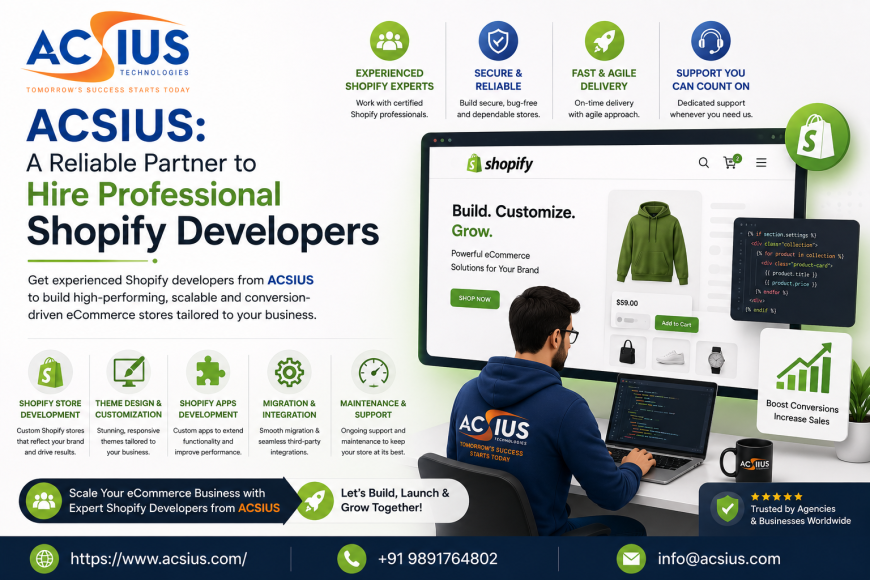
ACSIUS: A Reliable Partner to Hire Professional Shopify Developers
ACSIUS works with businesses at exactly this stage — helping them move from a generic storefront to a fully customized, well-optimized e-commerce experience.
 acsius
An online store's success rarely comes down to the platform alone — it comes down to how well that platform is built, customized, and maintained. Shopify gives businesses a solid foundation, but out-of-the-box themes and default configurations rarely deliver the performance, customization, or conversion optimization that a growing e-commerce brand actually needs. This is why so many businesses eventually search to hire professional Shopify developers, rather than relying solely on drag-and-drop tools or template themes.
ACSIUS works with businesses at exactly this stage — helping them move from a generic storefront to a fully customized, well-optimized e-commerce experience. Alongside Shopify development, the team also supports WordPress and WooCommerce projects, giving businesses flexibility depending on which platform genuinely fits their needs. This article breaks down what to look for when hiring Shopify talent, where custom development actually adds value, and how ACSIUS approaches these engagements.
Why Shopify Still Requires Real Development Expertise
Shopify is often marketed as a platform anyone can use without technical knowledge, and for basic stores, that's largely true. But the moment a business needs custom functionality, unique design elements, third-party integrations, or performance optimization at scale, the platform's limitations become clear without skilled development support.
Common reasons businesses need professional Shopify development include:
- Custom theme development that goes beyond template constraints
- App integrations that don't work smoothly out of the box
- Site speed optimization, since slow-loading stores directly hurt conversions
- Complex product configurations, subscriptions, or multi-currency setups
- Migration from another platform without losing SEO value or data integrity
A developer who understands Shopify's Liquid templating language, API structure, and theme architecture can solve these problems in ways that generic customization simply can't.
What "Professional" Actually Means in Shopify Development
The word gets used generously across freelance platforms and agencies alike, so it's worth being specific about what genuine professionalism looks like in this context.
1. Deep Familiarity With Liquid and Shopify's Architecture
Shopify's theming language, Liquid, has its own quirks and limitations. A professional developer knows how to work within these constraints efficiently, rather than forcing workarounds that create technical debt or slow page performance.
2. E-Commerce-Specific Problem Solving
Building a Shopify store isn't just about writing code — it's about understanding how design and functionality decisions affect conversion rates, cart abandonment, and customer trust. ACSIUS approaches Shopify projects with this commercial context in mind, not just as a technical build.
3. App Ecosystem Knowledge
Shopify's app marketplace is vast, and choosing the right combination of apps — without bloating the store or creating conflicts — requires experience. A skilled developer knows which apps are reliable, which create performance drag, and when custom development is a better solution than another third-party plugin.
4. Post-Launch Reliability
A store isn't finished at launch. Ongoing updates, bug fixes, and seasonal adjustments (like holiday sales configurations) require a developer who remains available and responsive after the initial build, not one who disappears once payment is received.
Hire Professional WordPress Developers: A Different Platform, Similar Standards
Not every business belongs on Shopify. Companies that need extensive content management, blogging capability, or a hybrid site combining e-commerce with informational content often find WordPress a better fit. This is why businesses frequently search to hire professional WordPress developers alongside, or instead of, Shopify talent.
WordPress offers unmatched flexibility through its plugin ecosystem and open-source architecture, but that flexibility comes with its own risks — poorly coded plugins, security vulnerabilities, and performance issues from bloated builds are common when the platform isn't handled by experienced developers.
ACSIUS applies the same standards to WordPress projects as it does to Shopify work:
- Clean, maintainable custom theme and plugin development
- Security-conscious builds that minimize vulnerability exposure
- Performance optimization, since WordPress sites are particularly prone to slowdowns from excessive plugins
- Ongoing maintenance support rather than one-time delivery
Hire WooCommerce Developers: When E-Commerce Meets WordPress
For businesses that want WordPress's content flexibility combined with full e-commerce functionality, WooCommerce is often the answer. But WooCommerce stores require a different skill set than a standard WordPress build, which is why businesses specifically look to hire WooCommerce developers rather than assuming any WordPress developer can handle the job equally well.
WooCommerce development typically involves:
- Custom product configurations and variable pricing structures
- Payment gateway integrations tailored to specific markets
- Inventory and order management customization
- Performance tuning, since WooCommerce stores can slow down significantly as product catalogs grow
ACSIUS's WooCommerce work focuses on building stores that remain fast and stable even as inventory and traffic scale up — a common failure point for stores built without this consideration from the start.
Shopify vs. WordPress/WooCommerce: Helping Businesses Choose Correctly
One of the most valuable things a development partner can do isn't building — it's helping a business choose the right platform before development even begins. ACSIUS approaches new e-commerce projects by evaluating factors like:
- Catalog complexity — large, frequently changing catalogs often favor Shopify's streamlined backend
- Content needs — businesses relying heavily on blogging or content marketing often benefit from WordPress/WooCommerce's flexibility
- Budget and scaling plans — Shopify's subscription model versus WordPress's more variable hosting and maintenance costs
- Customization depth required — highly specific functionality sometimes favors WordPress's open-source flexibility
This consultative approach matters because the wrong platform choice early on often leads to costly migrations later.
What to Evaluate Before Hiring a Developer or Agency
Whether the need is Shopify, WordPress, or WooCommerce development, a few evaluation criteria remain consistent.
Portfolio Relevance
Generic portfolios don't tell the full story. It's worth asking for examples specifically relevant to your industry or store complexity — a developer experienced with simple catalog stores may not be the right fit for a subscription-based or high-SKU business.
Communication and Process Transparency
A reliable developer or agency explains their process clearly — timelines, testing procedures, and how revisions are handled — rather than leaving clients guessing about progress.
Security and Performance Awareness
Especially for e-commerce, security lapses and slow load times translate directly into lost revenue. Ask specifically how a developer approaches these areas rather than assuming they're handled by default.
Support After Launch
Development doesn't end at go-live. Ongoing support for bug fixes, plugin or app updates, and seasonal adjustments should be part of the conversation from the outset, not an afterthought negotiated later.
E-E-A-T and E-Commerce Development: Why Trust Matters Here Too
Search engines evaluate content credibility through Experience, Expertise, Authoritativeness, and Trustworthiness — but the same framework is a useful lens for evaluating a development partner. Businesses are trusting a developer with their revenue-generating storefront, which makes genuine expertise and reliability non-negotiable.
ACSIUS reflects these principles in its development engagements by:
- Assigning developers with verifiable, platform-specific experience
- Maintaining clear documentation and honest timelines
- Prioritizing security and performance as core deliverables, not optional add-ons
- Offering continued support rather than one-time, disconnected project delivery
Final Thoughts
Whether a business needs to hire professional Shopify developers, WordPress specialists, or WooCommerce experts, the underlying decision is the same: finding a partner capable of building something that performs well, scales safely, and doesn't require a costly rebuild within a year of launch.
ACSIUS approaches each of these platforms with the same foundation of technical rigor and transparent communication, helping businesses choose the right platform and then build it properly. For companies evaluating where to hire their next e-commerce or web development partner, the most important question isn't which platform sounds trendiest — it's which partner can be trusted to build something that lasts.